
Gasoline Just Lost the Majority. The Repair Shop Already Knew.
Pure gasoline cars fell below half of global sales for the first time. The shift shows up in layoffs, lost orders, and a battery pack on the lift.
In the first half of 2026, for every 100 new cars sold worldwide, 49 were pure gasoline vehicles. In 2021, that number was 73. Mobility Global reports that pure gasoline vehicle sales fell 10% year-on-year to 20.25 million units. The overall auto market contracted by about 5%. Gasoline cars declined at twice the rate of the broader market.
On the shop floor, the numbers look different. Bosch workers receive layoff notices. ZF’s balance sheet shows more than €15 billion in debt. Continental’s board approves a plan to cut 10,000 jobs. A survey by the European Association of Automotive Suppliers sits on the table. About 24% of suppliers expect to lose money in 2026, up from 15% in the previous survey.
An engine doesn’t need that many parts
A traditional gasoline car has about 30,000 parts. A pure electric car has about 20,000. The engine, transmission, drivetrain, and exhaust system are replaced by the battery pack, motor, and electronic controls. Precision machining capability is replaced by a single-speed reducer and fixed gear ratio that cost a few hundred yuan.
European Association of Automotive Suppliers data: from 2024 to 2025, the European components industry cut a cumulative 104,000 jobs. During the worst two years of the pandemic, that figure was 53,700. Bosch’s total layoffs in Germany reached 22,000, with an annual cost gap of €2.5 billion. ZF has total debt of more than €15 billion and plans to cut 11,000 to 14,000 jobs in Germany by 2028, equivalent to a quarter of its German workforce. Continental plans to cut about 10,000 jobs globally by the end of 2026.
The association’s survey shows that 76% of companies expect profit margins below 5%. Five percent is widely regarded as the survival line for sustaining R&D and capacity investment. Toyota’s then-president Koji Sato issued a survival warning to 484 core suppliers. Hybrids provide a buffer. Toyota plans to raise annual output of hybrids and plug-in hybrids to about 6.7 million units by 2028, 30% higher than its estimated 2026 output and nearly 60% of total planned production. Demand for internal combustion engines will not go to zero, but it will fall from mainstream power to auxiliary power. The bargaining power and profit margins of related suppliers will be squeezed.
The new barriers are on another production line: power electronics, semiconductors, battery materials. Silicon carbide power devices replace traditional IGBTs, and 800V high-voltage platforms accelerate adoption. Demand rises for batteries, motors, electronic controls, high-voltage wiring harnesses, thermal management, silicon carbide power devices, on-board power supplies, and integrated chassis components. Whoever masters these gets a ticket to the next round of the supply chain.
Europe cuts off an arm, Japan loses orders, China goes abroad
European component companies are under pressure on two fronts. New-energy-related capital expenditure accounts for nearly 40%, while corresponding revenue remains low. Energy and labor costs are high, and automakers are moving investment to lower-cost regions. CLEPA warns that if industrial policy and the market environment do not improve markedly, 350,000 jobs in the EU auto supply chain could be at risk by 2030.
Japan’s supply chain is hollowing out. Suzuki has decided to expand its use of Chinese-made components in EV batteries and next-generation ADAS chips, including BYD’s lithium iron phosphate batteries and Horizon Robotics’ AI semiconductors. Nikkei reports that Toyota is expected to start production of the new-generation Lexus multi-purpose electric SUV in China as early as autumn 2027. Major component orders for the body, battery, and other parts mostly go to Chinese suppliers. Japanese parts makers are losing orders one after another, even losing bids. EVs have 30% to 40% fewer parts than engine cars, and automakers screen suppliers more strictly. Japan’s auto industry is linked to 5.5 million jobs. If the component supply chain continues to shrink, the impact will go beyond the auto industry itself.
China’s new energy vehicle industry is moving beyond scale. It is building factories, supply networks, and research centers in the markets it sells to. In the first quarter of 2026, China’s new energy passenger vehicle global share was 61%. Vehicle exports reached 2.312 million units, up 40.9% year-on-year, including 954,000 new energy vehicles, up 116.3%. BYD has put factories into production in Thailand, Uzbekistan, and Brazil, with combined annual capacity of more than 300,000 units. It is advancing capacity in Hungary, Malaysia, and elsewhere. Chery has built factories in Brazil and Indonesia and plans to land its first European production base in Spain. Geely has five global engineering R&D centers in Frankfurt, Germany; Gothenburg, Sweden; and Coventry, UK. Xiaomi Auto, XPeng, and Leapmotor have set up European R&D centers in Munich.
Gao Chengfei, deputy director of the Brand and IP Committee at the Influence Research Institute, points out that taking the entire industrial chain overseas bypasses trade barriers, locks in long-term profits, and embeds the company in the local economy. Building factories overseas avoids tariff costs of more than 25%, and localized production enjoys the benefits of regional trade agreements. R&D close to the market shortens product iteration cycles. The problems are specific: compliance costs, geopolitical risk, and the daily work of managing a factory in a different labor culture. The fast-paced decision-making and vertical integration model that Chinese automakers are good at may not travel well in Europe or Latin America.
Fewer oil cans in the repair shop
In the first quarter of 2026, gasoline vehicle service visits fell 5% year-on-year. Demand for traditional maintenance categories such as engine oil and oil filters shrank. New energy vehicle service visits rose 20% year-on-year. In the second quarter, new energy vehicles accounted for 13.3% of service visits. The core aftermarket categories are shifting from engine oil, spark plugs, and timing belts to tires, power batteries, and electronic control systems. New energy vehicles require less frequent maintenance. The technical threshold is shifting from mechanical repair to electronic and software diagnostics.
Nationwide, there are about 400,000 gasoline vehicle maintenance companies. There are only 20,000 to 30,000 new energy repair companies. Stores with the capability to repair the three electric systems, battery, motor, and electronic control, account for 2% to 3%. In June 2026, the Ministry of Commerce and eight other departments jointly issued a notice. It encourages new energy vehicle and battery companies to open maintenance technology authorizations, encourages repair instead of replacement, and improves socialized maintenance service capacity for new energy vehicles. The notice makes clear that automakers may not restrict consumers from independently choosing maintenance companies. They also may not use that choice as a reason to refuse their statutory three guarantees responsibilities.
The aftermarket numbers show the shift. New energy vehicle maintenance output value rose from 9.1 billion yuan in 2020 to 90.4 billion yuan in 2025, nearly a ninefold increase in six years. Its share of the overall aftermarket rose from 1% to 8%. Tuhu Car Care has served more than 4 million new energy users. It has obtained official authorization from more than 10 power battery companies. Its number of new energy vehicle users grew 80% year-on-year. CATL’s Ningjia Service raised its repairable model coverage to 76.8%. It relies on the R1 to R4 tiered technology authorization system and CTP deep repair technology to promote repair instead of replacement. The power battery aftermarket is moving from replacement service to precision repair.
Chen Shihua, deputy secretary-general of the China Association of Automobile Manufacturers, said the auto aftermarket has moved from rapid expansion into steady growth. The focus of competition is shifting from total growth to structural adaptation. Companies need to plan ahead around new energy three electric systems, intelligent diagnostics, professional equipment, and technician capability building.
Full life cycle and charging piles
Cao Xianghong, an academician of the Chinese Academy of Engineering, proposed at the 2026 World Lubrication Technology Conference that the carbon reduction effects of different pathways must be viewed across the full life cycle: energy production, material extraction, equipment manufacturing, vehicle use, and recycling. As the number of electric vehicles expands, charging facilities, grid carrying capacity, key mineral supply, power battery recycling, and energy conditions in different regions place different limits on how fast each region can switch. Densely populated urban areas face coordination issues between parking spaces and charging facilities. High-frequency fast charging places demands on distribution networks and battery life. Power batteries retired en masse require recycling channels and environmental governance.
As of the first quarter of 2026, the EU had 1.1 million charging piles in total. It faces a gap of about 800,000 against its 2030 target of 3.5 million. Ultra-fast chargers account for 16%. Globally, more than $635 billion will need to be invested between 2025 and 2040 to build the electric vehicle charging network. More than half of the funds will go to commercial fleet sites and public fast-charging stations.
Cao Xianghong suggested building a power landscape in which pure electric, hybrid, efficient internal combustion engines, hydrogen fuel cells, hydrogen internal combustion engines, and diverse low-carbon fuels develop together. He also suggested implementing equal rights for oil and electricity. Equal rights for oil and electricity does not mean canceling support for new energy vehicles. It does not mean relaxing fuel consumption, emissions, and carbon constraints on gasoline vehicles. Policy evaluation should shift from power form to actual energy consumption, full life-cycle carbon emissions, and resource and environmental impact. Gasoline and diesel demand will decline. The huge stock of gasoline and hybrid vehicles means they will not exit in the short term. Refiners must improve gasoline and diesel quality to meet the requirements of high-compression-ratio, high-efficiency, and low-particulate-emission engines.
The workshop after the tide goes out
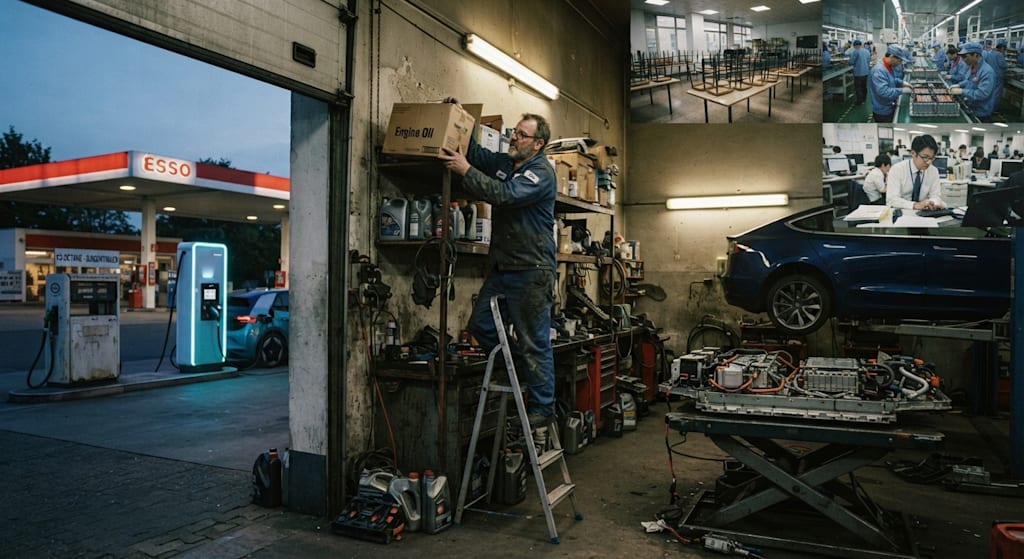
A canteen at a German component factory closed in 2025. A night-shift production schedule at a Chinese battery factory runs into 2027. At a European gas station, the 92-octane pump has a discontinued tag. The newly installed charging pile next to it has a screen glowing with "Please scan the code." A salesperson at a Japanese parts factory forwards a bid-loss email to the department head. There is no exclamation mark in the email.
A repair technician lifts the last case of engine oil onto the top shelf, then turns to remove a battery pack. He does not say the times have changed. He just plugs in the diagnostic tool, and a line of fault codes jumps onto the screen. He photographs the fault codes, sends them to the battery maker’s technical authorization group, and waits for a reply.
About the Creator
Jin
Writer of reamstories
https://reamstories.com/jin
Enjoyed the story? Support the Creator.
Subscribe for free to receive all their stories in your feed. You could also become a paid subscriber, letting them know you appreciate their work.
Comments
There are no comments for this story
Be the first to respond and start the conversation.