
GAC Just Traded Shares for Half of FAW Toyota. Here’s What Changes.
A 6.5 billion yuan limit-up, two Toyota joint ventures, and a restructuring plan that could reshape how the company runs in China.
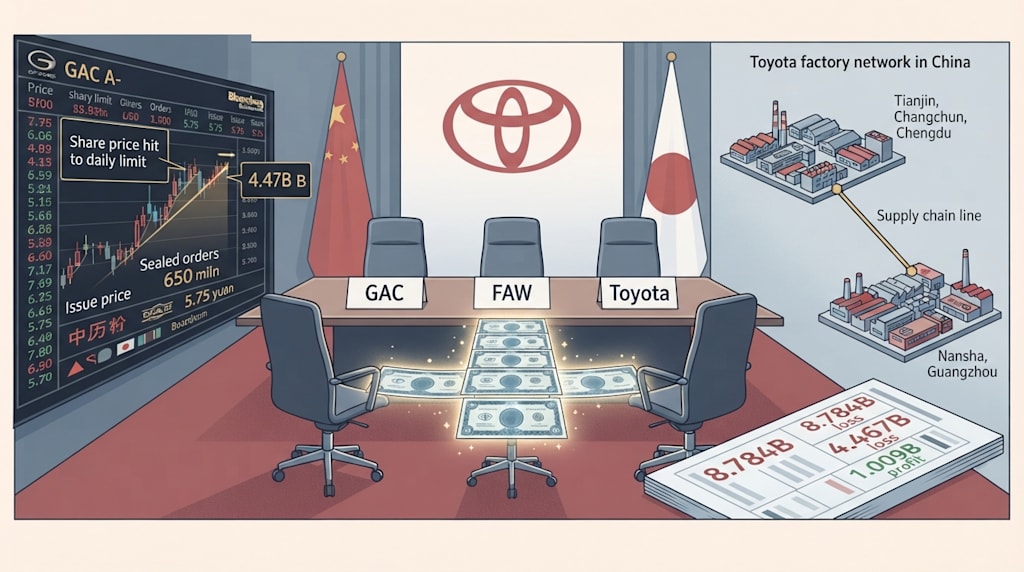
On September 29, GAC Group’s A-shares resumed trading. The stock hit the daily limit at the open. Sealed orders reached 650 million yuan. The night before, GAC released 16 announcements. The company plans to issue shares to buy the 50% stake in FAW Toyota held by FAW. It also plans to raise matching funds. The pre-suspension closing price was 5.08 yuan. The issue price is 5.75 yuan, a premium of about 13%.
The structure: shares for shares
FAW Toyota used to be a 50-50 joint venture between FAW and Toyota Motor. After the deal, GAC Group will hold 50%. Toyota Motor keeps 50%. FAW will no longer directly hold FAW Toyota equity. FAW will receive newly issued GAC A-shares. It becomes GAC’s second-largest shareholder. GAC’s actual controller remains the Guangzhou SASAC. FAW is a strategic shareholder. It does not control GAC’s personnel appointments, removals, assessments, or incentives. FAW Toyota’s legal entity stays. Its plants stay. Labor relations do not transfer with the equity.
The number of shares to be issued is not set. The target’s valuation is not set. The final price depends on audit, appraisal, and state-owned asset approval. GAC can issue up to 30% of its pre-issuance share capital. That creates dilution risk. UBS said the acquisition is unlikely to reverse GAC’s losses. The bank also said the asset base could be diluted by up to about 30%.
GAC’s numbers
GAC lost 8.784 billion yuan in 2025. It lost another 4.467 billion yuan in the first half of 2026. FAW Toyota made 4.717 billion yuan in 2024, 4.234 billion yuan in 2025, and 1.009 billion yuan in the first half of 2026. A 50% stake sends half of that profit to GAC’s income statement.
FAW Toyota’s sales are falling. In the first half of 2026, domestic sales dropped 27.4% from a year earlier. In the first eight months, FAW Toyota sold 379,000 vehicles. GAC Toyota sold 447,000. In full-year 2025, FAW Toyota sold 806,000 and GAC Toyota sold 773,000. FAW Toyota has fallen behind GAC Toyota.
Two joint ventures, one brand
Toyota runs a one-brand, two-joint-venture system in China. FAW Toyota started in 2003. GAC Toyota started in 2004. Each has its own purchasing, R&D, and sales operation. Their sister models overlap. Corolla faces Levin. Avalon faces Camry. RAV4 faces Wildlander. Granvia faces Sienna. The new energy lineup differs. GAC Toyota has the Bozhi 3X and Bozhi 7. FAW Toyota has the bZ3 and bZ5. The Bozhi 3X launched in March last year. It reached 100,000 sales in 14 months, the fastest for a joint-venture new energy model. From January to August this year, the Bozhi 3X and Bozhi 7 sold more than 70,000 combined. FAW Toyota’s bZ5 sold fewer than 10,000.
Capacity is another issue. FAW Toyota has four vehicle plants and two engine plants in Tianjin, Changchun, and Chengdu. Annual capacity is above one million units. GAC Toyota’s production sits in Nansha, Guangzhou. It has five lines and annual capacity around one million units. Industry capacity utilization is about 70.6%. Traditional joint-venture automakers run at 40% to 60%. The duplicate investment is easy to see.
What coordination could save
Citi estimates that a combined North and South Toyota could form a unified Toyota China platform with annual output of 1.2 million to 1.3 million vehicles. Joint procurement could cut costs by 2 to 3 percentage points. Sales and administrative expenses could fall by 1 to 2 percentage points.
R&D has already moved. At the 2025 Shanghai Auto Show, Toyota China introduced the ONE R&D system. It combines R&D staff from FAW Toyota, GAC Toyota, and BYD Toyota. The number of Chinese chief engineers went from four to seven. Model development decisions for China moved from Toyota’s Japan headquarters to the local team.
Sales is still under negotiation. Several sources say a unified Toyota China sales company may be created. The proposed split is Toyota 50%, FAW 25%, and GAC 25%. Production and sales would separate. GAC would coordinate production. Toyota would lead sales through a three-party structure. The hard parts are dealer network interests, brand authorization changes, local tax sharing, and long approval chains. Yicai reported that the three parties are still discussing who leads sales and how to split the work.
A lighter kind of merger
In 2025, Dongfeng and Changan announced a restructuring. It was suspended after 100 days. The reasons included unequal administrative levels, competition over the headquarters location, and job placement. GAC and FAW chose not to merge legal entities. They chose to link interests through equity. Zhou Lisha calls this light integration. The payoff depends on continued coordination among shareholders. It is hard to push deep changes in organization and software. It works when the parties are similar in size, each brings something the other needs, and they share a joint-venture partner.
The policy deadline is explicit. On September 9, 2026, the Ministry of Industry and Information Technology and nine other departments issued the 15th Five-Year Plan for the Intelligent Connected New Energy Vehicle Industry. The plan calls for more mergers and restructuring. It also calls for strict control of new capacity. Industry profit margin is 1.5%. Independent brands hold 66.2% of the market. Joint-venture brands hold 33.8%. Integration is splitting into three tracks. Central and local state-owned automakers use strategic cross-shareholding. Small, inefficient carmakers sell assets or enter bankruptcy reorganization. Subsidiaries in batteries, charging, and intelligent driving use cross-shareholding. CAAM said cross-region integration faces capacity quota transfer, tax sharing, and long approval chains. It asked for supporting policies.
What FAW and Toyota get
FAW gives up direct equity in FAW Toyota. It gains strategic shareholder status in GAC. FAW’s own new energy transition is under pressure. Hongqi and Bestune have not built scale in electric vehicles. By taking a stake in GAC, FAW can share what GAC has learned in new energy, intelligent systems, and overseas sales. FAW’s actual controller, the SASAC of the State Council, manages FAW Group only. It does not directly supervise GAC Group. FAW can get a board seat at GAC. It has no decisive power over GAC’s personnel appointments.
Toyota’s gains are concrete. A coordinated North and South Toyota would let Toyota unify purchasing volume, capacity allocation, and channel coverage in China. Toyota China’s R&D system is already combined. If the sales company is created, Toyota would lead the sales side. BYD and Tesla are pressing hard. Toyota needs lower costs and faster decisions.
Four numbers to watch
The limit-up sealed 650 million yuan in orders. The issue price is 5.75 yuan. FAW Toyota’s plants remain in Tianjin, Changchun, and Chengdu. GAC Toyota’s five lines remain in Nansha. The restructuring plan is only a framework. The valuation is undecided. State-owned asset approval is incomplete. Sales talks are unresolved.
Watch the audit and appraisal report. Watch FAW’s final shareholding ratio. Watch whether the Toyota China sales company is created. Watch whether joint procurement lowers parts costs. Watch how capacity in Nansha and Tianjin is reallocated. The limit-up lasted one day. The audit report, the final stake, and the sales company will take longer.
About the Creator
Jin
Writer of reamstories
https://reamstories.com/jin
Enjoyed the story? Support the Creator.
Subscribe for free to receive all their stories in your feed. You could also become a paid subscriber, letting them know you appreciate their work.
Comments
There are no comments for this story
Be the first to respond and start the conversation.