
EV Sales Hit a Record. The Rest of the Car Market Fell Apart.
Fuel car sales dropped 40%. EV sales also fell. Dealers are drowning in inventory. The August data reveals a demand crisis that has little to do with oil vs. electric.
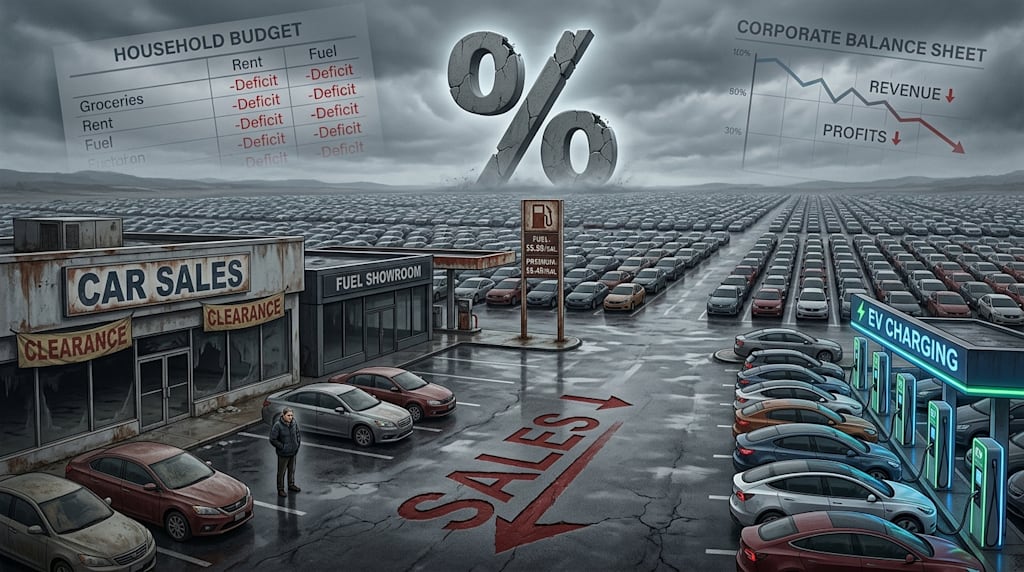
August Auto Market: Behind 65% Penetration, the Fuel-Car Denominator Is Collapsing
August passenger car retail sales: 1.541 million, down 470,000 from a year earlier.
That equals roughly one month's sales for the entire French market. In the first eight months, cumulative retail sales fell 20.8% year on year. In July, retail sales of the auto category widened their decline to 17%, the worst drop among all major consumer goods categories.
In the first half, total national retail sales of consumer goods grew only 1.3% year on year. Excluding autos, growth reached 2.8%. One category dragged the entire consumption picture down by a large margin.
Fuel Vehicles: Accelerating Their Exit
August retail sales of conventional fuel vehicles: 540,000, down 40% year on year. Pure fuel vehicles plunged 45%.
The China Passenger Car Association attributes this to high oil prices suppressing demand and accelerating “oil-to-electric replacement.” In 2026, domestic gasoline prices have risen by more than 1,720 yuan/ton cumulatively. Vehicle-use costs now carry more weight in purchase decisions.
High oil prices are only the surface. The trade-in and replacement subsidies in 2025 pulled forward part of 2026's car-buying demand. During the subsidy period, large numbers of “zero-mile used cars” appeared. With limited income growth, many buyers rushed to purchase during the subsidy window. After the subsidies ended, demand fell sharply.
The U.S. CARS program in 2009 is a typical case. Subsidies stimulate short-term consumption. After demand is pulled forward, removing subsidies leads to a rapid decline. Subsidies change the timing of demand. They do not create sustained new demand.
The bigger problem: during the subsidy period, automakers and supply chains expanded capacity based on optimistic expectations. After demand fell back, overcapacity turned into a price war. This year, terminal discounts are even bigger than the old subsidies. That is the cost of clearing inventory.
New Energy Is Also Falling. The Problem Is Not Oil vs. Electric.
August retail sales of new energy passenger vehicles: 1.005 million, down 10.1% year on year.
The number is easy to miss. New energy has grown fast for so long that a year-on-year decline signals a different market. Production was 1.528 million, up 19.2% year on year. Wholesale was 1.510 million, up 16.4%. Retail was 1.005 million, down 10.1%. The 523,000-unit gap in the middle went partly overseas and partly into dealers' parking lots.
New energy penetration reached 65.2%, a record high. Cui Dongshu, secretary-general of the CPCA, says this high rate is more of a “passive rise” after the fuel-vehicle market's denominator shrank sharply.
Company sales show clear divergence. BYD's August retail sales were 233,943; Geely, 110,560; Leapmotor, 84,874; Changan, 57,874; SAIC-GM-Wuling, 53,087; Tesla China, 50,047; Chery, 46,391; HarmonyOS Smart Mobility, 42,101; Li Auto, 37,679; NIO, 35,655; Great Wall, 33,531; XPeng, 30,982; Xiaomi Auto, 30,153.
Monthly sales of 20,000 units are now the basic threshold for a new energy brand to stay in the market.
The CPCA describes the current market this way: replacement demand is squeezing first-time purchases. Demand for B-segment and above high-end models is strong. A-segment and A00-segment economy EVs continue to shrink. New demand driven by intelligent driving is emerging. Consumers are paying more attention to AI driving functions. Technological experience is becoming the third major purchase factor after range and charging. People with money are upgrading. People without money are postponing or canceling first purchases.
The Most Dangerous Place: The Dealer Dam
Wholesale is slowing less than retail. Pressure is shifting to dealers.
Automakers wholesale cars to dealers and count wholesale sales. Whether dealers can sell those cars to consumers is a separate question. Retail keeps falling while wholesale still grows. Channel inventory keeps accumulating.
In August, the auto dealer inventory warning index was 62.3%, far above the 50% boom-bust line. More than 80% of dealers are selling below invoice. More than half are operating at a loss.
To recover cash, dealers cut prices. Price cuts make profits thinner or negative. Losses lead to worse after-sales service and a higher risk of dealers exiting the network. Exits affect automakers' channel stability.
Once this chain forms, short-term stimulus cannot easily break it.
Many industries have seen pressure on the middle link. The top wants good sales data. Demand at the bottom is insufficient. Pressure goes to middlemen and dealers. The auto industry is no exception.
Macro Background: Households Are Contracting Their Balance Sheets
The auto consumption slump is not just an industry problem.
People are repaying debt first, deleveraging, and increasing savings. Cars and houses are big-ticket purchases, often hundreds of thousands of yuan. They depend most on credit and future income expectations. When home values shrink and job expectations are unstable, people cut this kind of discretionary spending first.
This is demand contraction caused by households actively shrinking their balance sheets. It is not a temporary consumption downgrade.
China's auto consumption market has also touched its total ceiling. The incremental era driven by new-car penetration and consumption upgrading is over. The market has entered stock competition. The industry competes on price and share. The overall pie is hard to expand.
Exports Are a Buffer. Uncertainty Is Rising.
August passenger car exports: 888,000, up 77.8% year on year, 38% of automakers' total sales. New energy vehicles accounted for 58.4% of total exports.
In 2025, the overseas market sales share of Chinese own-brand new energy passenger vehicles was 15.8%. By July 2026, it reached 28%.
China's global share of new energy passenger vehicles reached 62% in January-July 2026 and 65.3% in July. Its global share of pure electric vehicles rebounded to 62% in July. Its global share of plug-in hybrids reached 74% in July.
Global penetration rates in 2026: world, 24.1%; Germany, 32.6%; Norway, 81%; the UK, 35%; the US, 7%; Japan, 4%.
Exports face tariff barriers. The EU is discussing countervailing duties on Chinese-made plug-in hybrids. The simple whole-vehicle export model is becoming harder. Automakers must move from exporting products to building capacity, brands, and supply chains overseas.
Ending
One dealer group's August financial report showed after-sales profit exceeding new-car sales profit for the first time.
Selling cars is no longer profitable. Every car sold loses money. The store stays alive by repairing cars.
About the Creator
Jin
Writer of reamstories
https://reamstories.com/jin
Enjoyed the story? Support the Creator.
Subscribe for free to receive all their stories in your feed. You could also become a paid subscriber, letting them know you appreciate their work.
Comments
There are no comments for this story
Be the first to respond and start the conversation.