
CATL Made $72 Billion While Automakers Barely Survived. Now They’re Learning to Walk Away
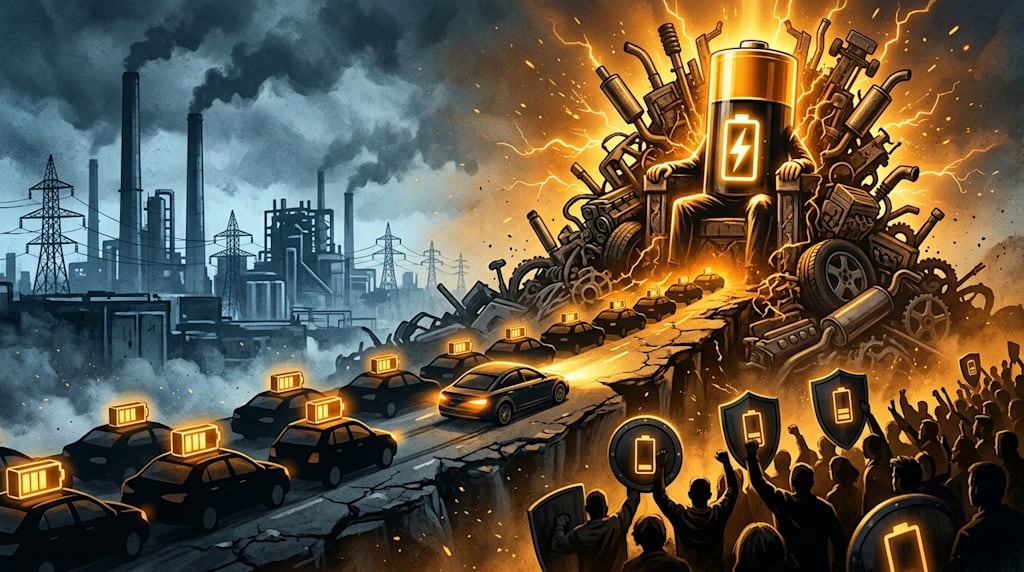
In 2026, car companies stopped treating CATL as the default. The reason isn’t just cost. It’s control.
I. One Earnings Report and $700 Billion Gone
In March 2026, CATL released its 2025 annual report. Revenue: RMB 423.7 billion. Net profit: RMB 72.2 billion, up 42.28% year on year. Nearly RMB 200 million in net profit per day. Gross margin: 26.27%, 6.4 times that of the auto industry. By any measure, those are strong numbers. The capital market answered with the opposite. The share price fell from a May high of RMB 467 to RMB 297. That is a cumulative drawdown of more than 36%. Over RMB 700 billion in market value disappeared.
Profit rose. Market value fell. Behind that contradiction sits an industrial power struggle that has run for years and is now entering a new phase.
Three months before the earnings report, Li Auto injected RMB 2.65 billion into Sunwoda Power to become its second-largest shareholder. Battery suppliers for locked-in orders of the new MEGA switched from CATL to Li Auto’s self-developed 5C battery. Li Auto President Ma Donghui explained the decision to reporters in restrained terms. “The battery is not an externally procured component. It is part of the vehicle’s core capability.”
An earlier signal came in June 2025. AITO, long supplied exclusively by CATL, announced it would bring in two second-tier battery suppliers, CALB and Gotion High-tech. In September, Xiaomi Auto launched its self-developed battery brand, Dragon Armor Battery. The Pengcheng series uses it across the board. Cells come from CALB and Sunwoda.
For a time, “de-CATLization” moved from an undercurrent to a public narrative. The breakup is more complex than a supply-chain adjustment.
II. Profit Imbalance: The Battery Eats the Vehicle’s Profit
Any crack in a commercial relationship can be traced back to how money is split. The conflict between automakers and CATL begins with an extreme imbalance in the industrial chain.
Cui Dongshu, secretary-general of the China Passenger Car Association, once gave figures at an industry event. Chinese automakers together earned USD 14.7 billion in profit. CATL alone took USD 7.1 billion. “Automakers other than battery makers account for only around ten percent of the profit.” He described it in four words: too miserable to look at.
Battery costs account for 30% to 40% of the total cost of a vehicle. For high-end long-range models, the share often passes half. In the vehicle cost structure, the battery is the single component with the highest share. When one supplier controls that cost item and sets prices, the downstream automaker’s profit space gets squeezed.
In the first quarter of 2026, CATL’s net profit was RMB 20.7 billion. That exceeded the combined net profit of seven leading automakers. The average profit margin of the vehicle industry fell to around 4%. In 2022, former GAC Chairman Zeng Qinghong complained in public: “The battery accounts for 60% of the vehicle’s cost. Aren’t I just working for CATL?” Three years later, the problem has not eased.
The auto industry has a deep-rooted belief. The automaker is the chain master. It controls final product definition and brand premium. In the electrification era, the battery accounts for more than one-third of vehicle cost and is concentrated in one supplier. That hollows out the chain master position. The automaker’s brand premium is eaten by battery costs. Differentiation space is compressed by standardized cells. Product rhythm must accommodate the supplier’s capacity schedule. This reversal of roles drives automakers’ de-CATLization more than any single price dispute.
III. Three Paths: How Automakers Are De-CATLizing
The supply-chain adjustments of 2026 are not one thing. Different automakers, based on sales scale, technical accumulation, and financial strength, have chosen different paths.
The first path is self-development plus contract manufacturing. The automaker controls definition. The supplier produces cells to its standards. Li Auto is the most systematic example. The new Li L8 uses Sunwoda cells across the board. Li Auto invested RMB 2.65 billion in Sunwoda Power for an 11.17% stake. The two sides jointly established Shandong Li Auto Battery Co., Ltd. Registered capital: RMB 300 million. Each holds 50%. In the fourth quarter of 2026, the MEGA, i9, and 2026 i6 will complete the switch to self-developed batteries in batches. The company promises battery health will remain no lower than 75% for 8 years or 160,000 km.
Xiaomi’s approach is more systemic. The Dragon Armor Battery is not a cell that Xiaomi develops and produces itself. It is a power battery standard system and overall solution built from a vehicle-wide perspective. Xiaomi leads product definition and battery pack design and development. It participates in cell material selection, formulation design, and manufacturing processes. Its shadow factory mechanism matters. Xiaomi quality experts are stationed on supplier production lines. There are more than 8,000 quality checkpoints. First- and second-tier suppliers face penetrating management. Process-related information is archived for 15 years. This goes beyond traditional procurement. It embeds automaker quality standards into supplier manufacturing.
The second path is joint ventures to build factories. Leapmotor’s joint venture with CALB, Zhongling New Energy’s Wuyi cell base, has a planned annual capacity of 33.6 GWh. That is enough to support more than 500,000 new energy vehicles. Leapmotor launched three standardized cells: L148, L208, and L300. It consolidated cell specifications into three standard models.
The third path is bringing in second and third suppliers. AITO brought in Gotion High-tech and CALB. XPeng upgraded CALB to a core battery supplier. This is the most common and pragmatic approach.
Automakers’ supply-chain strategies are not a blanket abandonment of CATL. For high-end core models, automakers continue to deepen cooperation with CATL. For volume models, they build multi-supplier systems to spread risk. At the same time, they make forward-looking reserves in self-developed battery technology. The layered strategy aims to balance CATL. The goal is not to do without CATL. The goal is to have the ability to do without it.
IV. From Gray Box to White Box: The Fight Over Definition Rights
Looking at supply-chain changes only through cost misses the depth of this shift. Power batteries are moving from a gray box model to a white box model.
For more than a decade, automakers bought shelf products from leading battery manufacturers. Cell processes and material formulations could not be independently controlled. Production site management could not be deeply intervened in. The industry called this the gray box model. That model is breaking. Automakers are shifting from submitting requirements to setting standards. They use penetrating management to reach into cell materials, production processes, and second- and third-tier supply chains.
A new energy vehicle engineering lead called this model a white box. “It is not simply obtaining the supplier’s bill of materials and parameter permissions. It is the full penetration of automaker standards across the entire battery R&D and production chain.”
The most visible sign of white-boxing is battery branding. BYD has Blade. Geely has Golden Brick. Xiaomi has Dragon Armor. Li Auto has its self-developed 5C battery. Automakers no longer settle for marking “CATL battery” on the specification sheet. They want their own battery brands.
Why does definition power matter? The battery is becoming a key fortress for differentiated competition. In 2026, China’s auto market is launching new models in a stampede. Intelligent driving and cabin experiences are becoming homogeneous. Battery performance is one of the few remaining differentiation battlefields. Xiaomi’s Dragon Armor Battery uses a 25 mm impact head and raises impact energy to 500 J. The national standard requires a 30 mm impact head and 150 J impact energy. Such indicators cannot be achieved through general standardized solutions.
Ma Donghui put it clearly. “The battery is not an externally procured component. It is part of the vehicle’s core capability.” The statement raises the battery from a supply-chain management issue to vehicle product definition. When the battery is defined rather than bought, the automaker grasps a core competitiveness of the electrification era.
V. Consumers Say No CATL, No Buy
Automakers’ path to de-CATLization faces an unexpected obstacle. Consumers are not buying it.
NielsenIQ’s 2026 Global New Energy Vehicle Consumer Research Report found that 37.1% of Chinese consumers said they would give up buying a preferred model if it did not have a CATL battery. CATL’s brand trust in China reaches 81%. “Very trustworthy” accounts for 39%. The weight of the battery in purchase decisions reaches 13.8%. That surpasses intelligent features at 8.7% and driving performance at 8.6%. Only vehicle safety ranks higher.
The data reveals a paradox. Over more than a decade, CATL built a moat in technology and capacity. It also built strong brand awareness in consumers’ minds. When automakers try to push their own battery brands forward, consumers instinctively question whether an automaker’s self-developed battery pack can match CATL.
That consumer perception is the greatest resistance to de-CATLization. After Li Auto switched the battery supplier for the new MEGA from CATL to its self-developed solution, consumers canceled orders. The Li i9 CATL version sold out in seconds. That confirms CATL’s brand appeal from another angle.
There is another side. Consumer brand perception can be shaped over time. If automakers keep investing in brand building, and if self-developed batteries deliver testable results in safety, range, and charging speed, the trust balance can move. The key is whether automakers will bear the quality risks and time costs that may arise.
VI. CATL’s Moat: Has It Been Breached?
CATL is not without means of retaliation.
On technology, CATL still holds a strong lead. Its third-generation Shenxing ultra-fast-charging battery, released in April 2026, achieves a full charge in 6 minutes at room temperature. The third-generation Kirin battery has an energy density of 280 Wh/kg. It achieves 1,000 km of range and comes with 10C ultra-fast charging as standard. The battery pack weighs 625 kg. That is 255 kg lighter than a comparable 1,000-km-range lithium iron phosphate model. The Kirin condensed-matter battery raises range to 1,500 km. Second-tier battery makers will struggle to match those parameters in the short term.
On manufacturing, CATL Chief Manufacturing Officer Ni Jun offered a key judgment. “Making one good battery is not hard. What is hard is making a billion batteries that are all equally good.” In 2025, CATL’s full-year capacity utilization rate was 96.9%. In the first half of 2026, it was 94.86%. That large-scale manufacturing advantage is hard for second-tier manufacturers to match.
On strategy, CATL is adjusting. It acquired Geely-affiliated battery plants. It reached an exclusive cooperation with Leapmotor to supply only cells. It won Volkswagen Group’s annual award. It has begun to accept the role of selling only cells. It shifted from providing complete battery system solutions to focusing on cell supply as a technology partner. That role narrows CATL’s value share per vehicle. It does not necessarily weaken its industry position or the irreplaceability of its core technology.
A deeper problem is emerging. Some analysts say CATL’s battery technology R&D in the past two years has shown a tendency toward PPT-ification. Press conferences are loud. Breakthrough results that clearly widen the technology gap with peers are limited. Sunwoda and CALB together spend about RMB 6.5 billion on R&D. CATL alone spends ten times that. From the product side, the huge investment gap has not translated into a proportional experience gap.
CATL remains in a leading position. The degree of leadership is shrinking. When the technology gap no longer supports excess profit, automakers have the motivation and courage to look for alternatives. If CATL had Jensen Huang-style technology, ecosystem, and policy moats, if it were ten streets ahead of second- and third-tier battery makers, Li Auto and Xiaomi would not dare to de-CATLize even with a hundred times the courage.
VII. A Power Redistribution Without an Endgame
The de-CATLization wave is more than a supply-chain adjustment. It is a restructuring of the industrial chain’s power structure as China’s new energy vehicle industry moves from barbaric growth into refined cultivation.
During the industry’s explosive growth phase, battery supply was tight. CATL occupied the core position thanks to its technological lead and production scale. To secure capacity and deliveries, automakers accepted King Ning’s pricing and terms. When industry growth slows, competition intensifies, and profits are compressed, automakers begin to ask why the largest cost item should be dominated by one supplier. They ask why they cannot take back definition rights for this core component.
A policy variable matters. Starting September 1, 2026, lithium-ion batteries will be subject to a 2% consumption tax. The rate rises to 4% in 2027. Batteries produced and used in-house for continuous production are exempt. That draws a new cost divide between automakers that make batteries and automakers that do not. It gives vehicle companies an institutional incentive to make batteries.
The risks of de-CATLization cannot be ignored. Power batteries require extremely high precision and have a low tolerance for error. A battery pack contains hundreds of cells. At mass-production scale, small problems multiply. For automakers to make batteries, they must consider technology and safety. They must also judge whether it is economical and sustainable based on their own sales scale and financial strength.
A healthy industrial chain should not pursue universal thin margins and universal involution. The gap between the vehicle industry’s average profit margin of 1.5% and the battery leader’s 17% is a gap in technical barriers and industry structure. It is not simply an unfair distribution of interests. The question is whether automakers can surpass their past levels in battery safety, product quality, and user experience after de-CATLization. If self-development is merely packaging for switching to a cheaper supplier, and if cost reduction comes at the expense of quality, the ultimate victim will be the competitiveness of China’s entire new energy vehicle industry.
Wu Xiaobo, commenting on CATL’s dilemma, proposed a framework. Super suppliers have three breakout paths. Shift from selling products to exporting technology and platform capabilities. Deepen joint R&D with customers, turning a buyer-seller relationship into a symbiotic one. Open new tracks to find incremental markets.
Power in the industrial chain will not stay fixed on one side. Will CATL, like Intel in its time, move from the absolute rule of Intel Inside to being diluted by a multi-supplier system? Or will it, like TSMC, remain irreplaceable through extreme leadership in manufacturing processes? Or will it walk a different path, transforming from a battery supplier into an energy technology platform?
Those questions have no certain answers. The 2026 de-CATLization wave marks a new stage for China’s new energy vehicle industry. Automakers are no longer satisfied with being a brand shell. They are penetrating deeper into the industrial chain and fighting for definition rights for every core component. The endgame has not arrived. This is the opening phase of a long game.
About the Creator
Jin
Writer of reamstories
https://reamstories.com/jin
Enjoyed the story? Support the Creator.
Subscribe for free to receive all their stories in your feed. You could also become a paid subscriber, letting them know you appreciate their work.
Comments
There are no comments for this story
Be the first to respond and start the conversation.