
BYD’s 1.02 Million Employees Explain the Jobs Debate Better Than Any Salary Chart
Toyota, Volkswagen, and China’s state giants give the headcount context. The story sits between 120,000 R&D engineers and the workers in Xi’an, Shenshan, and Jinan.
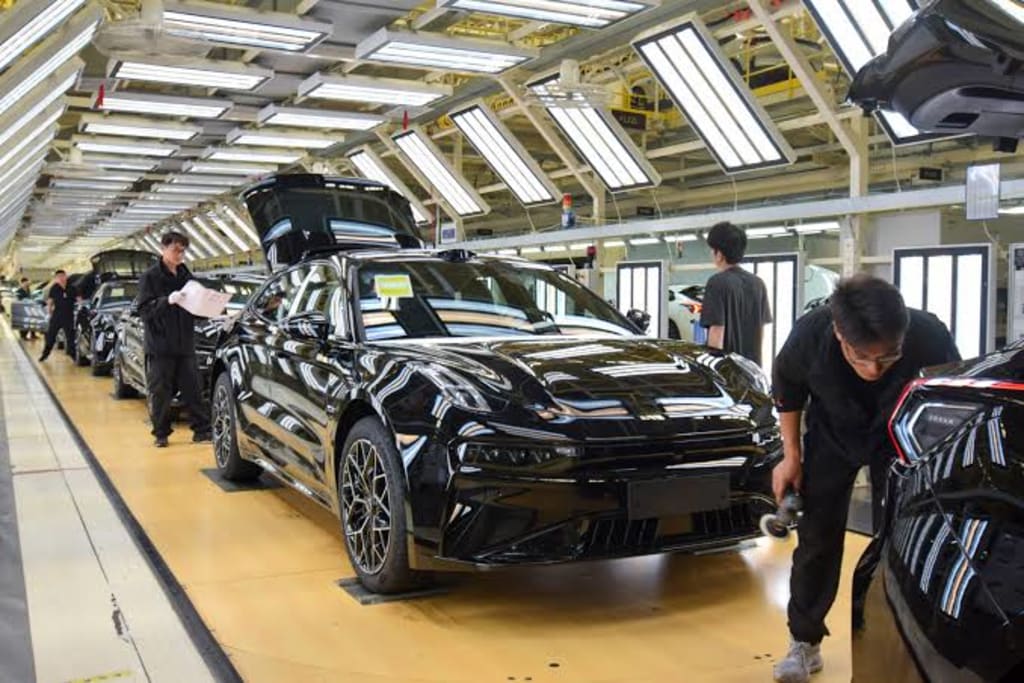
On the day Wang Chuanfu received the Rao Bin Award, he gave a number: as of October 2026, BYD employed more than 1.02 million people. About 60,000 work overseas. 120,000 are R&D engineers.
A number on its own says little. Put it beside reference points. Toyota employs about 390,000 people worldwide. Volkswagen has about 660,000. Ford has about 169,000. GM has about 156,000. Tesla has about 134,000. Together those four employ 851,000. BYD’s payroll is about 170,000 larger than all four combined. In China, entities that have steadily kept more than a million employees have mostly been central state-owned enterprises: China Railway Group at about 2.04 million, State Grid at about 1.36 million, CNPC at about 1.02 million. BYD is the only private company in that group.
Size is not the interesting part. Toyota sells more than 10 million vehicles a year with fewer than 400,000 people. BYD sells more than 4 million with 1 million. Output per employee works out to roughly 4 to 5 vehicles at BYD and nearly 30 at Toyota. The gap is six- to sevenfold.
That gap does not prove BYD is inefficient. Toyota’s batteries sit on Panasonic’s books. Its components sit on Denso’s. BYD keeps batteries, motors, electronic controls, and semiconductors inside its own boundary. The 1.02 million includes about 165,000 people at BYD Electronics, plus payroll in battery external sales, energy storage, and rail transit. The company has pulled a long industrial chain’s employment onto one payroll. It pays for weight with control. Both costs and benefits show up on the ledger.
More revealing than the total: 120,000 R&D engineers and hundreds of thousands of frontline jobs sit inside the same company. In 2025, BYD spent 63.4 billion yuan on R&D. Employee compensation within that exceeded 31.3 billion. Blade batteries, DM hybrid systems, and vehicle intelligence must pass through yield rates, process work, equipment commissioning, and line maintenance before mass production. R&D density and manufacturing density reinforce each other here. At the Xi’an base, general operators earn a comprehensive monthly salary of 5,500 to 8,000 yuan. At Shenshan, 5,500 to 6,500. Skilled workers earn 5,000 to 10,000. In Jinan, general workers earn 5,000 to 9,000 yuan a month, or 60,000 to 108,000 a year, while the average annual wage of private-sector employees in Jinan is about 65,000. In Fufeng, Shaanxi, a family member of an employee said people used to go to Guangdong and come home once a year. Now they take home more than 5,000 yuan after deductions and get home every day.
A job’s weight cannot be measured only against internet salaries. It also has to be measured against the local choice set. In central and western China and in eastern Guangdong, a stable formal manufacturing job that lets someone stay near home is not dismissed by saying the pay is not high.
Debate about BYD pay often gets stuck on per capita figures. In 2025, total wages were about 130.5 billion yuan across 869,600 people, or about 150,000 yuan per person. That average mixes algorithm engineers with line operators. The structural change matters more. Headcount fell from 968,900 to 869,600. More than 90 percent of the nearly 100,000 reduction came from frontline production. R&D staff rose by 4,741. Total wages rose from 117.1 billion to 130.5 billion yuan. The welding shop at the Zhengzhou super factory is 97 percent automated. Replaceable roles are shrinking. Roles that need engineering capability are growing. Layoffs and pay raises do not capture this. It is a rebuild of the employment structure.
Overseas staff are about 6 percent of the total, but the direction is clear. Li Ke said European staff will soon exceed 10,000. BYD plans more than 40,000 in Europe by 2030. The Hungary plant is in final production preparation. France and Spain are candidates. Where cars are sold, factories and payroll follow. From export sales to overseas production, 60,000 is a starting point.
Back to the employment contribution award. The case for it does not rest on the size of 1.02 million. It rests on a company holding scale at both the R&D end and the manufacturing end. Hundreds of R&D jobs and thousands of production jobs follow different employment logic. The first needs high-skill talent. The second absorbs workers with different skill backgrounds. BYD’s vertical integration has built density at both ends. There are costs: efficiency, output per employee, and management complexity are real problems. But when manufacturing employment capacity is under pressure and regional job opportunities remain uneven, a private company that supports a million-level payroll and keeps a presence in R&D and manufacturing deserves specific recognition.
The name employment contribution award depends on the ruler. If the ruler is the salary ceiling of a few roles, the answer is one thing. If the ruler is whether more ordinary workers have a job they can choose, the answer is another.
About the Creator
Jin
Writer of reamstories
https://reamstories.com/jin
Enjoyed the story? Support the Creator.
Subscribe for free to receive all their stories in your feed. You could also become a paid subscriber, letting them know you appreciate their work.
Comments
There are no comments for this story
Be the first to respond and start the conversation.