
At 500 km/h, Horsepower Is the Least Interesting Number
Yangwang’s U9 Xtreme is chasing a record on an open road. The real test is whether the battery, carbon tub, and tires still have margin when the speed stops being theoretical.
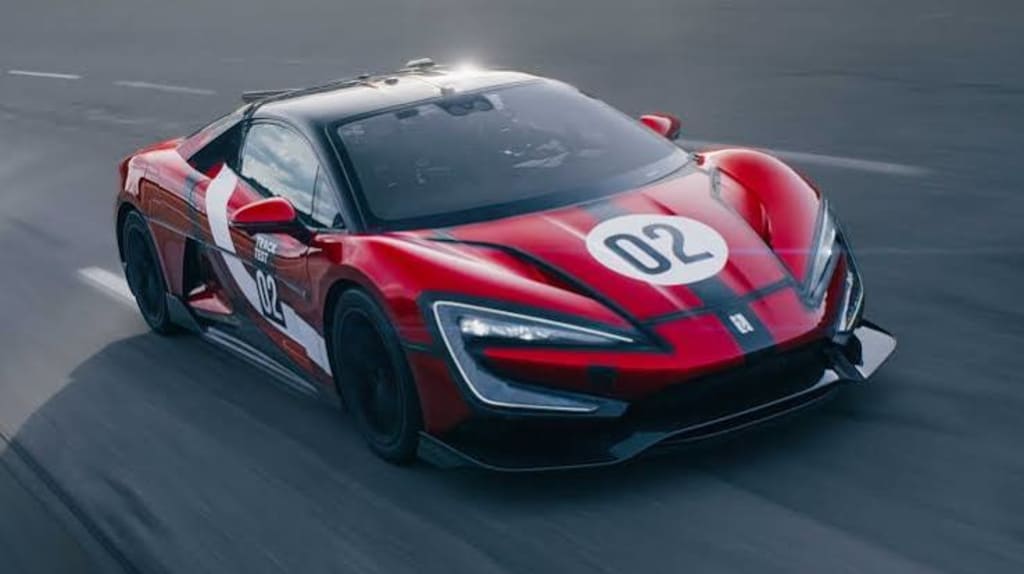
For a production electric hypercar aiming at 500 km/h, horsepower is the easiest part to explain. The U9 Xtreme has 2220 kW, 3019 hp, and a power-to-weight ratio of 1217 Ps/t. Above 480 km/h, drag rises with the square of speed. Every extra 10 km/h nearly doubles the energy demand. At that point, 3019 hp is an entry ticket.
Heat decides the run. The battery must survive the final seconds without thermal protection cutting output. The carbon monocoque must preserve survival space in a crash above 425 km/h. The chassis must hold attitude when crosswinds and dust hit a 2480 kg car on an open road.
Yangwang moved the U9 Xtreme from the Papenburg high-speed oval in Germany to an open road in Abu Dhabi. That shift pushes the test from controlled boundary conditions into real disturbance. The earlier crash above 400 km/h already answered part of the question.
Heat decides the final seconds
The e4 four-motor architecture has a clear physical advantage. Four motors spin to 30,000 rpm. Each motor peaks at 555 kW. Torque arrives instantly, with no turbo spool and no gearbox downshift. At a 30C discharge rate, the lithium iron phosphate Blade battery can theoretically supply the current for full power.
A top-speed run is not a launch. At the end of the 496.22 km/h run, the driver lifted because the car had drifted left toward the barrier. Telemetry showed about 1.5 seconds of full-throttle acceleration remained unused. The team treats that as data, not a gamble.
That 1.5 seconds is also a heat problem. Full-power discharge creates heat inside the pack. The final sprint has no slow dissipation margin. Cooling power is up 133 percent. The double-layer cooled Blade pack lowers heat by reducing cell internal resistance. The key variable is whether the pack hits thermal protection in the last dozen seconds. Before 496 km/h, electricity goes to propulsion. After 496 km/h, heat competes with propulsion for the same management system.
Abu Dhabi is harder than Papenburg in one respect. The oval’s banked surface and flatness are built for top-speed runs, so the heat load is predictable. Abu Dhabi heat raises the cooling system’s starting temperature. Crosswinds and dust may force attitude corrections during the sprint and add load to the drive system. The hardware is solid. The road exposes the margin. Thermal margin decides whether that margin exists.
The crash was a full-scale test nobody ordered
In the 2026 crash at a closed domestic test facility, impact speed was in the 425-450 km/h range. The rear axle assembly tore completely from the body. The front and rear subframes deformed. The crumple zones and mechanical components at both ends were destroyed. The central aerospace-grade carbon-fiber monocoque kept its basic frame. The A-pillars and B-pillars did not suffer fatal crushing. The driver walked out. The battery did not catch fire. After the crash, the team reviewed and retuned the car, then set a 457.89 km/h domestic record in the same test cycle.
The result says more than “the driver was fine.”
A traditional hypercar safety logic uses front and rear crumple zones plus a high-strength occupant cell. That logic has been validated for decades below 200 km/h. Above 425 km/h, the energy facing the crumple zones is not something “energy absorption” can comfortably cover. The U9 Xtreme divides the car into three zones. The front and rear are sacrificial deformation zones. They dissipate kinetic energy through crushing, fracturing, and complete detachment of assemblies. The central carbon-fiber monocoque is the non-negotiable zone. It uses more than 110 kg of carbon fiber and protects occupant survival space. The battery pack sits directly beneath the occupant cell through CTB technology. The carbon cabin and the surrounding carbon-steel-aluminum structure constrain its deformation. That is the structural reason the crash did not produce a thermal event.
An F1 car crashing at a similar speed can still face fire and serious injury. A production battery-electric car with a 2480 kg curb weight survived a non-frontal, multi-impact crash in which kinetic energy was dissipated in stages. It kept the occupant and the battery intact. The safety redundancy has moved past race-car logic into something closer to aircraft survivability design.
Above 480 km/h, downforce keeps the car straight
Below 300 km/h, downforce serves cornering. Above 480 km/h, downforce suppresses straight-line instability caused by aerodynamic lift.
The U9 Xtreme’s carbon-fiber aero package includes a front splitter, a dual-channel vented hood, a swan-neck high rear wing, and a widened rear diffuser. At this speed range, the package presses the car onto the road so tire contact pressure is not canceled by lift. The DiSus-X active suspension adjusts damping 100 times per second. When crosswind disturbance or a small road undulation appears, it pins the body back down before the motion grows. At speeds near Mach 0.4, attitude control matters more than power output. A small pitch or yaw motion at 500 km/h can become unrecoverable instability.
Tires are one of the few links with no redundancy. The Giti custom GitiSport e·GTR2 Pro semi-slick is rated for over 500 km/h and uses aramid fiber to suppress high-speed centrifugal expansion. The load on those tires in Abu Dhabi is less predictable than on the Papenburg oval. Road temperature, dust adhesion, and slight slope changes at the start and end of the straight all change stress in the contact patch. Tires sit closest to the physical limit and carry the least safety margin. Their behavior will not give that 1.5-second countdown in the telemetry beforehand.
The open road changes the test
The Papenburg ATP oval is a physical laboratory for top-speed sprints. Every number produced there happens inside carefully controlled boundary conditions. The roughly 15 km straight in Abu Dhabi adds high temperature, crosswind, and dust to the variable list.
The test changes character. On the oval, engineers check whether the car can reach a speed. On the open road, they check whether the car can still deliver that speed under real disturbance. Between those two questions sit thermal management at non-ideal starting temperatures, yaw stability in crosswinds, chassis attitude over small road irregularities, and a test system that can review, retune, and continue after a crash.
After the crash above 425 km/h, the team did not stop. The 457.89 km/h domestic record came in the same test cycle. Then the challenge moved to Abu Dhabi. A system that recovers from an extreme event and keeps pushing says more about the engineering base than an isolated record.
500 km/h is a round number. The test is whether one system can contain power, heat, structure, and attitude at the edge of a production car’s physical limits. It also tests whether the remaining links bring the driver back when one link fails. The crash sampled the second half of that question. Abu Dhabi answers the first.
About the Creator
Jin
Writer of reamstories
https://reamstories.com/jin
Enjoyed the story? Support the Creator.
Subscribe for free to receive all their stories in your feed. You could also become a paid subscriber, letting them know you appreciate their work.
Comments
There are no comments for this story
Be the first to respond and start the conversation.