
Alibaba Wants to Be the Electric Company for AI Thinking
At Apsara 2026, CEO Wu Yongming made an economic case: machine thought will be sold like power. Alibaba is building the plants, the grid, and the meters.
Alibaba Wants to Be the Electric Company for AI Thinking
At Apsara 2026, CEO Wu Yongming made an economic case: machine thought will be sold like power. Alibaba is building the plants, the grid, and the meters.
On September 22, at the Apsara Conference in Hangzhou, Wu Yongming opened with the Industrial Revolution, electricity, and economics. He did not start with model parameters or product launches.
He made an analogy. The Industrial Revolution turned power into a commodity at scale. People built steam engines, internal combustion engines, and electrical grids, then built modern industry on top. This time, he said, thinking is next.
When a CEO describes the future in economic terms, he is looking at more than technology. He is looking at who produces, who transmits, who consumes, and how the whole thing gets priced.
The 1,000x Claim
Wu said machines will eventually supply more than 1,000 times the total thinking humans supply.
He started with supply. Top human thinking is scarce. A top scientist needs decades of study, practice, talent, and luck. Neonatal progeria appears in a few dozen newborns worldwide each year. Only a few hundred patients have ever been recorded. No drug company would spend a decade and huge sums to develop a treatment for a few hundred people.
AI changes the math. If compute is cheap and abundant enough, a niche field can run millions of agents that research, simulate, and verify around the clock. Top-level thinking can move from luxury to mass-produced commodity.
Then he looked at demand. In the industrial age, consumption depended on population. Coffee needed drinkers. Cars needed drivers. Phones needed users. A person can only consume so many physical goods.
In the AI era, that limit loosens. Give an AI the goal of building a spaceship to Mars. It can break the work into tens of millions of subtasks. With enough resources, millions of agents and robots can work without stopping. A person supplies an idea and a target. The system supplies the intellectual labor. Thinking consumption stops tracking population and starts tracking machine depth and machine supply.
Wu put it this way: “Every super individual can have tens of thousands of times the intellectual leverage.”
Add supply and demand together, and the 1,000x number appears.
He left three questions unanswered. If thinking becomes a commodity like electricity, who sets the price? What is the unit? Who controls the network that delivers it?
Those three questions are one question. Whoever controls production, measurement, and distribution controls the most valuable layer of the era.
Alibaba’s moves answer it.
Three Cornerstones, One Chain
Wu named three cornerstones for the machine intelligence era: AI models, AI chips, and AI cloud. He called them the requirements for supplying machine thinking at scale.
They are not parallel. They form a chain.
The Industrial Revolution turned power into a commodity through steam engines, grids, and factories, railways, and appliances. Thinking needs the same production, circulation, and consumption system.
Chips handle production. Without powerful, cheap chips, thinking cannot scale. T-Head’s Zhenwu V900, Yitian CPU, Panmai smart NIC, and ICN interconnect chip address the production efficiency of thinking power.
Models handle quality. Chips produce tokens. Models determine how smart those tokens are. Qwen’s work on RSI and its 5T to 10T parameter target aim to increase the thinking depth of each token. Wu also stressed multimodal ability. A smart brain is not enough, he said. AI also needs perception and interaction. The foundation model sets the ceiling. Multimodality sets the reach.
The cloud handles circulation. Chips produce tokens. The cloud delivers them. By 2032, Alibaba Cloud plans to operate more than 20GW of global data center capacity. The more complete that network becomes, the more users and agents join it. Scale and network effects follow.
There is a business logic underneath.
Chips carry pricing power. Global AI chip supply is tight. Wu admitted that shortages limit how fast compute can grow. If Alibaba does not make its own chips, its thinking supply depends on someone else.
Models carry differentiation. If every company uses the same chips and the same cloud, the model becomes the main variable.
The cloud carries scale. Commodity thinking needs abundant supply. Abundant supply needs scale.
Chips, models, and cloud feed one another. Alibaba is positioning itself as economic infrastructure for machine intelligence. That ambition goes beyond building a next-generation operating system.
Agents Need a Full Stack
After the strategy, the practical question is how these judgments become productivity inside companies.
Alibaba’s answer is full-stack optimization aimed at agents.
For agents to enter business and production, three problems matter: compute efficiency, long-task reliability, and cost.
At Apsara, Alibaba’s AI teams announced work across chips, servers, super nodes, networking, models, inference systems, and MaaS. The goal is joint tuning across the whole line.
At the chip layer, CPUs handle task planning, state management, and tool calls for agents. AI chips, super nodes, networking, and storage support long-running, high-concurrency workloads.
On the cloud side, Alibaba released AgentCore and a new generation of CPFS. Both target an Agentic Cloud built for models, harnesses, and context.
At the model layer, Qwen keeps improving planning, tool use, and long-horizon execution.
Those improvements reach developers and enterprise customers through the Qwen AI platform. One end upgrades MaaS model services for inference efficiency, elasticity, and cost. The other launches Agent Studio, which combines models, tools, memory, runtime, and enterprise governance into one agent service.
Alibaba is rebuilding the path from thinking production to thinking delivery around agents that do work, rather than adding a few features to its stack.
An agent is a long-horizon task execution system. It calls compute continuously. It needs stable networking and storage. It has to stay reliable over long runs. It has to control cost. If one link fails, the agent does not ship. That is why Alibaba is optimizing the whole stack, from chips to cloud platform to agents.
Two Tracks
Alibaba’s work runs on two tracks.
The first track is medium and long term. The company keeps investing in AI models, AI chips, and AI cloud. These are the technical cornerstones for higher-order intelligence. Wu called this Alibaba’s long-term strategic choice.
The second track is current demand. Agents are growing fast. Alibaba is optimizing the full stack so agents enter business and production. That includes CPUs, AI chips, super nodes, storage, cloud runtime, and the MaaS platform. The work targets compute efficiency, long-task reliability, cost, and enterprise governance.
Both tracks serve one goal: prepare enough technical foundation for market demand, production demand, and business demand so intelligence can enter real work.
One detail stands out.
Wu said the representative product of the machine intelligence era has not appeared yet. Today’s AI Coding is like the electric light in 1882. It can replace existing work, but it cannot create a new era by itself. “In the earliest days, Edison sold light bulbs and gave away electricity,” he said. “Today’s agents give away tokens in the same way.”
Every AI product visible today may sit in that electric light stage. They prove electricity works. They do not define how people live with it. The native AI application may not be a chat box or a Copilot. It may be an interaction model that has no name yet.
Around 1900, electrical appliances were entering homes. The world’s entire annual electricity output then would run today’s world for about two hours.
Machine intelligence will demand infrastructure on a scale that makes today look small. Alibaba’s spending on AI infrastructure is soil for a product that has not arrived.
For a giant, that thinking is practical. Do not rush to declare the next product paradigm. It is fine to arrive late. But when the next era needs roads and bridges, start early and do not step aside.
The Bet
Alibaba’s AI economics fit in one sentence: do not bet on one hit product. Bet on the infrastructure everything else needs.
If AI is electricity, Alibaba wants the power plants, the grid, and the motor standards. It wants agents to be the biggest electricity user.
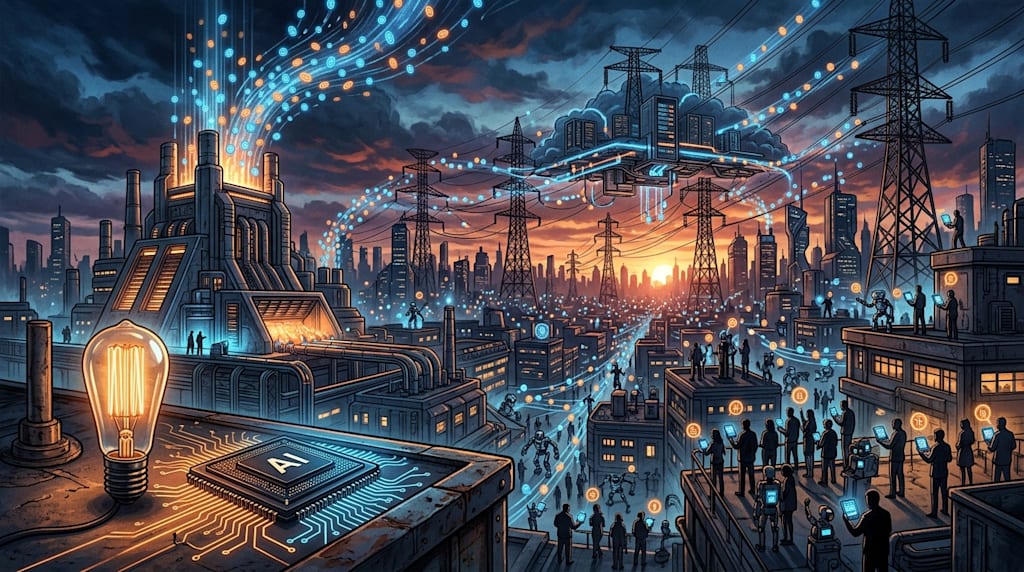
Chips are generation equipment. Models are the quality standard. The cloud is the grid. Agents are appliances. MaaS is the meter. Agent Studio is the distribution box and fuse.
Alibaba wants to become the measurement and settlement layer for thinking power, beyond selling models or cloud.
The strategy has a clear source of certainty. Demand for intelligence has almost no ceiling. Infrastructure is always needed. As long as machine thinking expands and agents become part of production and business, demand for compute, models, cloud, and full-stack optimization will continue.
The risks are just as clear.
Capital spending is enormous. A 20GW data center target means long-term, asset-heavy investment with a long payback period. The unit economics depend on compute utilization, falling inference costs, and customer willingness to pay.
The chip supply chain is constrained. Global AI chip supply is tight. In-house chips help, but advanced process nodes, ecosystem compatibility, and software stack maturity remain hard.
Open source and commercialization must balance. Qwen’s open-source ecosystem gives Alibaba influence and a developer base. Turning that influence into durable revenue is still an open question.
Agent reliability and governance remain hard. Long-task execution, tool calls, memory management, enterprise permissions, security, and compliance can each become a deployment bottleneck.
Value distribution is uncertain. Infrastructure matters, but profit may pool in applications, data, or new distribution points. Alibaba can collect the electricity bill only if it holds an irreplaceable place in the thinking commodity chain.
In 1882, the electric light came on. No one then could predict factory lines, home appliances, the internet, and modern cities. Today’s AI Coding, chatbots, and Copilots may be electric light products.
Alibaba is building power plants, grids, and meters. Its bet is that every super app will need electricity, not that one particular super app wins.
The meter is already turning.
About the Creator
Jin
Writer of reamstories
https://reamstories.com/jin
Enjoyed the story? Support the Creator.
Subscribe for free to receive all their stories in your feed. You could also become a paid subscriber, letting them know you appreciate their work.
Comments
There are no comments for this story
Be the first to respond and start the conversation.