
Alibaba Cloud Does Not Want to Build Cars. It Wants to Be the Road.
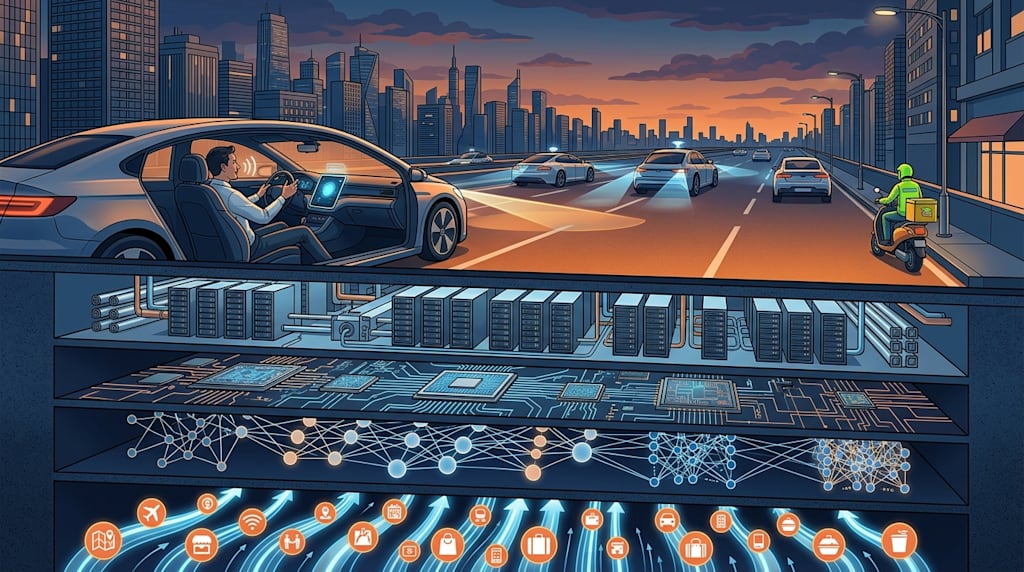
China’s smart-car race is moving into the data center. One company is quietly becoming the foundation every automaker needs.
At the 2026 Apsara Conference Automotive Summit, Frost & Sullivan and LeadLeo released a report. The number was simple: Alibaba Cloud held 45.2% of China’s automotive public cloud market. It ranked first in six tracks, including intelligent driving, intelligent cockpits, and industrial efficiency.
That number says more than any launch event.
China’s smart-car industry is going through a shift. On stage, the competition is about city NOA, cockpit personalities, and launch-day hype. Behind the curtain, the fight is about data pipeline speed, training cluster reliability, and model iteration cycles. Those unglamorous things decide who stays in the game.
Li Qiang, General Manager of AI Automotive Industry at Alibaba Cloud Intelligence Group’s Public Cloud Business Unit, sums it up in five words: integrated chips, cloud, and models. From cockpits to intelligent driving, from small in-car models to cloud-based trillion-parameter inference clusters, and from carmakers’ internal workflows to organizational efficiency, Alibaba Cloud is building AI infrastructure across the whole chain.
It is building the ground under the industry.
I. Cockpit: from “can chat” to “can get things done”
Two years ago, the hottest story about large models in cars was that they could chat and provide emotional value. That line appeared on many launch slides.
Two years later, users still are not impressed. Huo Jian, General Manager of AI Automotive Industry Solutions at Alibaba Cloud Intelligence Group’s Public Cloud Business Unit, talked with cockpit teams at several carmakers. He found that casual chat is not a high-frequency use case. Users care about whether the system can handle vehicle control, navigation, and services at the right moment.
A car that only chats is not enough. Users need a car that gets things done.
The cockpit is a task assistant. When you hire an assistant, you first check whether he can finish work. Then you trust him. Then you rely on him. Only later might you confide in him. The order matters.
So the biggest cockpit AI change this year is from chatting to doing. This is a teardown and rebuild. Old cockpit systems ran on rule engines and stitched-together modules. Every new feature meant another engineering pileup. That approach hits a wall with large models.
The new approach uses a Harness, an engineering governance framework, plus large models. The model handles intent understanding, task breakdown, and tool calls.
Alibaba Cloud does not sell a complete cockpit product. It provides cloud, models, and other full-stack AI capabilities, plus agents for Alibaba’s services. The reason is simple: cockpits are highly customized. Carmakers know their users and brand best. A complete solution from Alibaba Cloud would push in the wrong place.
The Qwen Cockpit Agent has two main capabilities.
First, casual chat and retrieval. This comes from the Qwen consumer app, bringing Alibaba’s consumer-side strengths into the car.
Second, agents for Alibaba Group services. This is the sharper edge. In the past, a carmaker that wanted to integrate Taobao Shangou, Amap, and Fliggy had to negotiate with three business teams, deal with inconsistent interfaces, and pay high maintenance costs. The Qwen Cockpit Agent turns those services into a unified agent interface. A carmaker integrates once and can call the whole Alibaba network.
Imagine driving home, not wanting to cook, and telling the cockpit, “Order takeout. Have it arrive when I get home.” Behind that request are location, estimated arrival time, restaurant choice, payment, and delivery timing. In the past, a carmaker had to connect several APIs. Now, through the Qwen Cockpit Agent, one A2A call handles the chain.
The cockpit agent is only what users see. What matters happens behind it.
Most carmakers are already building their own cockpit systems on open-source Qwen models. They deploy Qwen models of different sizes and modalities in the cloud and in the car. As open-source models enter more R&D and production systems, Qwen is becoming a base for automotive AI.
Alibaba Cloud’s cockpit role is not a smarter voice assistant. It is the model and service base for cockpit intelligence.
II. Intelligent driving: algorithms step back, engineering steps up
The cockpit fight is still visible. The intelligent-driving fight moved behind the scenes long ago.
From 2020 to 2025, China’s autonomous driving went through several route changes: rule-driven modules, data-driven modular systems, two-stage end-to-end, one-stage end-to-end, and VLA. By 2026, the main line is clear: end-to-end native multimodal large models, vision models, and reinforcement learning. The goal is to bring the Scaling Law proven in LLMs into autonomous driving.
The migration matters. Techniques proven in large language models are moving into intelligent-driving models. MoE was rare in driving models two years ago. Today it is standard for large cloud models. MoE has many parameters but activates few, which makes inference efficient. It also demands high bandwidth between machines. As models grow, MoE becomes important for some cloud models. Carmakers now care less about card count and more about high-speed interconnect, super nodes, and cluster efficiency.
Given the broader environment, domestic compute that supports mainstream AI systems and super-node architecture has become a practical choice.
At the 2026 Apsara Conference, T-Head launched the Zhenwu V900 AI chip. Official figures put its performance at three times the previous Zhenwu M890. It can handle training and inference for trillion-parameter models. Mass production and sales begin in Q1 2027. More than 30 carmakers and driving solution providers have already done R&D on Alibaba Cloud. T-Head’s Zhenwu 810E has reached more than 150,000 cards in industry use, and more than 50 mainstream autonomous-driving models have passed compatibility checks.
Zhou Guang, CEO of DeepRoute.ai, spoke about compute adaptation. DeepRoute.ai was one of the first companies to train on Alibaba’s Zhenwu AI chips. Zhou said at the roundtable that after testing, the team found it “really quite usable” and able to meet practical training needs. Carmakers and driving companies do not just need usable cards. They need infrastructure that fits new model architectures and supports growing training scale.
Compute cards are only the ticket in. Data pipeline speed is the ceiling on model iteration.
A complete driving data loop works like this: vehicles collect raw video, frames are split, vehicles, pedestrians, lane lines, and traffic lights are labeled, quality checks verify the labels, training clips are generated, clusters train the model, the model iterates, it deploys to the car, and new data comes back. Every step can break.
In the past, carmakers’ data teams copied raw data from vehicles to local servers, uploaded it to the cloud in batches, converted formats, removed duplicates, cleaned it, and handed it to labeling teams. Every step was a break.
Alibaba Cloud rebuilds the pipeline. Data returns from the car and moves through the system without manual handling. Conversion, cleaning, and labeling happen automatically. The data goes straight to training. Breaks disappear. Speed rises.
The data pipeline solves raw material. The model base sets the capability ceiling. That difference separates Alibaba Cloud from a pure compute seller.
Yuan Tingting, Senior Director of Autonomous Driving Products and Head of the Robotaxi Business Unit at XPeng, gave a direct judgment at the roundtable. Data and compute used to be support items for models. Now the data system and AI Infra are part of the model approach itself. Fast iteration depends not only on algorithms but also on whether the data loop, training infrastructure, and on-car hardware work together.
VLA models need physical causality: why the car ahead brakes, whether a pedestrian will cross. They also need common sense: temporary signs, tidal lanes, yielding to ambulances. Driving data alone does not provide that. Language models learn it through massive training.
Building a base model from scratch is expensive. A more practical path is to post-train on Qwen’s large-parameter base in the cloud, distill it into smaller models, and fit different in-car compute platforms. From Qwen 2.5 to Qwen 3.7 and Qwen 3.8, an improving base means carmakers often do not need fine-tuning. They can use it directly with enough accuracy, cutting scenario development time.
Cloud training and on-car deployment are already in production validation.
At the Alibaba Cloud Automotive Summit, Yuan Tingting said the distilled version of XPeng’s second-generation VLA has been pushed to cars with a single Turing chip. She stressed that distillation cannot be judged by simulation alone. It must be judged by real user data. The cloud model raises the ceiling. Different in-car compute versions benefit too.
A model that learns to drive still cannot handle every road. Training must cover rare scenes that decide safety: extreme weather, unusual roads, emergencies. Waiting for those scenes on real roads costs too much time and money. Tongyi Wanxiang plays that role. As the generation engine for the world model, it writes the test and grades the answers.
By 2026, the driving fight is no longer at the algorithm layer. Chips decide whether you get a seat. The data pipeline decides how fast you run. The model base decides how far you go.
III. Organizational AI: not on the line, but at the desk
Automotive intelligence looks like a product fight. At a deeper level, it is an organizational efficiency fight.
When cockpits, driving, marketing, after-sales, supply chains, and R&D management are all reshaped by AI, carmakers must answer a different question. Not “Is our car smart enough?” but “Is our organization smart enough?”
Alibaba Cloud is betting on two products here: Qwen Office and Qoder. Qwen Office is for all employees. Qoder is for R&D. Both point to one judgment: the next efficiency jump for carmakers is not on the production line. It is at white-collar desks.
Changan and FAW offer two different answers.
Changan Automobile requires all employees to use AI Agents. Qwen Office is already in R&D, manufacturing, supply chain, sales, and service. The impressive part is not the broad statement. It is the people.
Guo Ziya, a quality-system management engineer who has worked at Changan for 13 years, had never written code. She started using AI this year. Production-line barcode scanners could not recognize Chinese characters. She built a barcode-to-Chinese tool with Qwen Office. It is now used in several production units in Hebei Changan.
Zhang Yongze, a 55-year-old packaging administrator in logistics, manages packaging reviews across hundreds of suppliers and thousands of parts per project. He taught himself Qwen Office and broke the process into seven or eight automation scripts. The scripts capture data, summarize progress, and flag delays. His workload dropped by more than 90%.
Changan shows AI tools reaching the front line. FAW EOA, its Enterprise Intelligent Operations Platform, pushes AI into how the organization runs. ERP records and manages existing processes. EOA tries to make agents the execution body. People define goals, watch results, and improve capabilities.
The attempt builds on four years of FAW data and models. In July 2026, FAW’s automotive industry model, trained on Qwen, went live on the Alibaba Cloud Qwen AI Platform and rolled out across the company. Men Xin, Assistant to the General Manager of China FAW Group, Vice President of the Hongqi Brand Operations Committee, and General Manager of the System Digitalization Department, said: “Alibaba’s L0-level Qwen model provided solid support for the rapid application of our industry large model.”
FAW has cases in production. Agents in Super BOM handle parts BOM work across the lifecycle. Engineers move to observing and improving Skills. In talent evaluation, an agent reviews 284 competency reports in one second. The model is used for senior manager reviews.
Alibaba Cloud provides the model, training, and cloud platform base. FAW controls enterprise data, business scenarios, and agent governance. Men Xin said FAW has started exporting these capabilities. It has signed commercial contracts with 32 companies across industries around its training platform, EOA architecture, and governance system.
Automotive AI competition is moving from the car to the company. Whoever turns AI into organizational capability gains a deeper advantage in product iteration, cost control, and supply chain response.
IV. What holds up 45.2%
Cockpits, driving, and organizational AI face the same system problem. Compute and data, training and evaluation, cloud and car must work together with less friction. Whoever cuts that friction shortens the whole system’s iteration cycle.
Alibaba Cloud connects chips, compute, data, models, agents, and global infrastructure. Its role is to reduce friction inside that system.
Frost & Sullivan and LeadLeo put Alibaba Cloud’s share of China’s automotive public cloud market at 45.2%, first in six tracks. Alibaba Cloud is becoming one of the default bases for automotive AI.
The advantage has four layers.
Cloud. Public cloud, hybrid cloud, and global infrastructure support data return, training, simulation, and global deployment.
Chips. T-Head’s Zhenwu series, including Zhenwu 810E and the soon-to-be-produced Zhenwu V900, gives carmakers a domestic compute option that fits mainstream AI systems and supports super-node architecture.
Models. Qwen runs from open source to closed source, from large cloud models to small in-car models. Carmakers can post-train, distill, and adapt Qwen without building a base model from scratch.
Services and agents. Alibaba Group has Taobao Shangou, Amap, Fliggy, and other consumer services. Turned into agents, they plug into car cockpits through the Qwen Cockpit Agent. Other cloud providers cannot copy that easily.
Remove one layer, and 45.2% does not hold.
V. A lead does not guarantee a win
A 45.2% share does not mean Alibaba Cloud can relax.
Carmakers are sensitive about data control and platform lock-in. Driving data is a core asset. The cockpit touches user experience and brand identity. Carmakers will use multiple clouds to avoid depending on one vendor.
Leading carmakers still want to build in-house. Chips, base models, training clusters: if scale is large enough, they will calculate whether building or buying costs less over time. Alibaba Cloud must keep proving it is not just usable but more efficient, more economical, and more secure.
AI ROI still needs proof. Can cockpit agents raise willingness to pay? Can driving data pipelines shorten iteration beyond competitors? Can organizational AI show up as profit? Those answers decide how much carmakers will pay for an AI base.
Technology routes keep changing. End-to-end, VLA, world models, reinforcement learning, MoE, super nodes. Each can reshape demand for compute and models. Alibaba Cloud must stay agile and avoid betting its advantage on one architecture.
Still, the trend is hard to reverse. Smart-car competition is moving from single-car intelligence to system intelligence, from algorithm contests to engineering contests, and from product innovation to organizational efficiency.
The front stage gets louder. The back stage gets more concentrated.
Ending
Alibaba Cloud does not want to build cars. It wants to be the ground under every carmaker.
Infrastructure companies do not stand on stage. They make the people on stage move faster.
As China’s smart-car industry enters its next phase, the decisive factor may not be a feature in one car. It may be who can connect chips, compute, data, models, agents, and organizational tools into one efficient system in the cloud.
Alibaba Cloud is becoming that quiet, vast presence behind the wheel.
About the Creator
Jin
Writer of reamstories
https://reamstories.com/jin
Enjoyed the story? Support the Creator.
Subscribe for free to receive all their stories in your feed. You could also become a paid subscriber, letting them know you appreciate their work.
Comments
There are no comments for this story
Be the first to respond and start the conversation.