
AITO Is Going to Europe in 2027. Can the M9 Take On the GLS and X7?
Seres wants to sell a Chinese luxury EV against Mercedes and BMW. Tariffs, missing Huawei stores, and Europe’s distrust of self-driving cars stand in the way.
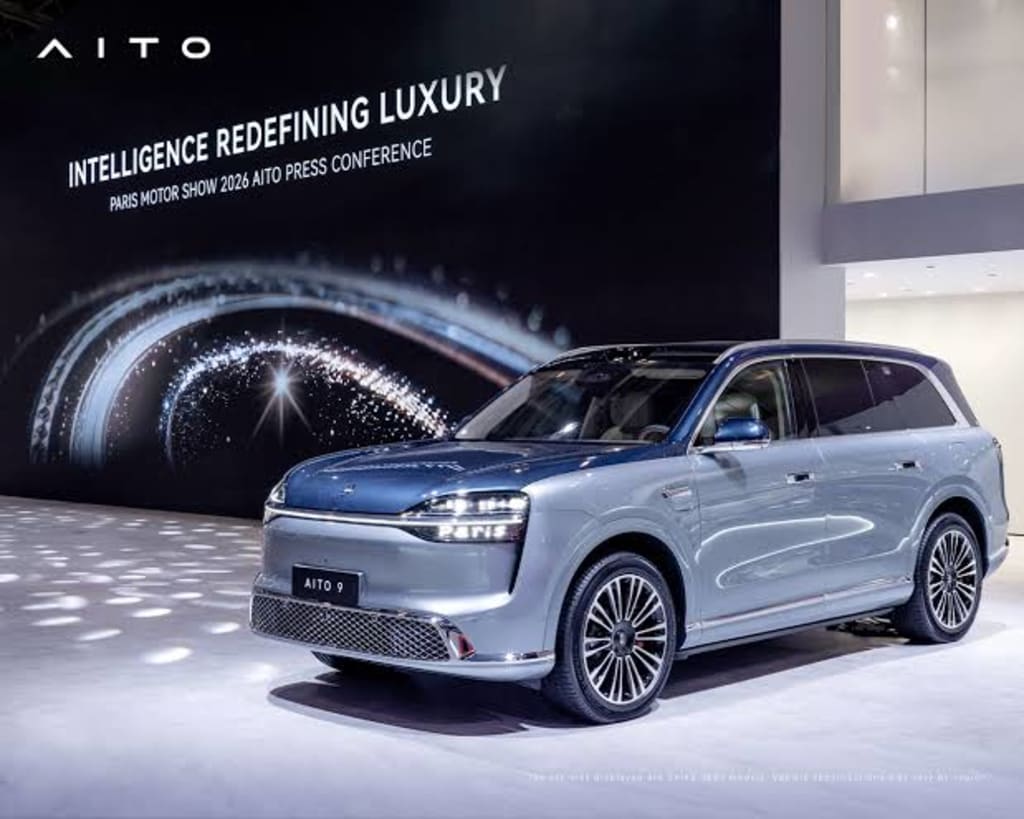
At the 2026 Paris Motor Show, AITO 5 through AITO 9 lined up. Seres Vice President Kang Bo gave the timetable: enter the European market in autumn 2027. WVTA EU Whole Vehicle Type Approval has started. Product development targets Euro NCAP 2026 five-star. AITO wants overseas sales to reach 20% of total sales within three years. Today that share is less than 1%.
Those numbers point to one goal: Seres wants AITO to become a global brand, not only a Chinese one.
Europe is not an extension of the domestic market. AITO’s three pillars in China (Huawei channels, Huawei brand, and smart-driving premium) face separation, prohibition, and consumer resistance in Europe. The rest of this piece breaks that down across five areas.
Price: the M9 is pushed by tariffs into direct battle with BBA
The EU imposes countervailing duties on Chinese-made pure EVs. On top of the 10% base tariff, the additional rate can reach 35.3%. The combined rate can reach 45.3%. The AITO M9 starts at about RMB 500,000 in China. At that tax rate, the terminal price rises to EUR 70,000 to EUR 80,000. That puts it in the same range as the Mercedes-Benz GLS and BMW X7.
In low-tariff markets such as Central Asia, Chinese brands still have a cost-performance advantage. In Europe, an EUR 80,000 price tag forces a choice between a new Chinese brand and a GLS or X7 with decades of brand equity. German launch coverage put the M9 starting price near EUR 150,000 and questioned whether buyers would pay it.
The trade environment can still change. A CLSA report describes two scenarios. In the optimistic one, China accepts price self-discipline in exchange for a low-tariff quota. In the pessimistic one, countervailing duties extend to plug-in hybrids and even hybrids. The average punitive tariff could rise to 21% and cover all new energy models. Seres has no localized European production and exports complete vehicles. Its pricing can be redefined at any time.
Brand and channels: from Huawei backing to starting from zero
One of AITO’s main advantages in China is Huawei’s nationwide retail network and brand endorsement. That advantage does not exist in Europe. It is being cut off. AITO has confirmed that starting January 1, 2027, it will withdraw from HarmonyOS Intelligent Mobility and Huawei specialty stores. Seres will lead the channels. In European AITO brand communications, Huawei never appears.
Seres faces a new car brand in Europe. European consumers prefer century-old brands. That preference is structural. AITO has more than 1.2 million users in China. To an ordinary European buyer, it may look less familiar than a niche EV brand that arrived two years ago.
Brand trust needs infrastructure: local sales companies, spare-parts warehouses, diagnostics, warranty policies, left-hand and right-hand drive configurations, and charging solutions. These take longer than WVTA. BYD sold more than 120,000 vehicles in Europe in the first four months of 2026, up nearly 100% year on year. It spent EUR 4 billion on a Hungarian plant and built channels in five core markets. For AITO to reach 20% overseas sales within three years, it needs comparable production and channel coverage first.
Compliance: a certificate is only an admission ticket
Seres has prepared on compliance. In December 2024, it obtained UN-R155 cybersecurity management system and UN-R156 vehicle software update management system certificates from the Netherlands Vehicle Authority (RDW). The basic framework exists.
WVTA certification is more than one certificate. It covers crash safety, emissions and energy consumption, electromagnetic compatibility, noise, pedestrian protection, braking, and active safety. Intelligent systems add UN R155 cybersecurity and UN R156 software update management. Driver assistance involves UN R171 rules. Geographic and user data must be stored and processed locally under GDPR. AITO plans to adapt four models at once, M6 through M9. Certification work, software localization, EU-spec sensors, and map solutions all have to be redone.
Huawei’s association adds scrutiny. Huawei-related technology triggers 5G security and supply chain reviews in some European markets. Making Seres the vehicle and brand entity and reducing Huawei to technology supplier lowers some brand-level associations. Smart-driving hardware and software, vehicle-cloud connectivity, and OTA still must be re-declared under EU technical documents. Geopolitical doubts do not disappear just because the entity changes.
GDPR fines can reach EUR 20 million or 4% of global annual turnover, whichever is higher. EU regulators fined a Chinese automaker EUR 180 million for failing to delete EU users’ driving trajectories. GDPR data compliance certification alone costs EUR 100,000 to EUR 300,000 per year. Local employment compliance adds 15% to 30% to labor costs. At NIO, 36% of per-vehicle sales cost in Europe comes from compliance. Compliance is a fixed cost of ongoing operations. It is heavy when initial sales are limited.
Intelligence: China’s biggest card, Europe’s question mark
AITO’s main selling point in China is Huawei’s Qiankun smart driving and HarmonyOS cockpit. European consumers see autonomous driving differently. The gap is large.
An XPeng survey of more than 5,000 respondents in six European countries found that only 13% would try a fully AI-controlled autonomous vehicle. In China, that figure is 70%. In Europe, 53% trust AI decision-making in cars very little or not at all. 61% list losing human control as a main concern. European driver research found that 40% do not plan to buy and 39% do not plan to use conditional autonomous driving. In Germany, only about 10% of luxury car customers would pay up to EUR 3,000 for an autonomous driving option.
Brian Gu of XPeng says Europe waits for more contact, not more features. What changes views is a system where humans can still issue commands and boundaries are clear. If AITO brings its domestic multi-lidar plus urban NCA package to Europe unchanged, it must pass three tests at once: explainable algorithms, data that stays in the EU, and compliant remote upgrades. The product logic needs reconstruction, not adaptation.
Financials and rhythm: cash reserves do not equal the capability-building cycle
There is tension between Seres’s finances and the investment needed for a European push.
In the first half of 2026, Seres reported a net loss of RMB 1.717 billion. Net operating cash flow was negative RMB 12.376 billion, down 185.73% year on year. In the first quarter, net operating cash flow was negative RMB 20.95 billion. That was nearly 2.75 times the negative RMB 7.63 billion from the same period a year earlier. Vehicle sales collections were slower than supplier payments.
Overseas revenue is shrinking. Seres overseas revenue fell from RMB 4.976 billion in 2023 to RMB 2.398 billion in 2025. In the first half of 2026, overseas revenue was RMB 1.053 billion, or 1.83% of total revenue. Overseas assets fell from RMB 13.698 billion at the end of 2025 to RMB 2.901 billion at the end of June 2026. The globalization layout is still in an early investment stage.
Seres management has said the overseas strategy starts with neighboring countries and advances one by one. Central Asia comes first. The long-term goal is overseas sales at 30% of company sales. The overseas AITO M9 infotainment system has been localized. Maps and Huawei ADS advanced smart driving are deployed. Central Asia first is a way to validate the overseas model in low-tariff markets and build localized operations.
NIO entered Europe with direct sales and invested about RMB 200 million to RMB 300 million per country in the early stage. It then slowed expansion and turned to local partners. NIO has been in Europe for less than three years. In Germany, it registered six vehicles in the first two months of 2026. Its German net loss in 2023 was EUR 58 million. A 100,000-unit plant in Europe would cost RMB 20 billion to RMB 30 billion in the early stage. Seres has RMB 73.15 billion in cash and interest-bearing debt at 3.2% of assets. That gives it room. Cash does not skip the capability-building cycle.
Conclusion: autumn 2027
Toyota lost money for nearly 10 years entering the U.S. market. Hyundai gained a firm foothold only after its Alabama plant opened in 2005. Seres’s European story needs the same patience.
The 2026 Paris Motor Show display is the start. Autumn 2027 is when European sales begin. In the EUR 80,000 range, the M9 sits beside the GLS and X7. European consumers have no established reason to add a new name to that list. Advertising will not give them one. Time, channels, compliance, product, and cash flow will.
About the Creator
Jin
Writer of reamstories
https://reamstories.com/jin
Enjoyed the story? Support the Creator.
Subscribe for free to receive all their stories in your feed. You could also become a paid subscriber, letting them know you appreciate their work.
Comments
There are no comments for this story
Be the first to respond and start the conversation.