
850,000 Car Owners Left in Tears: The EV Bankruptcy Nightmare No One Warned You About
When the company that built your smart car goes bankrupt, the warranty dies, the app stops working, and the car you paid for slowly turns into a very expensive paperweight.
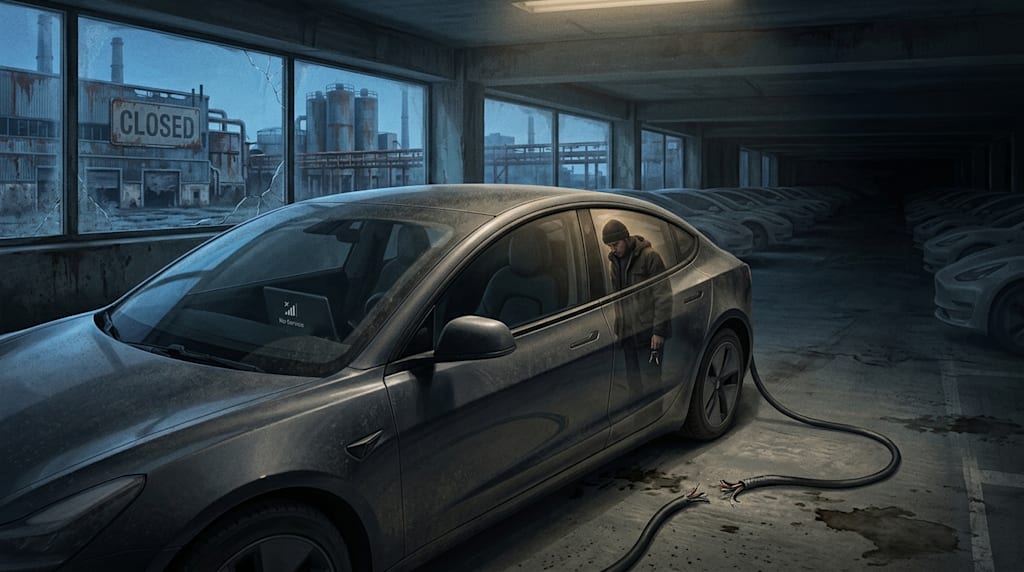
23 EV makers have exited, and 850,000 “orphan cars” reveal a systemic test of the after-sales system for smart electric vehicles.
1. A car, keys in hand, but not necessarily yours
A car is parked downstairs. The keys are in your hand. The registration certificate bears your name. Legally, it belongs to you.
But in the era of smart electric vehicles, whether a car can be driven, how long it can be driven, whether it can be repaired affordably, and whether it can be sold may not be entirely up to the owner. What determines the fate of the car, beyond hardware such as the battery, motor, and electronic control system, are the automaker’s servers, diagnostic systems, parts supply chain, authorized repair network, and cloud services. When the automaker is alive, these capabilities exist like air, and owners barely notice them. Once the automaker falls, the air is sucked away, and the vehicle becomes half-crippled without anyone realizing it.
As of May 2026, 23 domestic new energy vehicle companies in China are in bankruptcy liquidation, failed reorganization, or effective total shutdown. The cumulative number of legally sold vehicles still on the road is about 850,000. Behind this number are 850,000 families, 850,000 purchase contracts, and 850,000 expectations once placed in “smart mobility.”
They are called “unfinished cars,” or “orphan cars.”
“Turning into scrap” is an exaggerated complaint voiced by angry owners. But the reason this phrase spreads so quickly is that it precisely captures a reality: after an EV maker goes bankrupt, owners do not simply face “no one managing things.” They face the collapse of an entire after-sales system.
In the era of fuel vehicles, when an automaker exited the market, owners might merely lose the original factory channel. In the era of smart EVs, when an automaker exits, owners may lose part of the vehicle’s soul.
2. 23 carmakers exit: after the windfall, who was swimming naked?
The 23 NEV makers that have exited were almost all once in the spotlight.
WM Motor, HiPhi, Aiways, Qoros, Enovate, Niutron, LVCHI. Among these names, some were once seen as dark horses among new forces, some were backed by traditional automakers, some became famous overnight with high-end positioning, and some told grand stories in the capital markets.
Their common trait was also obvious: during the explosive growth period of the NEV industry, they expanded rapidly on financing, building factories, rolling out channels, launching new cars, and shouting slogans. But in the subsequent price war, technology war, and scale war, they failed to gain a firm foothold. Once cash flow broke, suppliers stopped supplying, factories halted, employees left, stores closed, and the companies ultimately moved toward bankruptcy liquidation or effective shutdown.
When a company exits, capital can cut losses, executives can turn around, and suppliers can write off bad debts. But owners who have already bought cars find it hard to cut losses.
What they face is this: official 4S stores closed, customer service calls unanswered, and promises made at purchase, including lifetime warranty, lifetime OTA upgrades, and free connected-car services, all canceled. For WM Motor and Aiways alone, complaints about invalid warranties and no place to repair have exceeded 100,000 cases.
This is not one company’s crisis. It is a systemic risk for the entire industry.
When NEVs change from mechanical products into integrated hardware-software smart terminals, the automaker is no longer just a manufacturer. It is also a service provider, a data company, a cloud service provider, and the sole entry point to the after-sales system. Once that entry point closes, owners are trapped in a room with no exit.
3. Why does an NEV become half-crippled when the carmaker falls?
To understand the plight of 850,000 owners, one must first understand a fundamental difference: fuel vehicles and smart EVs are two completely different industrial logics.
In the fuel-vehicle era, when an automaker went bankrupt, owners were certainly affected. Original parts became scarce, 4S stores closed, and warranties became void. But the core of a fuel vehicle is its mechanical structure: engine, transmission, chassis, body. Although there are brand differences, overall interchangeability is relatively high. The aftermarket parts supply chain is mature, and ordinary repair shops can handle most faults. A fuel vehicle discontinued for more than a decade can still run as long as parts exist.
Smart EVs are not like this.
They are essentially smart terminals on wheels. The three core electric systems are highly customized, software services are deeply tied in, and repair permissions and data interfaces are controlled by the automaker. Many vehicle functions are not realized by mechanical switches but by code, sensors, controllers, and cloud servers working together.
This means that after an automaker goes bankrupt, the after-sales chain breaks simultaneously at three levels:
First, the technology lock. Fault codes, diagnostic programs, and repair manuals for the three core electric systems are mostly encrypted by the automaker. Third-party repair shops without original authorization cannot accurately read faults or safely disassemble and repair them. Batteries, motors, and electronic controls are not things an ordinary repair shop can touch casually.
Second, the data lock. Navigation, remote control, automatic parking, online audio and video, voice assistants: these functions depend on the brand’s dedicated cloud servers. Once the servers stop, the car’s brain is gone. Smart features that once cost extra may become decorations overnight.
Third, the supply chain lock. Exterior parts, body wiring harnesses, and dedicated electronic control components of NEVs are often custom-made by the brand, with no universal aftermarket parts. When the automaker stops production, the parts supply chain breaks. Owners can only search owner groups for salvaged parts or watch their car sit in a repair shop waiting for a part that never arrives.
So when a fuel-vehicle automaker goes bankrupt, owners lose original factory service. When an NEV automaker goes bankrupt, owners lose the vehicle’s full usability.
This is why 850,000 owners are so anxious. They are not being dramatic. They have seen ahead of time a cruel reality: the car they bought for tens or hundreds of thousands of yuan may be turning into a half-wrecked asset that is expensive to repair, functionally incomplete, and hopeless in resale value.
4. Four real dilemmas: from warranty to insurance, every line falls
After an automaker goes bankrupt, the dilemmas owners face are not single but layered.
1. The three core electric system warranty becomes void, and repair costs are sky-high
At purchase, the salesperson’s most common line is: “Lifetime warranty for the three core electric systems.”
But after bankruptcy, that line becomes a blank check. What is worse, the three core electric systems are not something ordinary repair shops can fix. Fault codes are encrypted, diagnostic programs are closed, and original authorization is missing. Even if a third-party shop wants to repair, it often does not know where to start.
If the power battery or motor has a serious fault, owners can only buy salvaged parts. The price of a single battery pack often reaches one-third or even half of the original car price. After doing the math, many owners simply give up on repair.
A car’s life cycle ends early because of one battery. This is not a technical problem. It is an economic problem after the after-sales system collapses.
2. Original parts supply is cut off, and even basic repairs become difficult
If a three-core-system fault is a major disaster, then the cutoff of exterior parts, wiring harnesses, headlights, and electronic control components is daily torture.
Some owners waited months after a headlight was damaged and still could not find suitable parts, repeatedly asking in owner groups whether anyone had salvaged parts. Someone joked: “In the past, buying a car meant maintaining it. Now it means doing archaeology.”
This is not an isolated phenomenon. NEVs use a large number of customized parts. Once production stops, supply stops. There are no aftermarket parts, no universal parts, and the repair cycle is stretched indefinitely. The car can still be driven, but every minor accident can turn into a major hassle.
3. Smart features are collectively bricked, and the cabin becomes a radio
The smart cabin is one of the biggest selling points of NEVs. Large screens, voice control, navigation, audio and video, remote control, driver assistance: these features make the car look like the future.
But the future is built on servers.
When the automaker goes bankrupt, cloud services stop, the car system cannot update, navigation fails, remote control stops working, and online audio and video become unavailable. The originally tech-filled cabin may be left with only basic driving functions and local music playback.
Owners bought a smart car and ended up with a radio that can drive.
This gap is more painful than a mechanical fault. It means that the software value you once paid for was zeroed out the moment the brand died.
4. Asset value collapses, and even insurance is restricted
After an automaker goes bankrupt, the used-car market reacts quickly.
Dealers mostly refuse to buy unfinished cars because they are hard to repair, hard to source parts for, and hard to resell. When owners try to sell, the offer may be heartbreakingly low. A car bought for tens or hundreds of thousands of yuan a few years ago may now be hard to sell for even 20,000 yuan. In the industry, a phenomenon has even appeared: selling parts is more valuable than selling the whole car.
Insurance also becomes restricted. Because repair costs cannot be controlled, some insurers are unwilling to underwrite vehicle damage insurance for orphan cars. Owners can only buy compulsory traffic accident liability insurance and drive with the bare minimum. Once an accident occurs, the risk falls entirely on the owner.
From warranty to repair, from smart features to asset value, and then to insurance protection, every line of defense for owners is falling.
5. Why has the legal 10-year parts supply rule failed?
China’s motor vehicle maintenance regulations clearly stipulate that after an automaker stops production and sales of a model, it must guarantee parts supply for 10 years.
This rule played an important role in the fuel-vehicle era. But in the context of NEV automaker bankruptcy, it is almost useless.
The reason is that after a company enters bankruptcy liquidation, asset repayment follows a strict priority order. Employee wages, social insurance, taxes, and secured claims come first. Consumer after-sales rights are ordinary claims, with very low priority.
Take WM Motor as an example. Its total liabilities exceed 25 billion yuan, while its recoverable assets are only 9.6 billion yuan. Even priority claims cannot be fully repaid, let alone owners’ after-sales rights.
In other words, the law says 10 years of parts supply, but when a company cannot even pay wages and taxes, that rule loses its basis for enforcement.
The law did not fail to write it down. Bankruptcy reality is too cruel.
In bankruptcy proceedings, consumers are dispersed, weak, and last in line. They have no collateral, no priority, and no bargaining chips. At the moment the company’s balance sheet collapses, all those beautiful promises made at purchase become a line item among ordinary claims.
6. Are there paths to a breakthrough?
At present, there is no unified bailout plan for the industry. But some cases and institutional explorations are pointing the way forward.
1. Shareholder bailouts: the cases of JiYue and Hycan
After JiYue imploded, shareholder Geely took over after-sales maintenance for owners. After Hycan halted operations, GAC Group took over after-sales service for its existing vehicles.
These cases matter because they prove that when a brand is backed by a strong, reputation-conscious major shareholder, after-sales does not necessarily break completely.
But the problem is that such bailouts are voluntary shareholder actions, not universal. Not every bankrupt automaker has a Geely or GAC as a shareholder, and not every shareholder is willing to bear after-sales costs for a sub-brand.
2. Policy breakthrough: opening third-party repair rights for the three core electric systems
In April 2026, a joint interim measure issued by six government departments, the Interim Measures for the Management of Recycling and Comprehensive Utilization of Waste Power Batteries from New Energy Vehicles, officially took effect, mandating open third-party repair rights for the three core electric systems.
This means that repair data and technical permissions for batteries, motors, and electronic controls, once monopolized by automakers, are beginning to open to qualified third-party repair institutions.
This is one small step, and one giant leap.
Only by breaking the technical blockade can the third-party repair market grow, giving orphan cars a place to be repaired and making repairs affordable.
3. After-sales deposit system: making carmakers pay for exit in advance
The industry is pushing to establish an after-sales deposit system for NEVs. Simply put, automakers would be required to set aside a certain proportion of funds based on sales volume and deposit them into a special account to maintain basic after-sales service after the company exits the market.
This is equivalent to buying after-sales insurance for car owners. While the automaker is still making money, it reserves funds for the risk of a future exit.
If this system can be implemented, the situation of automaker goes bankrupt, owners suffer may be alleviated in the future.
4. Owner self-rescue: from waiting to acting
For owners who have already bought unfinished cars, more practical self-rescue measures include:
Joining official owner groups to share salvaged-parts resources;
Choosing third-party institutions qualified to repair the three core electric systems for routine faults;
Completing creditor registration in bankruptcy liquidation proceedings to seek corresponding compensation;
Keeping all purchase, repair, and warranty documents as evidence for future rights protection.
These measures cannot solve the problem completely, but at least they give owners a bit more control in a difficult situation.
7. EV buying guide: how to avoid an orphan car
The lesson of 850,000 owners is, for latecomers, most valuable as a reminder: when buying an EV, do not look only at range, acceleration, big screens, and smart driving. Also look at whether the after-sales system can survive until you drive the car into the ground.
Here is a practical guide to avoiding pitfalls.
1. Prioritize brands backed by major manufacturers
Brands backed by a traditional major group or a consistently profitable leading company generally have more stable after-sales protection.
For example:
BYD: Large ownership base, dense service network, strong independent supply chain;
Geely ecosystem (including Zeekr, Lynk & Co, etc.): Has precedent of group-level after-sales bailouts;
GAC ecosystem (Aion, etc.): Has a record of taking over after-sales for sub-brands;
NIO: Service system has a good reputation, and the battery-swapping network is a core advantage;
AITO: Deeply empowered by Huawei, with strong product experience and channel capabilities.
This is not to say these brands will never have problems. It is that when they do, shareholders, groups, supply chains, and channel systems are more likely to provide a buffer.
2. Watch the brand’s financial health and sales scale
Sales volume is the foundation. Brands with persistently low monthly sales, say below 2,000 to 3,000 units, carry higher operating risk.
Also watch financial signals: sustained large losses, frequent layoffs, executive turmoil, unpaid suppliers, factory shutdowns, store closures. Individually, these stories may be noise. Together, they are an alarm.
3. Carefully review lifetime warranty terms
Many lifetime warranties come with conditions:
First owner only;
Annual mileage cap;
Must be serviced at authorized shops;
May become void after an accident;
Wear parts not included.
Before buying, confirm clearly. Do not just listen to the salesperson’s verbal promises. Read the contract.
4. Understand the after-sales network and third-party repair support
Check the number and location of the brand’s authorized service centers locally. If a city has only one store, or none at all, after-sales convenience is questionable.
Also find out whether the brand’s models support third-party repair and whether technical data is open. After repair rights for the three core electric systems are opened, brands that support third-party repair will have stronger future risk resistance.
5. Look at ownership volume and used-car residual value
Models with a large ownership base have a more mature parts supply chain, easier third-party repair, and greater recognition in the used-car market.
Before buying, check the used-car price trend for the same brand and model. If a car loses more than half its value in a year, the market lacks confidence in it.
6. Keep all purchase and after-sales documents
Purchase contract, warranty certificate, repair records, payment receipts, chat records: keep them all.
Once the automaker has problems, these are key evidence for filing creditor claims and protecting your rights. Do not think it is a hassle. It can save you at a critical moment.
7. Do not make smart your only reason to buy
Smart cabins, driver assistance, and OTA upgrades are indeed attractive. But these functions depend heavily on the automaker’s continued existence.
Buying a car is first about buying a safe, stable, long-term means of transportation. Smart features are a bonus, not the only thing. If a car’s core value is entirely built on the cloud and software, its risk resistance may actually be weaker.
8. Conclusion: 850,000 cars won’t all become scrap, but the pain must be seen
The 850,000 vehicles will not all become immovable scrap.
Most can still perform basic transportation functions. The battery may still charge, the motor may still turn, the steering wheel may still respond. But the cost of use, the experience, and the asset value will all decline sharply.
This is a half-wrecked state: drivable but not reassuring; repairable but expensive; sellable but not at a price; insurable but with limited coverage.
This is the pain the NEV industry must endure as it moves from wild growth to maturity.
Over the past decade, capital poured in frantically, new brands emerged endlessly, and everyone raced for the next big thing, sales, and IPOs. But few seriously answered one question: If this company goes under, what happens to car owners?
Now, 850,000 car owners have thrown that question mark in the industry’s face with their plight.
A mature industry must not only build good cars but also handle everything after the car is sold. A responsible brand does not just shout lifetime warranty at launch events; it also leaves car owners a way out when it exits.
For automakers, after-sales is not a cost. It is credit.
For the industry, exit mechanisms are not scraps. They are infrastructure.
For consumers, buying a car is not just a purchase. It is a trust placed for more than a decade.
850,000 car owners left in tears should not be just a trending topic.
As EVs become more like phones, the industry must answer a question phones answered long ago: when a brand dies, who is responsible for the device in the user’s hand?
Before the answer becomes clear, everyone preparing to buy an EV should ask one more question:
“If this automaker is gone tomorrow, will anyone still take care of my car?”
About the Creator
Jin
Writer of reamstories
https://reamstories.com/jin
Enjoyed the story? Support the Creator.
Subscribe for free to receive all their stories in your feed. You could also become a paid subscriber, letting them know you appreciate their work.
Comments
There are no comments for this story
Be the first to respond and start the conversation.