
Why Do We Remember the Pyramids but Not the Ziggurats?
The answer isn't history—it's geology, media timing, and a golden mask that stole the show.
The Shadow of Stone
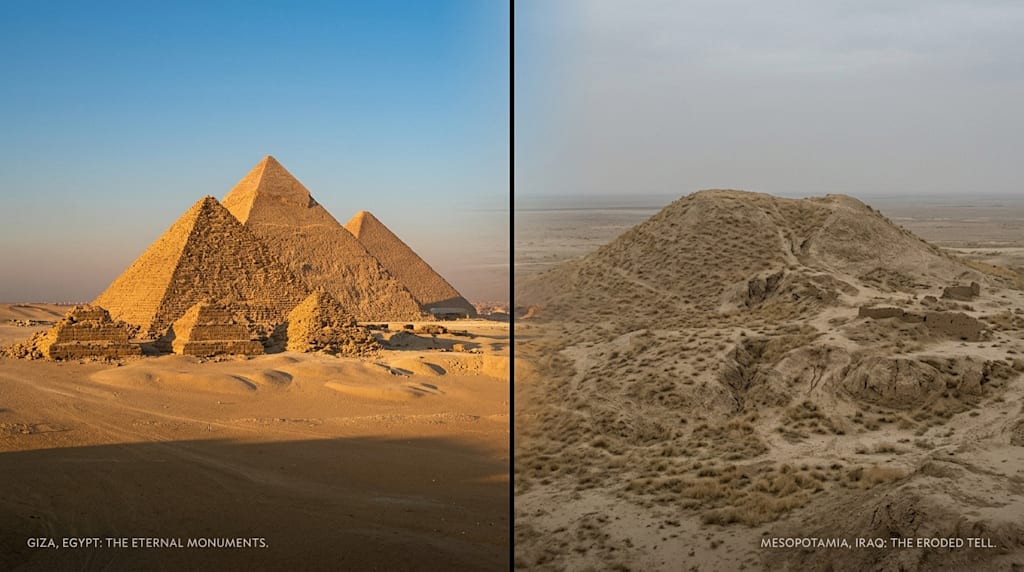
A modern man walks to the site of the Ziggurat of Ur, in southern Iraq.
He sees a mound of earth. Thorny camel grass grows on it; rain gullies run down its sides. The guide points to the mound and says that this was a wonder of the human world 4,300 years ago—the Sumerians built it with mud bricks, seven levels high, with a temple on top where priests could stand and see the Euphrates. The tourist stares at the mound for a long time, nods, and takes a picture. The picture shows only dirt.
Another modern man, in 1798, sails toward the port of Alexandria. Before he steps ashore, the triangle of the Great Pyramid rises above the horizon. The limestone glows white in the afternoon sun. It looks older than any church in Europe behind him—and it is, by more than three thousand years.
Egypt and Mesopotamia are separated not by time, but by geology.
The upper Nile has Aswan granite. The river valley has fine limestone. When the pharaohs built their eternal houses, they chose stone. Each block weighed two and a half tons; they stacked nearly two hundred layers. Egypt gets only a few millimeters of rain a year. The air is so dry that it wicks away every drop of moisture—the paintings in the tombs, the linen wrappings, the fabrics, all sealed as if put away yesterday. But the Mesopotamian plain is alluvium; there is no stone. The Sumerians fired mud bricks, bound them with reeds, and raised their great ziggurats. Those towers stood for two thousand years in the wind, then crumbled for three thousand in the rain. They returned to earth, to the flatness of the plain. Archaeologists come and dig out foundations and inscriptions, but that is not enough for an ordinary mind to conjure a "wonder." Standing on the mound, all he sees is a mound.
Egypt's advantages did not end there.
In 1799, Napoleon's soldiers dug a trench at Fort Rashid and unearthed a broken slab. That same expedition included 167 scholars and draftsmen. They traced the reliefs on the ceiling of the Temple of Dendera as copper engravings, copied the hieroglyphs from the corridors of the Valley of the Kings, and shipped the portfolios back to Paris. The hieroglyphs had eagles, snakes, beetles, eyes. Ordinary people could not read them, but one look made them feel that "there is a secret inside." Around the same time, the decipherment of cuneiform came nearly half a century later—and cuneiform looks like nails, triangles, and bars. It does not seduce the eye.
One hundred and twenty-three years later, the tomb of Tutankhamun was opened.
Howard Carter peered through a candle hole. The man behind him asked what he saw. Carter said, "I see wonderful things." That sentence, carried by radio waves, reached London, New York, and Sydney the same day. A newsboy in London shouted on the street, "The pharaoh's mask has been found." A housewife put down her iron and went to buy a newspaper. She could not read, but she could understand the photograph. In the picture was a golden face, eyes inlaid with obsidian and quartz, as cold as if they belonged to another world. It was the first time the whole world had watched the same archaeological site at the same moment. You did not need to know Egyptology. You did not need to know the pharaoh's name. One glance at that mask, and you were part of it.
The Royal Cemetery of Ur in Mesopotamia was excavated in the late 1920s. It yielded a golden lyre inlaid with lapis lazuli, a golden helmet, strings of beads. Exquisite, splendid, costly. But the lyre had no "face." The golden helmet was just a hat. The media age needs a face to carry empathy. Egypt gave it a golden mask. Mesopotamia gave it a pile of "things."
There is another secret to Egyptian art: it is extremely simple.
Frontality: side face, frontal eye, frontal shoulders, side legs. A five-year-old child, picking up a crayon for the first time, draws a person exactly like that. This two-dimensional, flat, cut-out style requires no artistic training to recognize, copy, or rework. The pyramid is a triangle. The pharaoh's headdress is blue-and-gold stripes. The scarab is an oval with a few lines. These shapes can be printed on billboards, turned into game icons, shrunk into mobile emojis. They work at any scale. But the winged bulls with human heads from Assyrian palaces are three-dimensional—muscles twisting, perspective foreshortening, masterful carving—yet they fall into an awkward middle: less refined than Greek sculpture, less strange than Egyptian wall paintings. They are neither universal nor exotic. They are stuck in the visual stockroom.
There is one deeper reason.
Egyptian civilization ended in 332 BCE, with Alexander. After that came Greeks, Romans, Arabs. Today, the people on the streets of Cairo speak Arabic and follow Islam. Their birth certificates and marriage licenses carry no hieroglyphs. Between pharaonic Egypt and modern Egypt lies a clean break.
Because of that break, storytellers around the world can use Egyptian elements freely, without fear of offending anyone. Screenwriters can turn pharaohs into zombies, Anubis into an alien, the pyramids into energy emitters. In 2011, in Tahrir Square, someone painted a pharaonic mask on a protest sign; another person spray-painted beside it: "This is not our ancestor." At the same time, on a Hollywood set, a makeup artist glued a false beard and blue-and-gold stripes onto an actor. The actor looked in the mirror and said, "This doesn't look like anyone alive." The Egyptians were arguing among themselves. Hollywood was playing. Neither cared much about the other.
Compare that with China. Between a modern Chinese person and the oracle bones of three thousand years ago, there is no such break. Mention "China," and you face the Twenty-Four Histories, dynastic cycles, Confucian ethics—these are alive, they have weight, they cannot be reduced to an empty symbol like a pyramid. Modern Greeks are not identical to the ancient Greeks either, but the West, since the Renaissance, has claimed Greece as its own spiritual bloodline. You cannot make Socrates the villain of a horror film—that would be mocking your own rational foundation.
Egypt sits exactly in that slot: it is the ancestor of human civilization, but it is not my ancestor. It is far enough to host any fantasy. It is close enough that a European could sail to its stones.
Herodotus sailed to Egypt in the fifth century BCE and wrote a sentence that has been quoted countless times: "No country has so many wonders." That sentence was repeated by every generation of European travelers, until something subtle happened: it was no longer Egypt speaking—it was Herodotus's sentence speaking. Egypt was buried under that sentence.
In the second half of the twentieth century, the land of Mesopotamia became Iraq and Syria. Oil, war, sanctions, rubble appeared on the news. When the word "Iraq" enters the mind, what jumps out first is fire and ruin, then Babylon—and Babylon lies underneath the ruin. If a region is too dangerous for tourists, its ancient past is locked in museum basements, out of reach of the popular imagination.
Finally, Hollywood divided the tracks.
Greece was assigned to "mythological fantasy" and "philosophical reflection"—it needs dialogue and explanation. Rome was assigned to "power intrigue" and "gladiatorial slavery"—it needs political background and class narrative. Egypt was assigned to "treasure-hunting adventure" and "supernatural horror." The pyramid interior is a ready-made vertical labyrinth. The mummy's resurrection is an aristocratic version of the zombie. Scarab beetles devouring flesh are the embodiment of trypophobia. No dialogue needed, no history lesson—as soon as a linen-wrapped body pushes open a stone sarcophagus lid, the audience knows which way to run.
The first Mummy was filmed in 1932. The set's pyramid corridor was too narrow, and Boris Karloff's headpiece got stuck in the doorframe. The director did not call cut; he kept the clumsy turn. Audiences later assumed that was the "stiff movement" of a mummy. A stage accident became the grammar of a genre. Every mummy since has walked with that rhythm.
Back to the opening question.
Why Egypt?
Because the tourist who takes a picture in front of that Iraqi mound, and the man who saw the pyramid's triangle rise above the horizon in 1798—they saw two entirely different things. One saw "once was." The other saw "still is."
The ziggurat of Sumer returned to dust. The stone columns along the Mediterranean were toppled by earthquakes and then hauled away by quarrymen. Chinese civilization runs like a great river, still carving its own bed. Greece and Rome have dissolved into the air we breathe and the bricks of our daily walls—you walk past the courthouse portico every day and do not call it Greek; you just call it "columns."
Only the pyramid. Four thousand years. When the sun hits it, the shadow is still that shape.
About the Creator
Jin
Writer of reamstories
https://reamstories.com/jin
Enjoyed the story? Support the Creator.
Subscribe for free to receive all their stories in your feed. You could also become a paid subscriber, letting them know you appreciate their work.
Comments
There are no comments for this story
Be the first to respond and start the conversation.