
The Ruins We Name: Why Only Financial Centers Become “Ruins”
Detroit rusted. Venice emptied. Hong Kong got a meme. The phrase says less about buildings than about trust.
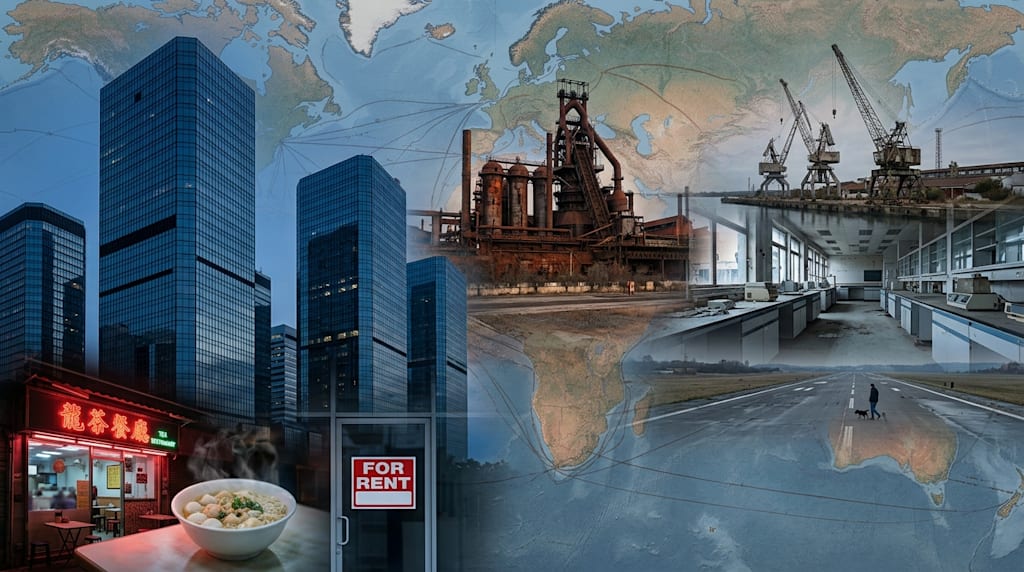
On Queen’s Road Central, a brokerage has a “For Rent” sign by the door. Inside, the reception computer is still on. The screensaver is the company logo. The security guard says last month people worked until two in the morning. This month the lights go off at six. Downstairs, the woman who runs the tea restaurant has changed “Today’s Soup” to “Today’s Special.” She does not follow IPOs. She only knows the fish-ball noodles are selling slower.
People call this “financial center ruins.”
At first the phrase sounded like a joke. Then it became a label. But the question remains: Was Detroit not industrial center ruins? Is Venice not shipping center ruins? Why is only the financial center called ruins?
The answer lies in what a financial center is made of. It does not run on blast furnaces or docks or patents. It runs on invisible conditions. Money enters safely. Money leaves freely. Contracts hold. Disputes get judged somewhere. Taxes stay low. Visas do not stall. The time zone fits. The language works. Stack those conditions together and you get credit. When credit is present, glass towers are a center. When credit recedes, glass towers are just real estate.
Industrial centers have a different fate. They have factories, railways, mines, workers’ neighborhoods. In Detroit, car plants moved away. Machines were dismantled. Foundations remain. In the Ruhr, blast furnaces went cold. Steel frames remain, and later became climbing walls. In northern England, textile mills emptied. Brick walls remain, now selling antiques and coffee. Around the Great Lakes, Pittsburgh and Cleveland turned old steel plants into parks and warehouses into apartments. In Hanwang, Mianzhu, chimneys still stand beside earthquake ruins. People call these places the Rust Belt, old industrial bases, industrial heritage. The phrase “industrial center ruins” rarely appears because industrial decline is ordinary. It arrives like a season.
Ports follow routes. Beside the old docks of Venice, tourists buy refrigerator magnets. In Genoa, cranes rust into sculpture. In Mocha, the coffee trade scattered. The port remains. The ships stopped coming. Ostia and Ephesus became archaeological sites. Guides hold little flags and say this was once Rome’s granary. People call these abandoned ports or shifted routes. They do not call them shipping center ruins because port fortunes move with maps. Water is too shallow. Ships grow larger. Canals change course. Hinterlands switch economies. The port grows old.
Tech centers depend on living people: professors, engineers, patent lawyers, venture capitalists, immigrants. In China, many health cities, medical cities, and big-data cities have glass doors with rental notices, dusty lab benches, empty incubator reception desks. People call them unfinished tech cities or vacant industrial parks. Baikonur still launches. Its budget shrank. The empire is gone. Brains can leave, so tech ruins do not feel as heavy as factory ruins. They do not feel as prophetic as financial ruins.
Airports leave a different scar. Kai Tak moved away in 1998. Planes no longer fly low over Kowloon City. The old runway became a park. People walk dogs there. They run. Hotels changed guests. Chek Lap Kok still operates, and its cargo ranking remains high. But Kai Tak became a postcard. Atarot closed. Nicosia was abandoned. Ciudad Real in Spain sat half-finished. Dubai and Abu Dhabi rise and fall with routes and capital. People call them old airports or abandoned airports. When routes leave, duty-free shops close, hotels empty, and the city looks like a vein has been pulled out.
Hong Kong is not industrial center ruins. Manufacturing moved north. Old industrial districts remain. Hong Kong is not shipping center ruins. Port throughput ranking has fallen, but ships still arrive. Hong Kong is not tech center ruins. Its tech base is weak, but weak is not ruined. To call Hong Kong financial center ruins is internet mockery and political metaphor. It is not an economic conclusion.
Tokyo is not ruins. It remains Japan’s headquarters, finance, research, high-end manufacturing, shipping, and aviation hub. After the bubble burst, it entered long-term low growth. That is not ruin. Singapore is even less so. It is a top shipping and financial center. Manufacturing is about one-fifth of GDP. Electronics, chemicals, biomedicine, and oil refining are strong. It is strengthening its center, not becoming ruins.
Milan, Munich, and London are not industrial center ruins. London deindustrialized and turned to finance, services, creative industries, and technology. Munich is a high-end manufacturing city. Milan is fashion, design, finance, and industrial services. Huizhou and Pingyao were premodern merchant and draft-bank centers, not modern financial centers. Venice, Florence, and Genoa were compounds of commerce, shipping, and finance. They are not financial center ruins in today’s sense.
So why did “financial center ruins” break out? Because Hong Kong sits at the center of Chinese-language public opinion. It connects China and the world. It carries offshore renminbi, IPOs, asset management, multinational headquarters, common law, free port status, aviation, and shipping. When people say “financial center ruins,” they are not saying the buildings collapsed. They are saying relative advantage is receding, institutional expectations are shaking, and geopolitical anxiety is rising.
Naming is a way of looking. The agricultural age left abandoned terraces. The industrial age left the Rust Belt. The shipping age left abandoned ports. The information age left unfinished data centers. The financial age left financial center ruins. Which word we choose depends on what we fear, what we miss, and what we mock.
Factory ruins show the past. Port ruins show the map. Tech ruins show ambition. Financial ruins show expectation. That last one stings because it is the least physical and the most reversible.
The foundation of a financial center is trust. Concrete matters less. Its wall is institution. Tariffs matter less. Its moat is expectation. Geography matters less. When trust recedes, when institutions are doubted, when expectations turn, even the tallest buildings become a row of glass waiting to be reinterpreted.
The elevators in Central still go up and down. Someone presses G. Someone presses the top floor. The woman at the tea restaurant changes “Today’s Soup” to “Today’s Special.” The pothos has withered. Administration has not replaced it. The security guard turns off the lights at six. The fish-ball noodles are selling slower.
About the Creator
Jin
Writer of reamstories
https://reamstories.com/jin
Enjoyed the story? Support the Creator.
Subscribe for free to receive all their stories in your feed. You could also become a paid subscriber, letting them know you appreciate their work.
Comments
There are no comments for this story
Be the first to respond and start the conversation.