
The Real Reason Hong Kong Is Called HK, Not XG
A village name, a treaty, and a set of letters the world never bothered to change.
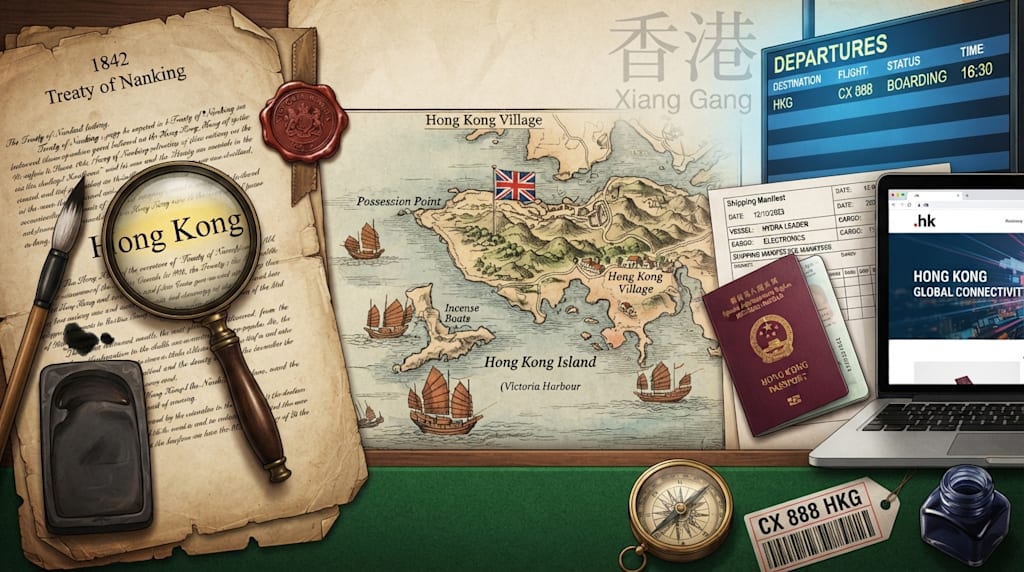
On the English page of the Treaty of Nanking in 1842, Hong Kong Island appears as Hong Kong. H capital, K capital, a space between. Qing officials signed in Chinese. British signed in English. That sheet went into the archive. Hong Kong stayed. Xiang Gang did not.
HK is the initials of Hong Kong. Hong Kong is an English place name. XG is the initials of Xiang Gang. Xiang Gang is Hanyu Pinyin. Two sets of letters, two timelines, two administrative systems.
1. Before Hong Kong Island, there was Hong Kong Village
In Ming texts, “Hong Kong” did not mean the whole island. It first named a small area on the southern part of Hong Kong Island, around present-day Aberdeen and Wong Chuk Hang. There was a port, a village, boats. One common account says incense wood from Dongguan was shipped and gathered there for transshipment, so the port became Hong Kong, “fragrant harbor.” Another says a nearby village was called Hong Kong Village, and the village name later spread.
At the time, Hong Kong Island had no single name. Old accounts mention Red Incense Burner Hill and other names. Fishing villages, Hakka villages, Wai Tau villages, and Tanka boat communities sat along the coast. For the people there, “Hong Kong” was one point, not a city.
2. 1841: The flag at Possession Point
In January 1841, British forces landed at Possession Point on the northwest side of Hong Kong Island, raised the British flag, and declared possession. Negotiations continued. War continued. In 1842, the Qing government ceded Hong Kong Island to Britain under the Treaty of Nanking.
The British needed a name. They heard “Hong Kong” from local people and wrote it in Latin letters as Hong Kong. The treaty fixed it in official documents. A village name became the official name of the island.
A popular story says British troops landed at Stanley, a Hakka villager named Chen Qun led them, and when asked the place name he answered “Hong Kong” in Hakka accent, so the British wrote Hong Kong. The story is vivid. The sources do not support it. Early British landing and flag-raising took place mainly at Possession Point, not Stanley. The Chen Qun story lacks reliable evidence.
Hong Kong did not come from one misheard word. It came from nineteenth-century Romanization habits used by Westerners recording Cantonese and local speech. There were no recorders, no IPA, no unified spelling system. Missionaries, merchants, diplomats, and naval officers used the letters they knew. Their spellings carried traces of English, Portuguese, Dutch, and other languages.
3. Missionary letters, merchant ledgers
Before Hanyu Pinyin existed, Westerners had been active along the China coast for centuries. They had to learn Chinese, preach, trade, litigate, and write treaties. They had to turn Chinese characters into Latin letters. Early missionaries and sinologists such as Morrison, Williams, and Eitel designed or used Cantonese Romanization systems.
Those systems had practical purposes: to let foreigners communicate with Cantonese speakers using Cantonese sounds. They were not designed for Chinese people. They were not designed for linguistic standardization. They served missionary work, trade, and colonial administration. Spellings were messy. One Chinese character could be written several ways. One surname could look completely different in different documents. 蔡 could be Choi, Choy, or Tsoi. 夏 could be Ha, or Shya.
After Hong Kong opened as a port, the colonial government had to manage streets, land, population, postal services, and shipping. It could not ask every time which Romanization system to use. So the administration gradually formed its own conventions: Hong Kong Government Cantonese Romanization.
This system does not mark tones. It does not aim at linguistic precision. It does not force one accent over all others. It asks for one thing: in government documents, the same place and the same name should preferably be written the same way. So Hong Kong, Kowloon, Tsim Sha Tsui, Tsuen Wan, Sha Tin, Tai Po, and Yuen Long were written again and again into maps, land deeds, postmarks, shipping manifests, and identity cards. They became fixed administrative spellings. Standard pinyin was not their job.
4. Government Romanization: built for governance
In the late nineteenth century, Hong Kong government departments such as surveying, land, postal services, police, and immigration gradually used the same spellings. Around 1960, the government published a gazetteer of Hong Kong, Kowloon, and the New Territories place names, standardizing spellings for municipal, transport, and immigration records. In the 1970s, the Royal Hong Kong Police issued a three-character Chinese commercial telegraph code handbook as an internal reference. After that, new streets, estates, and public facilities had to pass review by the Chinese section of the Civil Service Bureau and follow the same Latin transcription rules. Civil documents, household registration, and property papers followed official spellings.
The system has clear features. It does not mark tones. One sound can have multiple spellings. It accommodates Cantonese, Hakka, Wai Tau, and other local accents. It was used mainly in English administrative documents. It did not try to replace Chinese characters, only to provide external labels. It existed to run the city. Cantonese teaching was not its job. So it did not chase perfection. It chased operability.
Hong Kong place names in English are therefore uneven. Some come from Cantonese. Some come from local dialects. Some come from early Western habits. Some are simply customary. They lie in layers, pressed together, forming what we see today. Hong Kong is the piece that stayed.
5. Hanyu Pinyin came too late
In 1958, the People’s Republic of China officially promulgated the Hanyu Pinyin scheme. From then on, mainland place names, personal names, and publications gradually adopted Hanyu Pinyin. Peking became Beijing. Canton became Guangzhou. Amoy became Xiamen. In 1977, the Third United Nations Conference on the Standardization of Geographical Names adopted Hanyu Pinyin as the international standard for Romanizing Chinese place names.
Hong Kong was still under British administration. The Hong Kong government continued to use its own administrative Romanization. It did not switch to Hanyu Pinyin. In the 1980s and 1990s, Hong Kong entered the transition period before the handover. After 1997, under “one country, two systems,” the Hong Kong Special Administrative Region retained its previous legal, economic, and social systems, and its previous official language arrangements. English place names, street names, and personal-name spellings remained largely unchanged. So Hong Kong remained Hong Kong. Tsim Sha Tsui remained Tsim Sha Tsui. Kowloon remained Kowloon. Tsuen Wan remained Tsuen Wan.
Changing names was too expensive. Charts, treaties, airport codes, bank codes, company registrations, court judgments, shipping bills of lading, property deeds, passports, and visas were all tied to those letters. Change one letter, and you may disrupt decades of records and an entire international trade system.
6. HK, HKG, .hk
Today, HK is no longer just the initials of Hong Kong. It is an international standard code. ISO 3166-1 gives Hong Kong the alpha-2 code HK and the alpha-3 code HKG. The IATA code for Hong Kong International Airport is HKG. Hong Kong’s internet domain is .hk. The Hong Kong dollar is written HK$. Banks, shipping lines, insurers, and law firms repeat HK and HKG.
What would happen if Hong Kong were changed to XG? International standard codes would change. Airport codes would change. Domain names would change. Bank, shipping, insurance, and legal documents would change. Passports, visas, and identity card English names would change. Every historical archive, map, treaty, and judgment retrieval system would change. The whole world’s recognition of Hong Kong would have to be retrained. What would be gained? Only that the abbreviation would fit Mandarin pinyin better. Any government can do that math. Hong Kong will not be called XG. The change is possible. It is also pointless.
7. Jyutping, Yale, Government Romanization
Today, several Romanization systems coexist in Hong Kong. Hong Kong Government Cantonese Romanization is used for streets, household registration, identity documents, and public signs. Yale Romanization is often used in Cantonese teaching. The Linguistic Society of Hong Kong’s Jyutping, introduced in 1993, marks tones and is more precise, used in education, linguistics, and media annotation.
They have different jobs. Government Romanization does not mark tones and has multiple spellings for one sound; even locals often find it confusing. Jyutping covers initials, finals, and tones, and is better for academic work. None of them will replace Hong Kong. Hong Kong belongs to the international place-name system now.
8. HKG on the airport screen
Hong Kong International Airport, departures hall. The flight information screen flips. Flights departing Hong Kong show HKG at the front. A ground agent tears a baggage tag from the printer and sticks it on a suitcase. Below the barcode: HKG. A passenger hands over a passport. Inside, it reads Hong Kong Special Administrative Region. The gate announcement repeats in Cantonese, Mandarin, and English.
No one says Xiang Gang. No one writes XG. The letters stay. They record a small village, a war, a treaty, several Romanization systems, countless bills of lading and passports. Change one letter, and the archive of a whole city shifts.
About the Creator
Jin
Writer of reamstories
https://reamstories.com/jin
Enjoyed the story? Support the Creator.
Subscribe for free to receive all their stories in your feed. You could also become a paid subscriber, letting them know you appreciate their work.
Comments
There are no comments for this story
Be the first to respond and start the conversation.