
The Pinglu Canal Won't Build a New First-Tier City. The Software Problem Will Stop It.
Everyone is watching the water. The real story is in the failed factories, the missing investment judgment, and the graduates who keep leaving.
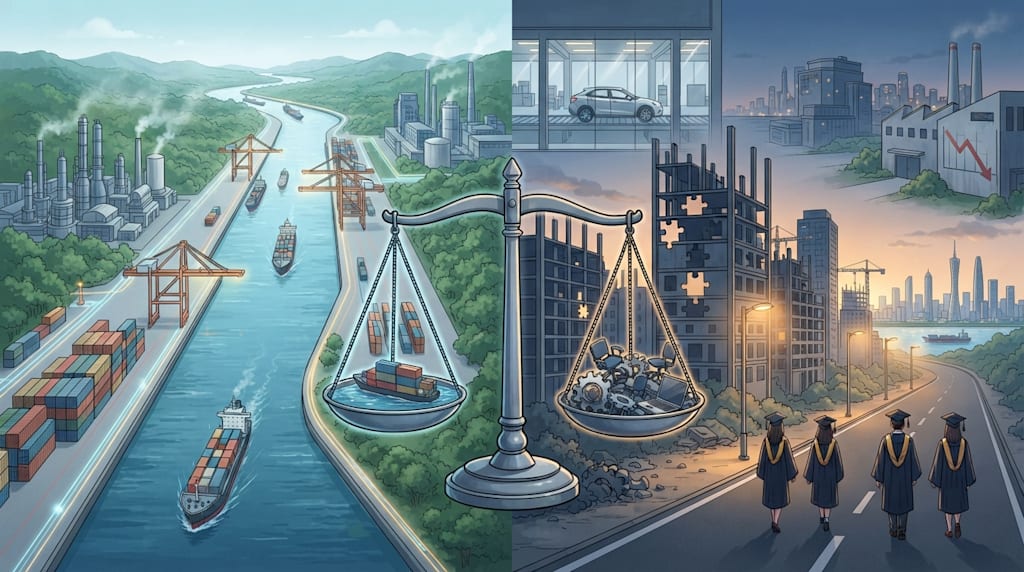
On September 16, 2026, the Pinglu Canal opened. The new 134.2-kilometer waterway runs from Pingtangjiang mouth in Hengzhou, Nanning, to the Beibu Gulf estuary at Qinzhou. It lets goods from the southwest reach the sea without detouring through Guangzhou Port. The voyage is more than 560 kilometers shorter. Total logistics costs fall by 18% to 30%. More than RMB 5 billion in transport costs can be saved each year. The project cost about RMB 72.7 billion and can handle 5,000-tonne vessels. It ends the southwest's old problem of rivers and sea not connecting.
When infrastructure like this opens, people ask a familiar question: will a new first-tier city grow along the water?
The real question is how much a canal can change a region's economic base. The Pinglu Canal can accelerate existing industrial and logistics advantages. It cannot create the industrial density, talent base, and institutional capacity a new first-tier city needs.
The canal has done what it can: filling in a piece of the hardware
Guangxi's coastal problem has a neat description: close to the sea but not reaching it. The main stem of the Xijiang River flows east toward the Pearl River Delta. Most of Guangxi's goods that go to sea first travel through Guangdong. The Pinglu Canal changes that. It connects the Xijiang system directly to the Beibu Gulf.
Some early industrial signals are already visible. At the Liujing Industrial Park in Hengzhou, Nanning, at the canal's starting point, 280 enterprises have settled. They form four port-adjacent clusters: high-end papermaking, new energy materials, green chemicals, and smart ships. BYD, Sun Paper, and France's Aisen Chemical have projects there. Thomas, Aisen's Nanning project director, said the canal was the key reason the company chose Nanning. On the estuary side, Qinzhou has 60 green petrochemical producers. Their annual output value tops RMB 100 billion.
Guangxi's industrial plan uses eight cities as its core zone: Nanning, Qinzhou, Beihai, Fangchenggang, Guigang, Yulin, Baise, and Chongzuo. The plan creates a leaf-vein-style seaward layout. Nanning is the canal's starting point. It focuses on hundred-billion-yuan clusters such as new energy vehicles and batteries, artificial intelligence, and next-generation information technology. Qinzhou uses its river, sea, and rail hub to focus on green chemicals. Beihai and Fangchenggang emphasize the seaward economy and large port-adjacent industries.
These arrangements are practical. The canal has created conditions for Guangxi to take over water-dependent industrial transfers from the Pearl River Delta and Yangtze River Delta. Since construction began in 2022, chemical, metal processing, pulp, and paper companies have started moving to areas along the canal.
What the canal attracts are water-dependent industries: chemicals, papermaking, nonferrous metal processing, and new energy materials. Those industries are useful. They build a port-adjacent industrial city. They do not build a new first-tier city.
The threshold for a new first-tier city: Nanning is more than one step behind
New first-tier city rankings look at five dimensions: commercial resource concentration, urban hub status, urban vitality, new economy competitiveness, and future potential. The point is to look past GDP and administrative rank and judge a city's economic texture.
Nanning's GDP in 2025 was RMB 621.246 billion. It was the first Guangxi city to cross the RMB 600 billion mark. The absolute figure matters less than the structure. In Nanning, the secondary sector is only 19.3% of the economy. The tertiary sector is 70.1%. For a provincial capital with more than RMB 600 billion in GDP, industrial added value has just passed RMB 90 billion. Growth depends heavily on services. The foundation under those services, manufacturing, is thin.
Compare existing new first-tier cities. In 2025, Changsha's GDP was RMB 1.573782 trillion. Wuhan's was more than RMB 2.2 trillion. Hefei, on the smaller side among new first-tier cities, was close to RMB 1.5 trillion. Nanning's economy is less than half the size of the gatekeeper among new first-tier cities. The structural gap is bigger. In Chengdu, Wuhan, Changsha, and Hefei, the secondary sector generally makes up more than 35% of the economy. They have solid advanced manufacturing clusters. Nanning's service-heavy economy looks less like post-industrialization and more like a city propped up by services before it finished industrializing.
The canal has improved Nanning's logistics hub status. Urban hub status is not only about cargo throughput. It also depends on the ability to concentrate and spread information, capital, and talent. On those dimensions, the gap between Nanning and existing new first-tier cities is not something a canal can close in twenty years.
The deeper problem: investment instinct and the direction of talent
The Neta Auto Nanning project shows how local investment judgment can go wrong. Around 2019, the Nanning municipal government signed a strategic cooperation agreement with Hozon New Energy. The plan was to invest RMB 3.5 billion in a pure electric passenger vehicle project with annual output of 100,000 vehicles. Expected annual output value was about RMB 12 billion. Nanning state capital put in RMB 2.4 billion as a shareholder. Neta Auto lost RMB 18.3 billion from 2021 to 2023. That is an average loss of more than RMB 80,000 per vehicle sold. Its three main production bases in Nanning, Tongxiang, and Yichun stopped production. Parent company Hozon New Energy entered bankruptcy reorganization. The complete vehicle manufacturing equipment at the Nanning base went to auction starting at RMB 60.3079 million. No one registered. The auction failed. Of the RMB 3.5 billion planned investment, the residual asset value was a fraction.
Nanning Sugar Industry (*ST Guangtang) is another example. This traditional Guangxi company saw operating revenue fall by nearly 25% year-on-year in 2025. Net profit attributable to the parent company showed a loss of about RMB 120 million. Net profit after deducting non-recurring gains and losses was negative for the most recent three fiscal years. The stock was placed under other risk warnings. Rising sugarcane purchase prices, falling sugar yield, weaker profitability in non-sugar segments, and credit impairment losses all contributed. It is a standard case of failed transformation in a traditional industry.
These cases point to a pattern: repeated failures in investment judgment. When industrial investment in a place keeps producing high input, low return, and difficult exits, the canal's logistics cost advantage can be eaten up by capital losses from bad decisions.
Talent is the other problem. The outflow rate of Guangxi college graduates rose from nearly 30% in 2021 to nearly 40% in 2023. Many went to the Pearl River Delta. Among Guangxi college graduates in 2024, 61% stayed in Guangxi for work. Those who left were mainly concentrated in the Guangdong-Hong Kong-Macao Greater Bay Area. Graduates signing with the Greater Bay Area alone made up 23.87% of total signings. At Guilin University of Electronic Technology, 26% of 2024 undergraduates went to Shenzhen. Only 7.2% stayed in Guilin. Talent votes with its feet. That signal is more honest than any planning document.
Without talent, new economy competitiveness is out of reach. Attracting talent requires an industrial base and a living environment where young people see career prospects. A logistics channel alone will not do it.
The canal's proper role: buying time for a floor
The canal's main value for Guangxi is in node cities like Qinzhou and Hengzhou. It gives them concrete industrial openings. It gives the port-adjacent sector a firmer base. Qinzhou Port has opened 90 container shipping routes. They cover major ports in Southeast Asia and Northeast Asia. The hardware for river-sea intermodal transport is taking shape. The papermaking, chemical, and new energy material clusters at Liujing Industrial Park in Hengzhou could grow into a competitive industrial belt.
Regional development sometimes needs a few points to stand up first. It does not need an entire surface to leap forward at once. Qinzhou's green chemicals, Hengzhou's new materials, and Fangchenggang's steel and nonferrous metals will slowly change Guangxi's industrial density and employment structure. Only when those industries form real clusters can the talent outflow reverse. That is a process measured in decades. It is not a sudden mutation triggered by a canal.
A new first-tier city is judged on several dimensions. They include commercial prosperity, transport convenience, human activity, new economy strength, and future growth space. Behind those dimensions are long-accumulated industrial capacity, institutional efficiency, and talent reserves.
The Pinglu Canal has rewritten Guangxi's geography. It cannot change this: a city becomes new first-tier when countless companies make money there and countless young people see a future there. The canal can help with the first part. The second part depends on things far more complex than a waterway.
About the Creator
Jin
Writer of reamstories
https://reamstories.com/jin
Enjoyed the story? Support the Creator.
Subscribe for free to receive all their stories in your feed. You could also become a paid subscriber, letting them know you appreciate their work.
Comments
There are no comments for this story
Be the first to respond and start the conversation.