
The Night Shibuya Hired an African Guard to Patrol Its Streets
A viral video sparked a debate about race, policing, and a changing Japan. But the truth is more complicated than the outrage suggests.
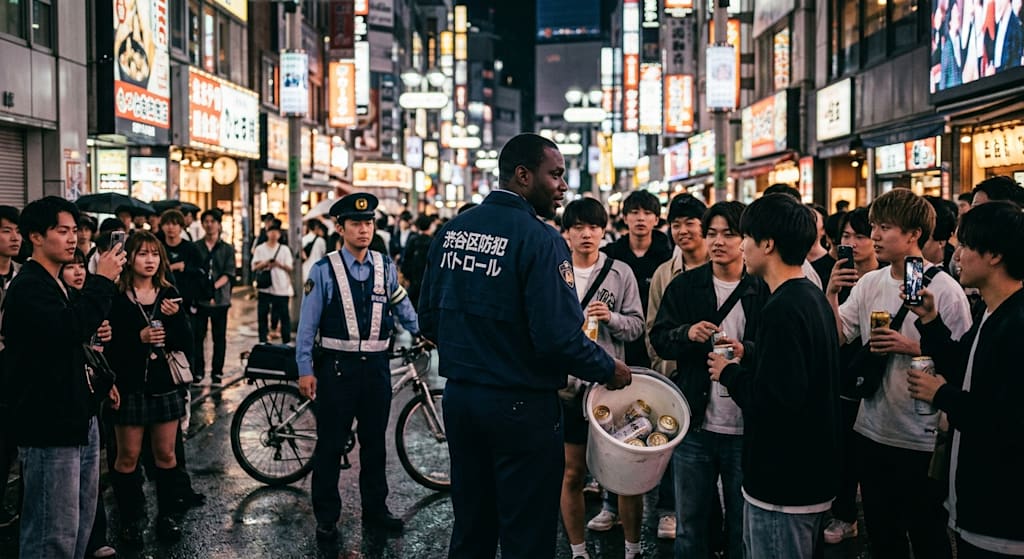
On an October night in 2026, neon lights smeared the wet asphalt of Shibuya Center-gai into a blur of red. The crowd moved slowly. Some people held up phones. Others stood by the roadside with beer cans. A video that would later be replayed again and again was filmed here. Several security guards in dark blue uniforms surrounded a group of young people. One guard, a man of African descent, reached out and took hold of another man's arm. He tried to pull him away from the crowd. The man being held was a head shorter. He was saying something, his body pulling backward. The guard did not let go. Another guard raised both hands in a calming gesture. The camera shook. Someone shouted something that could not be made out.
Within hours, the video spread across Japanese, English, Chinese, and Russian social platforms. The captions grew shorter and more certain. Some said Shibuya had hired a Nigerian patrol team to deal with foreigners. Some called it "using Black people to control Black people." Some said Japan had finally found a way to solve the public-order problems caused by foreigners. In the comment sections, "Nigerian" and "foreigner" appeared again and again, like two terms defining each other.
The guard in the video is not a police officer.
His uniform says "Shibuya Ward Crime Prevention Patrol." This is a street-order maintenance program run by a private security company commissioned by the Shibuya Ward government. The guards have no handcuffs, no batons, and no arrest powers. They carry a plastic bucket to collect alcohol cans from people on the street. Shibuya Ward's safety division says the patrol team's method is to explain the ordinance to people drinking on the street and ask them to hand over their alcohol. Most people cooperate. For those who do not, the most the patrol team can do is keep persuading them.
This commissioned patrol is not a new policy. In September 2023, Shibuya Ward issued its "No Nuisance Street Drinking Declaration," listing blocked passage, litter, and noise from street drinking as problems to address. In October 2024, a revised ordinance took effect. It expanded the nighttime street drinking ban around Shibuya Station from a temporary Halloween measure into a year-round rule. The ban runs from 6 p.m. to 5 a.m. To enforce it, Shibuya Ward commissions a private security company to send out patrols every day during the ban hours. On weekdays, the patrol is about ten people. On weekends and nights before holidays, it can reach eighteen. It operates every day of the year.
The ordinance has no penalties. The only thing the patrol team can do is ask people to hand over their drinks.
Shibuya Ward made one requirement about the patrol team's composition. In each five-person shift, one or two guards must be able to communicate in English. The ward government's survey data showed that about seventy percent of street drinking before the ordinance involved foreigners. When language fails, the rules cannot be explained. When the rules cannot be explained, cooperation cannot begin.
This requirement does not specify nationality or skin color. It points to a capability: to explain Shibuya Ward's rules in a language the other person understands. In Tokyo's labor market, guards who can communicate fluently in English come from many backgrounds. The African guard in the video appeared on the streets of Shibuya in this context. His presence is not the result of a "racial matching" strategy. It is the natural outcome of a functional need, English communication, expressed in how personnel are assigned.
Reading this arrangement as "using Black people to manage Black people" has an obvious logical hole. The foreign drinkers on Shibuya's streets come from all over the world. American tourists, European backpackers, young Koreans, Southeast Asian workers. Their common trait is not skin color. It is that they do not know or do not care about Shibuya Ward's street drinking rules. If the patrol team's goal were to "use one foreign group against another," then when facing tourists from English-speaking countries, an African guard and a white guard would have no essential difference in communication. What matters is language ability.
But the reason this video provoked such a strong reaction is not only a logical misreading.
By the end of 2025, the number of foreign residents in Japan had passed four million for the first time. The figure reached about 4,125,000, a 9.5 percent increase from the previous year. The number itself is not shocking. Japan's total population is over 120 million. But foreign residents are heavily concentrated in major metropolitan areas such as Tokyo and Osaka. In certain industries and neighborhoods, they are highly visible. Shibuya, Shinjuku, and Roppongi are exactly the places where this visibility is most obvious.
The Nigerian community in Tokyo has existed in certain neighborhoods for more than a quarter of a century. One Nigerian man who has lived in Japan for nearly twenty-five years recalls that the concentration of Black touts in Kabukicho began in the late 1990s. At first, many Nigerians made a living selling hip-hop clothing. When that business stopped being profitable, they turned to running bars and clubs. Touts took on the job of attracting customers to those places in exchange for commissions. This economic ecosystem gradually took root in Kabukicho, Shibuya, Roppongi, and other areas with heavy foreign tourism. It produced various public-order problems related to touting.
These problems are real. There have been repeated reports of Nigerian touts in Kabukicho being arrested for aggressive solicitation. In July 2026, a fifty-three-year-old Nigerian man was arrested for grabbing a passerby's arm on the street in Kabukicho. He used lines such as "Not scary, five thousand yen, ninety minutes" to solicit customers illegally. As these incidents accumulated, they formed in the minds of some Japanese people a cognitive framework that directly linked "foreigners" with "worsening public order." When a video appeared showing an African guard in Shibuya making physical contact with foreign-looking young people, that existing framework was activated immediately. What people saw was not an ordinary act of maintaining order. They saw a complete narrative about "the foreigner problem."
Within that narrative, there is a background that often goes unmentioned.
Government survey data from 2025 shows that more than seventy percent of foreign residents in Japan had been stopped and questioned by police on the street in the past five years. That rate is 5.6 times that of Japanese people. In 2024, three foreign-born residents, one of whom had already acquired Japanese citizenship, sued the Japanese government and relevant local governments over racial profiling. A former Aichi Prefectural Police officer testified in court that he had long equated foreigners with "suspicious persons." He said he would conduct routine questioning and residence-card checks on foreigners who "did not even look suspicious."
The Tokyo Metropolitan Police Department is not unaware of the trust deficit between itself and foreign residents. In recent years, the international crime division has taken a series of measures. It distributes multilingual flyers at Thai festivals. It explains Japanese traffic rules and common scams to foreign residents. It organizes football matches to improve police-community relations. These efforts exist because daily interaction between Japanese police and foreign residents is far from smooth and mutual.
Back to that night.
The neon lights of Shibuya Center-gai were still on. The patrol team continued forward. A few empty cans sat in the plastic bucket. The African guard walked in the middle of the group. The words "Shibuya Ward Crime Prevention Patrol" on his uniform flashed once in the light. He bent down, picked up a crushed beer can from the roadside, and threw it into the bucket. Beside him, someone was holding up a phone to film. He did not look up.
The picture ends there.
About the Creator
Jin
Writer of reamstories
https://reamstories.com/jin
Enjoyed the story? Support the Creator.
Subscribe for free to receive all their stories in your feed. You could also become a paid subscriber, letting them know you appreciate their work.
Comments
There are no comments for this story
Be the first to respond and start the conversation.