
The Last Frontier: Inside Slab City, America's Off-Grid Desert Kingdom
Mystery Monday Edition

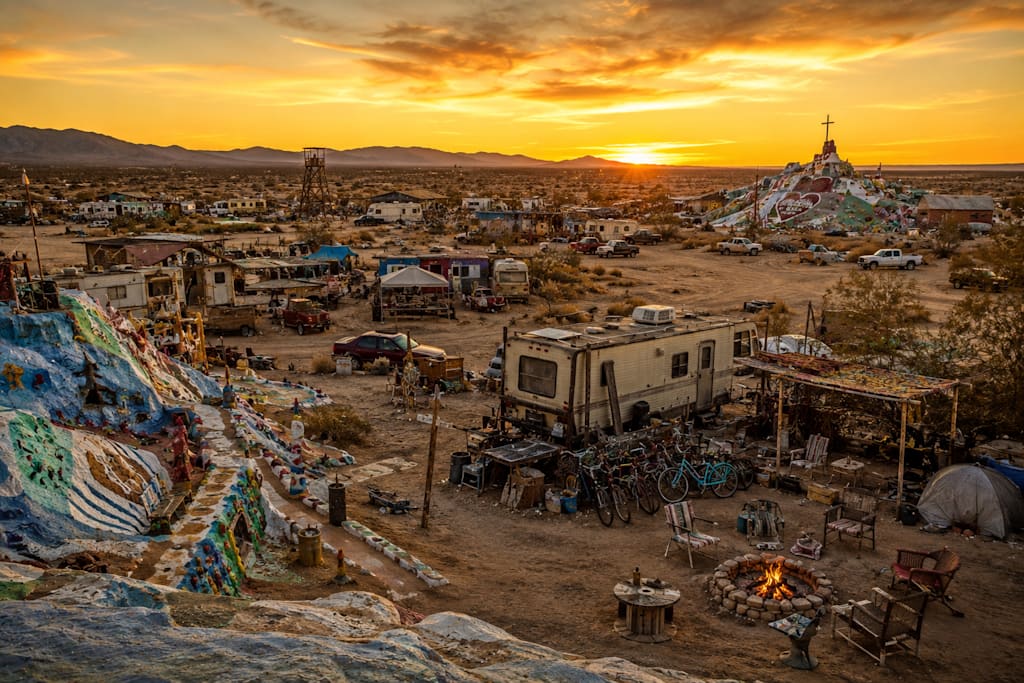
There are still places in America where the rules feel different, not in the sense that laws vanish entirely, but in the sense that the assumptions most people make about modern life simply stop applying. There is no city hall, no municipal water, no power company, no property taxes, no homeowners' association, no neighborhood watch, and no official government management. Just desert… and people. Lots of very unusual people.
Deep in the Colorado Desert of Southern California lies a place that many Americans have never heard of, despite it becoming one of the strangest communities in the country. To some, it is a symbol of freedom; to others, a cautionary tale; and to still others, it is simply home. Its name is Slab City, and depending on who you ask, it is either the last frontier in America or proof that frontiers never really disappeared at all.
The first thing that surprises visitors is that Slab City doesn't look like a city. There are no orderly streets lined with houses, no carefully planned neighborhoods, no shopping districts, and no municipal buildings. Instead, the landscape appears almost accidental: trailers sit beside handmade structures, solar panels rise from improvised rooftops, art installations emerge from the desert floor like mirages, and vehicles of uncertain age and origin are scattered throughout the settlement. Dust coats everything. At first glance, it feels less like a town and more like the aftermath of some strange experiment.
Yet thousands of people pass through Slab City every year, and hundreds call it home. To understand why, you must go back to World War II, when the United States military established Camp Dunlap near what is now Slab City. The facility served as a training base for Marines preparing for service in the Pacific Theater. Thousands of troops cycled through the camp, learning combat skills beneath the unforgiving California sun. When the war ended, the military no longer needed the installation; the buildings were removed, the equipment disappeared, and the personnel left. But one thing remained: the concrete foundations, hundreds of slabs scattered across the desert landscape.
Over time, those abandoned foundations became useful to an entirely different kind of population. Campers began parking recreational vehicles on the old slabs, travelers stayed temporarily, and seasonal visitors arrived during the cooler winter months. One visitor told another, then another, and before long, an unusual community had begun to form. The name came naturally… Slab City, the city built on slabs. Simple. Accurate. And oddly fitting.
What emerged over the following decades was something that few planners, politicians, or sociologists could have predicted: a functioning community without many of the institutions most communities rely upon. There is no mayor, no city council, no zoning board, and no formal municipal government. And yet, life continues. People arrive, people leave, some stay for weeks, others for years, and a few for the rest of their lives.
The residents themselves are as diverse as the landscape is harsh. Retirees living on limited incomes share space with artists seeking inspiration; veterans seeking solitude live beside traveling nomads. Survivalists, wanderers, dreamers, and people simply tired of conventional society all find their way into the desert. Many arrive for different reasons; some are escaping economic pressures, some are chasing freedom, and others simply prefer life outside traditional systems. What unites them is a willingness to accept conditions most Americans would find challenging.
Because Slab City is not easy. Summer temperatures regularly exceed 100 degrees; shade is precious, water must be brought in, and electricity is often generated by solar panels, generators, or improvised systems. Dust storms can sweep through without warning. The desert is beautiful, but it is also unforgiving. Visitors quickly discover that romantic notions of off-grid living become considerably less appealing when temperatures soar and supplies run low. Yet people stay, and that fact alone makes Slab City fascinating.
The community has developed its own culture, traditions, and landmarks over time. Perhaps the most famous is Salvation Mountain, rising unexpectedly from the desert floor; it appears almost otherworldly. Built by artist Leonard Knight over many years, the massive installation consists of adobe, paint, and religious messages covering a brightly colored artificial hill. Photographs rarely capture the full impact; imagine driving through a barren desert and suddenly encountering a mountain covered in vibrant colors and biblical imagery. It feels less like a monument and more like a vision. The site has become one of California's most unusual roadside attractions, drawing visitors from around the world, yet it somehow fits perfectly within Slab City, which specializes in the unexpected.
Elsewhere within the settlement, artists have transformed discarded materials into sculptures, performance spaces, and community gathering areas. Improvised galleries display creations that would seem entirely out of place in conventional towns. Art flourishes in Slab City for a simple reason: nobody is particularly interested in telling artists what they can or cannot build. That freedom attracts creative people and eccentric ones. In Slab City, the line between the two can sometimes become delightfully blurry.
What makes the community truly fascinating, however, is not just the art or even the unusual residents. It is the philosophical question lurking beneath the surface: how much society does a person actually need? Most Americans spend their lives surrounded by systems so familiar they become invisible. Water appears when a faucet is turned on, electricity arrives when a switch is flipped, roads are maintained, trash disappears, emergency services respond, and the government operates in the background. Life depends on countless layers of organization. Slab City strips much of that away, and the result becomes a living experiment.
Some residents see the community as proof that human beings can thrive with fewer rules and fewer institutions; others point to ongoing challenges involving safety, sanitation, and infrastructure as evidence that certain systems exist for good reason. Neither side is entirely wrong, and perhaps that tension is what makes Slab City so compelling. It is not a utopia or a dystopia. It is simply a place where people are attempting to answer questions that most of society stopped asking long ago. Questions about freedom, questions about independence, and questions about what happens when people intentionally step outside the boundaries of ordinary life.
Every Iron Lighthouse story eventually reaches a point where the strange details illuminate something deeper. For Slab City, that moment arrives when you realize the community represents a distinctly American impulse. The frontier spirit never fully disappeared, the covered wagons vanished, the cattle trails faded, and the wilderness became suburbs. Yet the desire to find a patch of ground beyond the reach of conventional expectations remains remarkably persistent. For generations, Americans have headed toward horizons in search of reinvention. Gold prospectors did it, homesteaders did it, and pioneers did it. In its own unusual way, Slab City continues that tradition, not with horses and wagons, but with solar panels, trailers, art installations, and a stubborn refusal to live exactly the way everyone else does.
Today, as modern life becomes increasingly connected, regulated, and digitized, Slab City feels almost like a relic from another era. A place where improvisation still matters, where independence still carries value, and where people can disappear from the conventional world without completely disappearing from society. It is dusty, chaotic, sometimes inspiring, sometimes troubling, frequently misunderstood, and undeniably unique. Which may be why it continues to endure. Somewhere in the California desert, beneath a blazing sun and endless sky, the last echoes of the American frontier are still alive, not in a history book, not in a museum, but on a collection of abandoned concrete slabs where people decided to build something entirely their own.
About the Creator
The Iron Lighthouse
Where folklore meets freeway. A guide to the strange heart of the American backroads...
Enjoyed the story? Support the Creator.
Subscribe for free to receive all their stories in your feed.
Comments
There are no comments for this story
Be the first to respond and start the conversation.