
The Hong Kong Place I’ve Never Visited but See Every Time I Remember
A one-yuan video ticket, five Hong Kong films, and the transparent film that turned Tsim Sha Tsui into my private city coordinate.
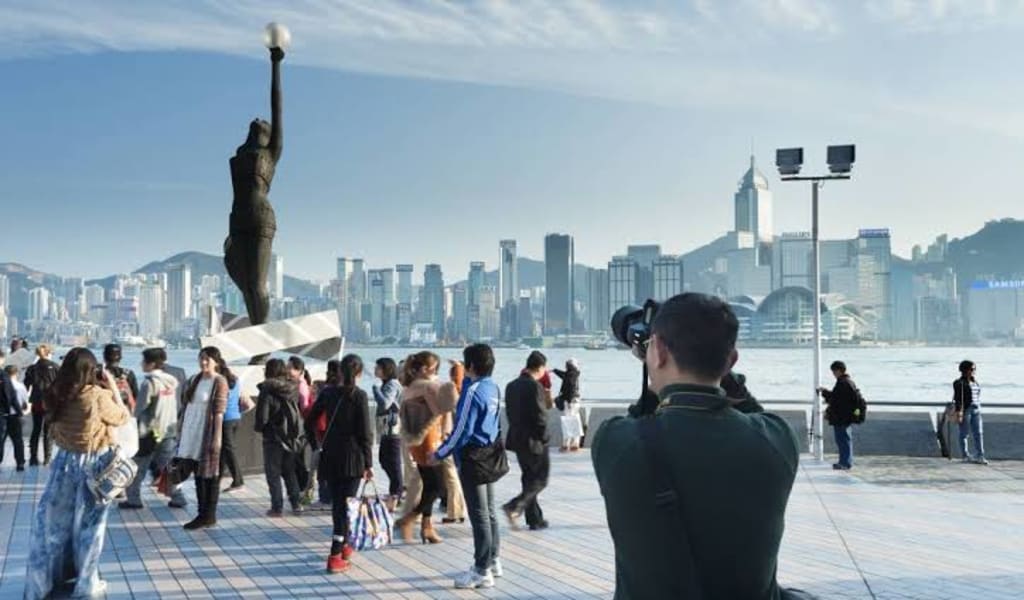
Tsim Sha Tsui: A Transparent Film Only I Can See
It was a Sunday afternoon. I spent one yuan on a ticket to a video hall. I did it without telling anyone. The poster by the entrance said that day’s screenings were Police Story and Project A, starring Jackie Chan. I had never been inside a place like that. It was dark. My eyes could not adjust. I could not see the seats, the walls, or the people around me. The only thing I could see was the television: Jackie Chan sliding down a steel pole from the upper floor of a shopping mall, sparks flying, fire and lightning everywhere.
Then I heard a line of dialogue.
Chu Tao: Chan Ka-Kui, you think you can catch me? In Tsim Sha Tsui, a lot of things can’t be settled with just a gun!
That was the first time I heard the three words “Tsim Sha Tsui.” I did not know where it was in Hong Kong. I did not know what it looked like. I only knew that it was a place where a gun was not always enough.
Later, I watched more Hong Kong films. Tsim Sha Tsui was laid out in front of me, one layer at a time.
In 1994, Wong Kar-wai pushed his camera into Chungking Mansions, beside Nathan Road. Brigitte Lin played a blonde-haired female killer in dark sunglasses. She moved through dim corridors full of South Asian vendors, backpackers, and people whose origins you could not quite name. The elevator doors opened and closed. Neon signs flashed outside the windows. I thought the building was mysterious and dangerous.
In 1995, it was Wong Kar-wai again, and Tsim Sha Tsui again. In Fallen Angels, Leon Lai played a killer who walked alone through empty streets at night. There were no gunfights, no chases. He rode a motorcycle through a tunnel, his face expressionless. Michelle Reis developed photographs in a darkroom. Takeshi Kaneshiro broke into a shop late at night and massaged a pig. At two or three in the morning, Tsim Sha Tsui belonged to no one.
In 1996, Comrades: Almost a Love Story left its gentlest scene on Canton Road. Leon Lai rode a bicycle with Maggie Cheung on the back. He pedaled slowly. Teresa Teng’s voice drifted out from shops along the street. Two people from the mainland, trying to make a life in Hong Kong, had a few minutes on that road when they did not have to think about tomorrow. Tsim Sha Tsui held guns and rainy nights. It also held the few minutes when one person sat on the back of another person’s bicycle.
In 2003, Johnnie To’s PTU gave Tsim Sha Tsui no daylight neon, only endless rain. Police officers walked through shadows, weighing justice against the law. A single wrong step led to two different endings. No one was absolutely good. No one was absolutely bad. Rain struck the road. Police car lights turned in the dark.
In TVB dramas, Tsim Sha Tsui appeared even more often. In O记实录, gold shop robberies on Nathan Road and standoffs on building rooftops were part of what O记 officers faced every day. They had to move between informants, triads, and witnesses. Gunfire was only part of it. The rest was the grinding game of intelligence. Tsim Sha Tsui taught them that prosperity and crime were separated by only one street.
This is Tsim Sha Tsui. This is the Tsim Sha Tsui that someone who had never been to Hong Kong came to know through video halls and television sets.
Take all of that away, and what is left? I do not know. The Tsim Sha Tsui in my imagination may be moving enough. If I went there, and the glow from the screen faded, it might become ordinary. Or when I stood there, the images that belong to me would not disappear. They would stack on top of the street scene, like a transparent film only I can see.
Walking along Nathan Road, I might think of Takeshi Kaneshiro. On a rainy day on Canton Road, I might think of Leon Lai and Maggie Cheung. Seeing the sign of Chungking Mansions, I might think of Brigitte Lin’s blonde hair and dark sunglasses. Passing the Clock Tower, I might think of the Star Ferry and the old railway station. Standing by Victoria Harbour, I might think of all those people in films who stood by the water, silent, saying goodbye, looking into the distance.
That is the city coordinate in my mind. It is more than a place on a map. Private memory and public story overlap there until they become one image. Tsim Sha Tsui is not all of Hong Kong. It is Hong Kong as a montage. It is a transparent film only I can see, laid over the streets, still developing every time I remember it.
About the Creator
Jin
Writer of reamstories
https://reamstories.com/jin
Enjoyed the story? Support the Creator.
Subscribe for free to receive all their stories in your feed. You could also become a paid subscriber, letting them know you appreciate their work.
Comments
There are no comments for this story
Be the first to respond and start the conversation.