
The Double-Decker Airplane Seat Is a Horror Story in Disguise
A viral cabin design promises more legroom. It also promises a stranger’s backside inches from your face.
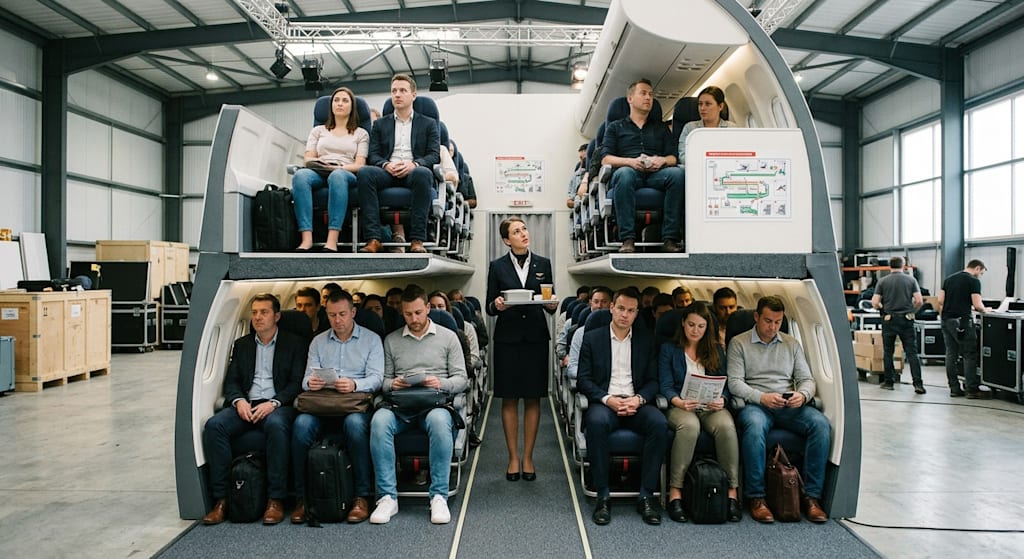
The airplane seats in the video look like drawers stacked on top of one another. The demonstrator bends down, climbs into the lower level, slides a suitcase under his feet, then lifts a hand and points to the row above. The camera pulls back. Two levels, neat and orderly, like shelves in a warehouse waiting for trucks. The title says “new design,” and the voice sounds confident about the future. The most striking thing in the frame is not the seat. It is the shape of a human being folded to fit.
The top comment does not ask about legroom, ticket prices, or when these seats will be available. It asks: what about farts?
The question is crude, and it is precise. On an eight-hour flight, the face of a passenger on the lower level might be only a few dozen centimeters from the backside of a passenger above. Air circulation can be as strong as it wants. It cannot remove the psychological humiliation. Someone names this kind of flight: after the red-eye, the pink-eye. Someone else says passengers on the upper level should eat a belly full of beans and cabbage before boarding. The jokes are ugly, but the fear inside them is concrete. A person is not density. A person burps, farts, gets airsick, vomits, gets numb legs, panics, and needs the toilet.
The spaciousness in the design video is a studio illusion. The filming location is a warehouse. The ceiling is high. The lighting is generous. A real cabin is a tube. Above the seats there are overhead bins, light strips, air-conditioning ducts, cables, and structural beams. Remove every overhead bin, and the curve of the fuselage is still there. The head of an upper-level passenger will press close to the ceiling. A lower-level passenger will feel like crawling into a cabinet. Vertical space does not appear out of nothing.
Safety is a harder wall. Modern civil aviation requires evacuation within ninety seconds. That standard is already difficult. Double-decker seats make the aisle narrower. They require climbing up and down. What happens to the elderly, the pregnant, the disabled, the obese, the injured? How does a flight attendant quickly confirm whether anyone is still on the lower level? If a passenger has a sudden medical emergency, how does a paramedic get in? In a fire, how does smoke move? In an emergency landing, does the upper structure collapse? These are not nitpicks. They are certification baselines. If it cannot pass evacuation, it stays a concept drawing.
Accessibility is another disaster. Many people do not need special assistance in daily life. That does not mean they can be packed into a tight space like building blocks. Someone with a back injury, bad knees, a larger body, a baby, or a tendency to panic will stop in front of this seat. Getting into the lower level requires bending, turning sideways, and moving luggage. Getting out requires climbing in front of everyone. Flying is already exhausting. This design turns sitting down and standing up into a physical fitness test. It assumes every passenger is young and healthy. The people on a plane are exactly the opposite: all kinds of people.
What about luggage? In the render, a lower-level passenger slides a case under his feet. It looks convenient. Where does an upper-level passenger put a bag? If it goes by the lower passenger’s feet, the upper passenger cannot reach it. If it goes in the aisle, it blocks the aisle. During boarding, everyone turns, lifts, and searches for a seat. The process becomes painfully slow. During deplaning, the lower level must exit first, then the upper level climbs down, like dominoes falling in reverse. Airlines care about turnaround time. This design turns boarding and deplaning into group gymnastics. If someone needs the toilet mid-flight, the whole row must stand up, the upper level must stop moving, and then everyone must step over legs and bags. Economy class already lacks dignity. This design grinds that dignity into the floor.
This concept is not new. For more than a decade, it has returned every so often under a different title. Sometimes it is called the future of airplane seating. Sometimes it is called a new cabin layout. Sometimes it is called a new solution to overcrowding. Each time it draws a wave of mockery, then disappears, then comes back a few years later. It circulates like an urban legend because it is clickbait. It feeds on public resentment toward airlines. It also feeds on anxiety about the future. Airlines want to pack in more people, so the design makes us angry. Technology can make people more comfortable, yet it is often used to make them more obedient, so the design feels absurd.
The defense is that it rethinks the seat. Rethinking does not mean stacking people. Better legroom, a more sensible boarding process, quieter and cleaner air, larger lavatories, usable accessibility features, seats that let you sleep without destroying your neck. These are directions. Design can push space to its limit. It cannot push the human body and human dignity into the same calculation. If a seat requires a passenger to fold himself first and then endure someone else’s backside hanging above his head, it has already failed. It targets the airline’s profit, not the passenger’s problem.
So this double-decker airplane seat will most likely never appear on a commercial flight. It will keep circulating in short videos. It will draw another round of “what about farts” jokes. It will vanish for a few years. Then it will come back under a new name. The demonstrator will still be in the warehouse, bending down, climbing into the lower level, sliding a suitcase under his feet, lifting a hand, and pointing to the row above. The camera pulls back. The video loops. A comment floats by: what about farts?
About the Creator
Jin
Writer of reamstories
https://reamstories.com/jin
Enjoyed the story? Support the Creator.
Subscribe for free to receive all their stories in your feed. You could also become a paid subscriber, letting them know you appreciate their work.
Comments
There are no comments for this story
Be the first to respond and start the conversation.