
Smart travel in Europe: How to avoid pickpockets and scams
I learned this from personal experience, the hard way


Europe’s rich history, culture, food, art, and magnificent architecture makes it one of the most rewarding travel destinations during the summer season. The railway system makes it especially attractive for those who want to travel to different countries in a short period of time.
Sadly, in recent years, Europe has been invaded by pickpockets and scammers who don’t understand the effort of working hard and saving for a holiday since well, they are criminal, opportunistic thieves. They are the reason why when planning your next holiday you must prepare to protect yourself, your family, and your belongings so you can enjoy your trip with confidence and peace of mind.
I learned this from personal experience, the hard way.
I’ve learned to be attentive in public transport, phone in my bag, wallet somewhere hard to reach, wearing sunglasses but my eyes on everyone else, my back against a wall, never letting anyone stand behind me if possible and if not possible: never a bag on my back but in front of me! I learned to be aware of my surroundings the hard way. Now, when I travel, I prepare.
These opportunistic thieves have always existed. However, they have multiplied and pickpocketing is not exclusive to men; you can be robbed and scammed by a woman or even a child commanded by an adult. There are lots of stories circulating on social media about this.
Here is how to stay one step ahead:
1. Understand where you are most vulnerable
Pickpockets and scammers thrive in touristy crowded areas where there are plenty of distractions, loud noises, where they can easily get lost in the crowd. Train stations, metro systems, airports, tourist landmarks, and busy outdoor markets are their favourite hunting grounds. Places like public transport during rush hour which look and feel more like a tin of sardines tightly packed than anything else or long queues outside attractions are prime opportunities.
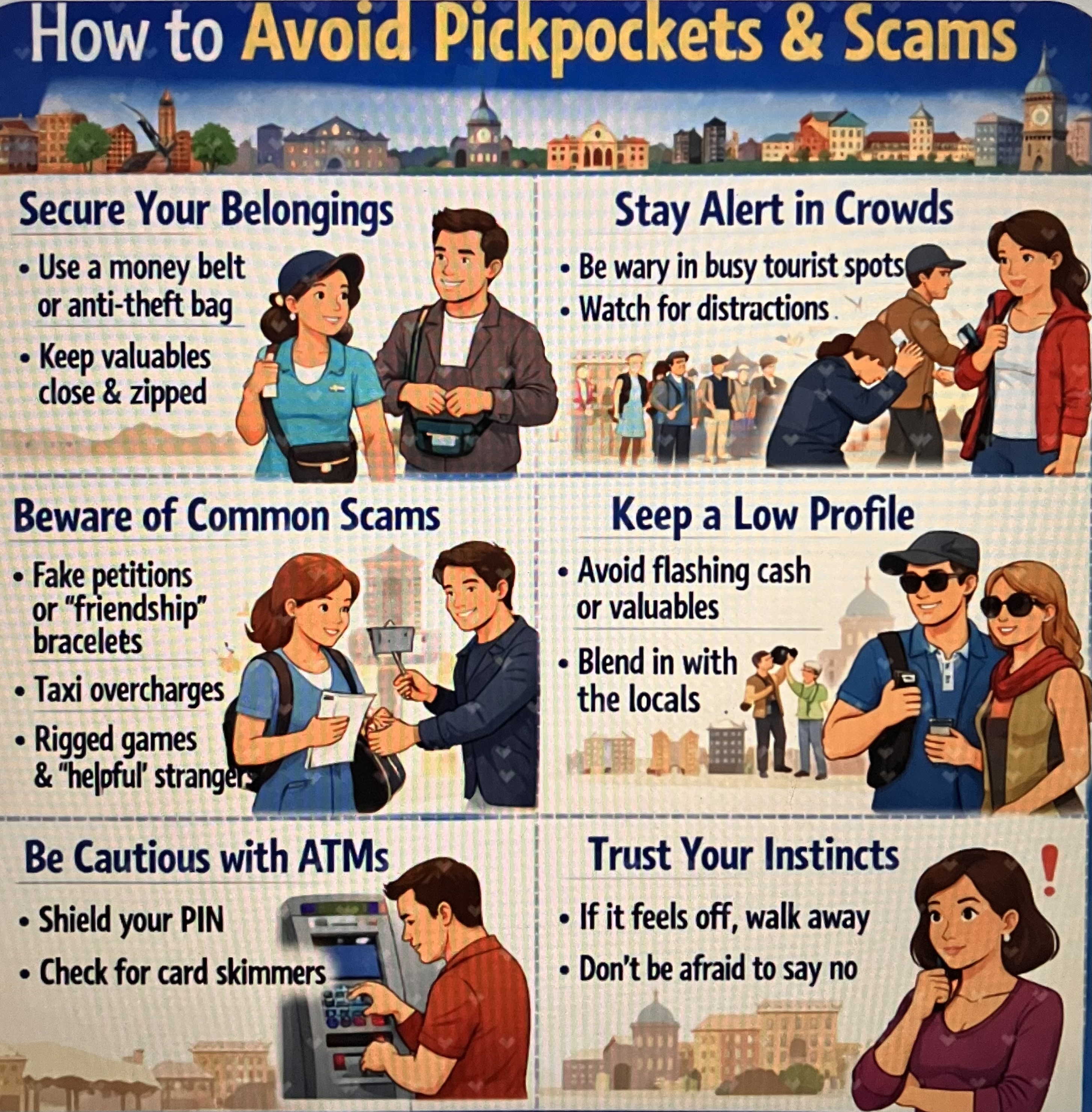
The key is not to be paranoid, but to be alert at all times. If you are in a dense crowd and someone bumps into you, treat it as an alarm that goes off and check your belongings immediately. Keep your bags in your front, never in your back.
Watch your back! Keep all your belongings at sight.
2. Keep valuables out of sight
A flashy phone, an open handbag, or a wallet sticking out of your back pocket can make you an easy target. Keep your valuables hidden and difficult to access. Ideally, get small padlocks for your handpack and backpack or some other locking system.
Opt for any of the many anti-theft bags that are available for purchase these days for a good reason, money belts, or crossbody bags worn always in front of you. Avoid carrying all your cash and your cards in one place, split them between different pockets or bags. If one item is lost or stolen, you won’t be left stranded. But remember that in Europe cash is rarely used or even accepted so there is no need to carry large amounts of cash or any cash at all.
3. Be wary of common distraction tactics
Most pickpocketing incidents rely on distraction. Someone may ask you for directions, spill something on you, or create a commotion nearby. Hold to your belongings and try to move away from the area. In that moment of confusion, an accomplice may take advantage. These parasites are really good team players, they speak criminal sign language at an advanced level, and there is a criminal team member always nearby and ready to help them to accomplish the task of stealing your hard earned possessions and money and disappear faster than you can say “help!”
Common scams spotted in crowded and popular European cities include:
Someone offering to help clean a stain on your clothes
A group of children approaching you with petitions or flowers
A “friendly” stranger trying to tie a bracelet on your wrist or hand you something “for free”
The rule is rather simple: if something feels off or overly intrusive, getting into personal space, or touching you in any way, politely but firmly disengage and move on as fast as you can.
4. Watch your belongings in cafés and restaurants
Outdoor seating is a lovely part of European travel, perhaps one of the loveliest, but it comes with risks. Never, and I mean ne-ver hang your bag on the back of your chair or place your phone on the table.
A common tactic is for a thief to place a newspaper or jacket over your belongings and lift them away unnoticed. Or someone could come to your table to ask something to distract you whilst an accomplice proceeds to steal your phone. Keep bags on your lap, on you, or looped securely around your leg or chair. The best is a bag that stays attached to you at all times such as a crossbody bag, a fanny bag, or a small backpack that you can keep in front of you (never on your back).
5. Use ATMs and card machines carefully
When withdrawing cash, use only ATMs located inside banks or well-lit, busy areas. Shield your PIN and be cautious if anyone stands too close to you in the queue, or tries to “assist” you.
Card skimming devices are less common than before but still exist. Regularly check your bank transactions during your trip and notify your bank immediately if anything suspicious appears.
6. Stay alert on public transport. I can’t emphasise this enough
Metro systems in major European cities are particularly notorious for pickpocketing. Thieves often work in teams, as said before: team players: one distracts whilst another steals, leaving you wondering if that’s what you worked so hard for. One of those thieves stole everything from me, the money for my rent, a large sum of cash I was going to deposit in my bank account, my new monthly transport card, my bank card … and with it, they emptied my bank account. I was left with nothing and a sense of empty desperation that I can’t describe and I doubt anyone could understand.
Keep your bag zipped and positioned in front of you, NEVER on your back. Avoid placing wallets in easily accessible pockets or on top of everything else because you want to find it easy and fast. That’s how a thief will find it: easy and fast. When boarding or exiting trains, the metro, or trams stay aware: these moments of movement are when many thefts occur.
7. Don’t fall for “too good to be true” offers
If someone approaches you with an incredible deal such as cheap tours, exclusive access, or heavily discounted tickets just pause and think. Nothing is free. Everything has a price. And scammers often rely on urgency and excitement to bypass your judgment.
Book tours and tickets through reputable online platforms or official vendors. A few extra euros for security and legitimacy is always worth it.
8. Trust your instincts
Your intuition is one of your best tools. If a situation feels uncomfortable, remove yourself immediately. You don’t owe strangers your time or attention or anything, especially if they are persistent and invading your personal space.
Confidence also plays a role. Walking with purpose, like you own the streets even if you are unsure of your direction; walking with purpose makes you less appealing as a target.
9. Prepare before you go
Make digital and physical copies of important documents such as your passport, other IDs, travel insurance, and cards. Store them separately from the originals. Send a digital copy to a family member.
If possible, consider travel insurance that covers theft and loss, it is a small investment that can save you significant stress.
Travel in Europe should be about discovery and enjoyment, not worry. By staying aware, keeping your belongings secure, and recognising common tactics played by thieves and scammers, you can minimise risks and focus on what truly matters: enjoying the journey.
A little vigilance goes a long way, and often, it is the difference between a stressful incident that could leave long-term financial distress and emotional scars, and a smooth, unforgettable adventure.
Remember: Enjoy your trip, but be aware of your surroundings and the common scams:
About the Creator
Susan Fourtané
Susan Fourtané is a Science and Technology Journalist, a professional writer with over 18 years experience writing for global media and industry publications. She's a member of the ABSW, WFSJ, Society of Authors, and London Press Club.
Enjoyed the story? Support the Creator.
Subscribe for free to receive all their stories in your feed.
Comments
There are no comments for this story
Be the first to respond and start the conversation.