
Situ Town Spent 30 Million Yuan on NPCs. The Real Problem Starts After the Photos.
A park with Guinness records and the city’s top revenue still can’t make young people stay. The missing piece is the system that keeps mascots alive.
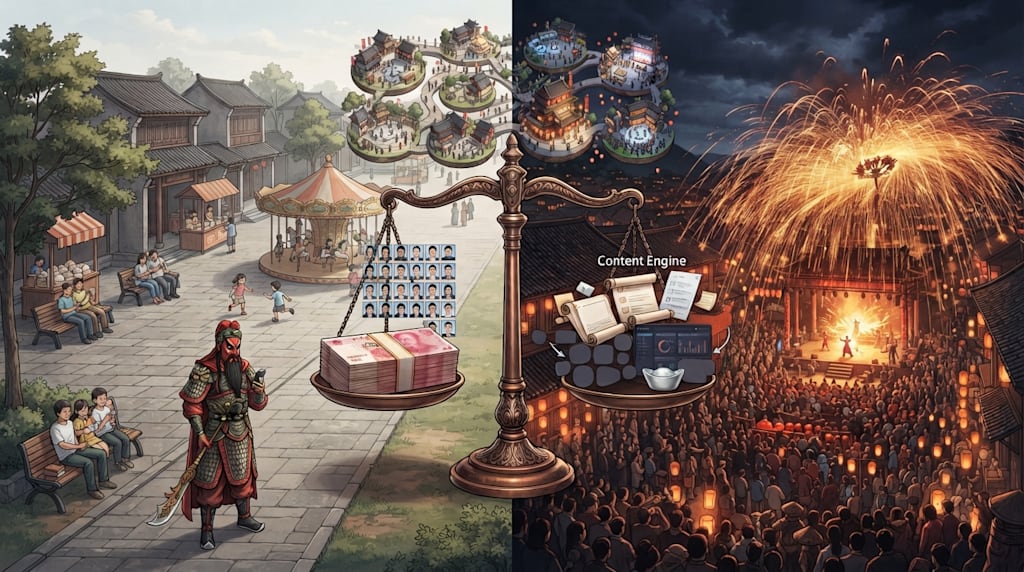
One park has Guinness records, the city’s top revenue, and a daytime problem that another mascot cannot fix.
Situ Town’s founder, Zhou Xiaoming, posted a video. Online, he is known as “Village Chief Zhou.” He has 1.14 million followers and more than 10 million likes. In the video, he said the park lacks NPCs who can push tourists’ emotions to the ceiling. The park held a meeting and decided to spend 30 million yuan to invite talent. The pitch: if you have skills and dare to perform, the park will pay one million or ten million yuan a year.
Recruiting NPCs is common in Chinese scenic spots. Recruiting them this loudly, with this kind of salary promise, is not.
The park plans to hire 100 people, divided into S, A, and B tiers. The top annual salary is 10 million yuan. The next tier is one million. The roles are Shanxi historical figures: Guan Yu, Diaochan, Wang Wei. The requirements are specific: quick with jokes, comfortable on camera, good at running social media accounts, able to turn interactions into posts that travel. The park says it has never hired NPCs before. The related positions inside the park are game roles, not NPCs. It openly says it is benchmarking against the “Snow Cake Monkey” at Changchun Zoological and Botanical Garden and “Wang Po” at Wansuishan in Kaifeng. It also welcomes actors who cannot find work and are looking for scenic-spot NPC jobs.
The numbers are large. Situ Town is a village collective scenic area in Jincheng, Shanxi. It is known for its iron-flower show, Thousand-Year Iron Soul, which has broken Guinness records twice. The land was first used for an agricultural ecological garden, built on abandoned mine shafts and a garbage dump. Later, the village spent 1 billion yuan to turn it into a multi-function industrial park. In 2021, it received the national 4A scenic area designation. In earlier years, annual visitors were around 200,000. In 2022, Zhou Xiaoming began appearing on camera to promote the park. The followers and traffic followed. In 2023, annual visitors reached 800,000. In 2024, 1 million. In 2025, 2.2 million.
Revenue tells a similar story. In 2024, Situ Town’s operating revenue was 133 million yuan, first among 52 A-level scenic spots in Jincheng. From January to July 2025, operating revenue was 109 million yuan, up 89.47 percent year on year. The park has more than 1,000 employees and 50 managers. Most are villagers from Situ Village. More than 100 villagers have stable jobs near home. Others run homestays and small businesses, living off the park’s traffic.
The numbers are strong. The park still says it lacks people.
The answer sits in the gap between day and night.
Situ Town follows an online marketing route. On social platforms, its reputation splits sharply. Praise comes almost entirely from the nighttime iron-flower show. “A rare and highly watchable iron-flower performance” is a common line. Affordable prices inside the park and no forced spending raise visitors’ tolerance. Complaints cluster around the daytime. Many visitors who enter during the day say there is too little to do and too few immersive projects. Some say the infrastructure is not enough, with too few places to rest. The park’s own staff put it directly: visitors are mostly families; outside winter and summer holidays, crowds concentrate on weekends; at other times, overall traffic drops. Food, drinks, and entertainment inside the park are free, but there is little to make young people come.
The pattern: no one during the day, packed at night. Families come. Young people do not.
If a park relies on one nighttime hit, the ceiling is visible. Visitors enter during the day and can only wait for night. Large crowds pile up in a short window. The park’s space cannot carry it.
Situ Town has tried. It keeps improving the visitor experience and offering sincerity. Free snacks have increased. Free meals have continued since around May last year. Thirty-four children’s rides are fully free. Hanfu rental is free. Self-driving visitors can get up to 120 yuan reimbursed for highway tolls with receipts. This summer, children who bought tickets could receive a free thermos with their ticket and valid ID. The park also launched a 5 million yuan cash pool for visitors who shoot and share videos. These efforts do bring family customers. They do little for young people. Young people want participation, emotional value, something they can post.
Situ Town has visitors. It lacks a reason for young people to make a special trip.
The problem looks sharper next to Wansuishan in Kaifeng, Henan.
The two parks are similar in size. Situ Town is about 742 mu. Wansuishan is about 500 to 600 mu. Situ Town is larger, but visitors often complain that it feels small, that the routes are messy, that it is cramped. Much of Situ Town is children’s amusement, zoo, homestay area, and ecological garden. Young tourists and pure sightseeing tourists have no reason to enter those areas. During the day, visitors walk around Liuchi Lane. At night, they crowd into the iron-flower theater. Movement is compressed into a few core points. There is little buffer and little room to explore.
Wansuishan is different. It has six theme zones: Water Margin, Xianxia, Jianghu Street, Cross Slope, and others. Each zone has its own performances and interactions. Visitors are spread across different areas. They do not all squeeze into one place. The 500 to 600 mu is cut into many small worlds. Each small world has its own content. It feels like there is always more to see.
The zone layout solves the question of where people go. Spatial separation helps, but each zone also has content pulling people forward.
That brings the focus to its NPC and performance system.
Wansuishan has about 1,500 NPCs and more than 2,000 interactions per day. It maintains a 30 percent annual program renewal rate. It expanded from a single Water Margin zone to six theme zones. Performance scale grew from 100 per day to more than 3,000. Many people know the park through “Wang Po Matchmaking.” Wang Po is an output of the system, not the cause. The park’s barrier is a closed loop: content production, on-site interaction, UGC distribution, secondary consumption, data feedback, program elimination.
Its core game is the “silver note task chain.” Visitors earn silver notes by joining interactions and exchange them for gifts. Poetry contests, riddles, and spending are all connected. Average stay time went from 3 to 4 hours to more than 8 hours.
In 2025, Wansuishan received 24.522 million visitors, up 146.9 percent year on year. Comprehensive revenue was 1.27 billion yuan. The starting point three years earlier makes the jump sharper. From 2019 to 2022, Wansuishan’s annual comprehensive revenue was around 80 million yuan. In 2023, it was 180 million. In 2024, 540 million. In 2025, 1.27 billion. Three years, more than 15 times growth. Tickets are 100 yuan for three days of unlimited entry. Bottled water is 1.5 yuan. Snacks are priced like outside the park. In 2025, secondary commercial revenue was 480 million yuan, up 153.6 percent.
Situ Town’s revenue structure is almost the reverse. From January to July 2025, ticket revenue was 88.13 million yuan, 81 percent of operating revenue. That number means visitors’ money mostly goes to the act of getting in. Once inside, beyond the free items, there is not much worth spending on.
The difference is the system.
Wansuishan turned content production into a system that iterates. Situ Town’s content supply still depends heavily on a single IP. The iron-flower show is its pride. It is also its ceiling. After the show, there is no second reason to stay.
The 30 million yuan buys one of two things. If the money goes to influencers and celebrities for appearances, it buys traffic. If it goes to character design, scripts, training, interaction boundaries, short-video distribution, and a silver-note-style secondary spending chain, it buys a system.
Behind Wansuishan’s 1,500 NPCs are task-chain design, a silver-note secondary spending system, a program elimination mechanism, and a data assessment system. These keep the NPCs alive and producing value. If Situ Town’s 100 NPCs only add some “characters you can take photos with,” with no story tasks and no consumption chain, the 30 million yuan may buy a burst of noise. When the noise fades, the people leave.
Situ Town has one advantage Wansuishan does not: it is a village collective enterprise. Nearly 200 iron-flower performers are villagers who changed jobs. That texture cannot be copied by outside NPCs.
The useful role for outside NPCs is to help the villagers’ stories reach more young people. The 100 roles need to grow out of the cultural lines of southeastern Shanxi, not simply copy Kaifeng’s jianghu.
There is a larger background. Since March 2026, more than 50 scenic spots across the country have posted NPC recruitment notices. The roles are highly homogenized: Sun Wukong, Li Bai, Tang Sanzang, emperors, swordsmen. One park insider said: “From sky maidens scattering flowers to flowers scattered everywhere, what is copied is only the skin.” Situ Town choosing Guan Yu, Diaochan, and Wang Wei has local cultural support. The direction is right. Whether it can break out depends on the depth of content operations.
Wansuishan’s answer is a content industry system that turns tourists from people looking at scenery into people inside the play. Situ Town’s iron-flower show has proved it can create a single hit. The ceiling of a single hit is clear. The 30 million yuan NPC recruitment is Situ Town’s first attempt to move from hit logic to system logic.
Whether this road works depends on the content mechanism behind the 100 NPCs. It does not depend on how many “Wang Pos” it hires.
Across the country, scenic spots are using high salaries to grab NPCs. The scarce thing is the content system that keeps those NPCs alive. Situ Town’s 30 million yuan buys one hundred roles or one capability. Other parks hiring NPCs face the same test.
About the Creator
Jin
Writer of reamstories
https://reamstories.com/jin
Enjoyed the story? Support the Creator.
Subscribe for free to receive all their stories in your feed. You could also become a paid subscriber, letting them know you appreciate their work.
Comments
There are no comments for this story
Be the first to respond and start the conversation.