
Pompeii Wasn’t a Theme Park. The Evidence Is Buried in the Dirt.
Volcanic layers, graffiti, ancient DNA, and carbonized scrolls all point back to a city buried in AD 79.
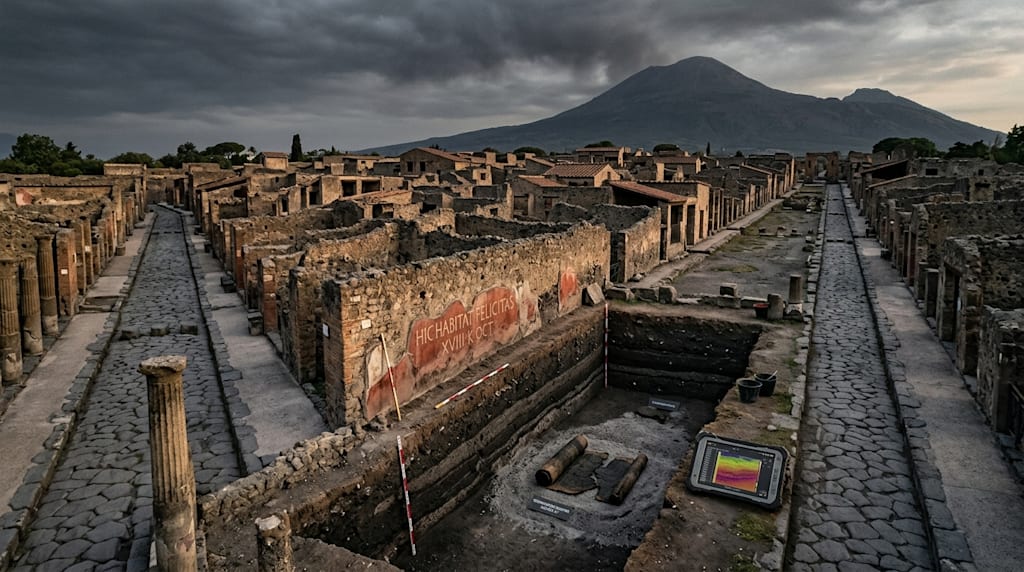
Every few years, the same claim circulates online: Pompeii is not an ancient Roman city at all, but a modern fabrication, a giant archaeological theme park built to manufacture a version of Western history.
The claim sounds dramatic. The problem is that drama is doing most of the work.
To make the argument hold, you cannot simply point at a wall and say, “That could have been built later.” You have to explain the entire body of evidence around Pompeii: the volcanic deposits, the damage patterns in the buildings, the excavation layers, the inscriptions, the graffiti, the neighboring sites buried by the same eruption, the human remains, the ancient DNA, and the carbonized scrolls recovered from nearby Herculaneum.
That changes the question.
The issue is no longer whether someone could fake an archaeological site. Almost anything can be faked in isolation.
The issue is whether people in the eighteenth century could have fabricated a city whose evidence would continue to agree with geological analysis, archaeology, ancient languages, genetics, and imaging technology developed centuries later.
That is a much harder claim to defend.
Pompeii was buried by more than “a layer of ash”
One of the simplest versions of the Pompeii story goes like this: Mount Vesuvius erupted in AD 79, ash fell, the city disappeared, and modern archaeologists eventually dug it back up.
The real deposit is far more complicated.
The material covering Pompeii is not one uniform blanket. The eruption produced different stages of deposition, including pumice fall, ash, and later pyroclastic density currents. The layers differ in grain size, composition, density, and the way they settled across the city.
That distinction matters because the volcanic material did not land on an empty field.
It landed on a city.
A sloping roof behaved differently from a flat roof. An open courtyard accumulated material differently from an enclosed room. A roof could shed pumice into a courtyard or cistern. Heavy pumice could cause roofs to collapse. Later currents could break walls in particular directions depending on how those currents moved through the streets.
The result is a physical record in which the volcano and the architecture interact.
A wall is not simply buried. It is damaged in a particular way.
A roof does not simply disappear. It collapses under particular loads.
A courtyard does not receive exactly the same deposit as a narrow room.
Even the thickness of the deposits reflects the shape of the buildings beneath them.
The original article cites estimates of roughly 30 to 40 minutes for the initial pumice fall, with deposition rates on the order of 10 to 15 centimeters per hour during that phase. Whether one focuses on those exact estimates or on the broader sequence, the important point remains the same: Pompeii records a series of physical events, not a single act of burial.
To manufacture that record later, a forger would have needed to reproduce relationships between volcanic material and thousands of structures across an entire city.
That is no longer ordinary forgery.
It becomes a geological reconstruction performed in reverse.
Pompeii was not uncovered in one grand reveal
Pompeii did not appear all at once in the eighteenth century.
Systematic excavation began in 1748, and the site has been investigated across generations. Different archaeologists recorded different buildings, materials, inscriptions, human remains, and layers. Interpretations changed. New excavations complicated older assumptions. Some long-standing identifications were abandoned.
That messy history is useful evidence.
A single fabricated archaeological display can be designed as a finished story. A site excavated over centuries behaves differently. Every new trench exposes more relationships that have to fit with what was found before.
Pompeii also does not stand alone.
The eruption of Vesuvius in AD 79 affected Herculaneum, Stabiae, Oplontis, and other settlements around the Bay of Naples. Their deposits differ because the sites were exposed to different parts of the eruption, but together they preserve another record of what happened.
That matters for the fabrication argument because the supposed problem is no longer one city.
It is a regional event recorded at several sites.
A claim that all of this was invented has to account for those sites too, not just Pompeii.
The graffiti are not decorative props
A visitor can look at a Roman wall painting and think of it as a museum object.
Graffiti are harder to treat that way.
Pompeii preserves thousands of inscriptions left by ordinary people. They include political election notices, advertisements, comments about gladiatorial games, names, jokes, insults, romantic messages, obscenities, and fragments of everyday speech.
Some are polished.
Many are not.
That distinction is useful because polished literary Latin would be easier to imitate than the messy language people actually scratched onto walls.
Ancient graffiti contain spelling variations, colloquial expressions, abbreviations, slang, grammar mistakes, personal names, references to local events, and traces of how people actually used language.
They are also distributed through the physical city.
A modern novelist could invent a convincing Roman sentence.
Inventing thousands of unrelated scraps of graffiti is a different problem.
The material has to fit the language of the period. It has to fit Roman naming practices. It has to fit the social world reflected elsewhere in the site. It has to appear where people would plausibly have written it. It has to avoid anachronistic vocabulary. And it has to coexist with thousands of other inscriptions without turning the whole city into one writer's imitation of antiquity.
The sheer banality of some graffiti is part of the evidence.
Ancient people complained about one another. They advertised sex. They insulted rivals. They promoted candidates. They wrote things on walls because they had walls and because they were people.
That is exactly the kind of material history tends to preserve badly, yet Pompeii preserves it in abundance.
A fabricated monument can imitate grandeur.
It is much harder to fabricate an entire population's bad jokes.
The dead complicate the old stories
Pompeii's human remains were once interpreted through the assumptions of earlier excavators and modern observers.
Modern scientific work has complicated those interpretations.
The original source describes genetic studies beginning to recover DNA from the remains associated with Pompeii and further work extracting genetic material from skeletal fragments inside plaster casts. Those studies have challenged some earlier identifications based largely on posture, location, or appearance.
One commonly repeated interpretation involved a supposed mother and child.
Genetic evidence complicated that story. The adult was male, and the pair were not genetically related.
That does not make the remains less valuable.
It makes them more interesting.
Archaeology is not supposed to preserve every nineteenth-century interpretation forever. New methods are expected to replace older guesses when the evidence changes.
Ancient DNA adds another layer because it comes from biological material rather than from a modern reconstruction of what a scene “looks like.”
The source also describes evidence of eastern Mediterranean ancestry among some Pompeii residents. That fits a Roman world in which people, families, slaves, merchants, soldiers, and migrants moved across a huge connected territory.
The important point is not that DNA magically tells us everything.
It does not.
Its value comes from joining other evidence. Skeletal remains sit within archaeological contexts. Those contexts sit within buildings. The buildings sit within volcanic deposits. The people belonged to a population shaped by the wider Roman world.
One test does not create the history.
The pieces reinforce one another.
Herculaneum kept a message for scientists who had not been born yet
Just outside Pompeii's story lies another problem for the fabrication theory: Herculaneum.
In 1752, excavators at the so-called Villa of the Papyri recovered more than 1,800 carbonized papyrus scrolls. They had been subjected to extreme heat during the AD 79 eruption and preserved in a blackened, fragile state.
For centuries, reading many of them was extremely difficult.
Opening a carbonized scroll could destroy it.
That created an unusual situation. Texts had survived, but the technology needed to read them safely did not.
Much later, researchers began using imaging methods, including X-ray computed tomography, together with computational techniques to examine scrolls without simply unrolling them. The source describes work using AI-assisted methods to recover text from material that had remained unreadable for centuries.
Many of the scrolls contain Epicurean philosophical works, including texts associated with Philodemus.
This creates an awkward problem for a modern fabrication theory.
Someone would have needed to manufacture not only an ancient-looking scroll, but a collection of texts that fit the history of Epicurean philosophy and the surviving manuscript tradition. The scrolls would then have to be physically carbonized and buried in a way consistent with the archaeological site. They would have to remain unreadable for generations and later yield meaningful ancient text when new imaging technology became available.
That is a very specific chain of dependencies.
The people who supposedly created the forgery would not have known what a future CT scanner would reveal.
They would not have known what future machine-learning systems could recover from damaged papyrus.
They would have had to create material whose later examination would make sense.
The joke about time travel is easy to make because the sequence sounds absurd.
The underlying point is more sober.
A good historical forgery usually depends on fooling the people examining it at the time.
Here, the evidence was not fully examined by the people who first excavated it.
Much of it waited for methods that did not yet exist.
The problem with “fake history” is not doubt. It is explanation.
There is nothing wrong with doubting an archaeological claim.
History depends on skepticism.
Archaeologists argue about dates, interpretations, building functions, identities, diets, migration, and the meaning of inscriptions all the time. New evidence can overturn accepted explanations. Pompeii itself provides plenty of examples.
The difficulty begins when skepticism stops at suspicion.
Saying “this could have been fabricated” does not establish that it was fabricated.
The stronger claim has to explain the evidence.
Why do the volcanic layers correspond to known eruption processes?
Why do the deposits interact with roofs, walls, courtyards, and streets in physically coherent ways?
Why do inscriptions preserve the language and social habits expected in the Roman world?
Why do neighboring sites show related evidence from the same eruption?
Why does biological material recovered from the remains produce genetic information consistent with ancient populations?
Why do carbonized manuscripts contain texts that remained hidden until technologies developed centuries later?
Those questions do not prove every interpretation of Pompeii.
They do something more basic.
They make the fabrication theory expensive.
To replace the historical explanation, you would need another explanation that accounts for the same evidence with fewer unsupported assumptions.
That is how historical inquiry works.
A theory does not become strong because it sounds suspicious. It becomes strong when it explains more of what we can observe.
A city is difficult to fake in layers
The most revealing thing about Pompeii may be that no single piece of evidence carries the whole argument.
The volcano matters.
So do the buildings.
So do the inscriptions.
So do the neighboring sites.
So do the human remains.
So does the genetic evidence.
So do the carbonized scrolls at Herculaneum.
Each piece comes with its own uncertainties. Archaeology is full of uncertainties. But those pieces were produced through different processes, studied with different methods, and preserved in different forms.
The layers do not all depend on one modern curator telling the same story.
They constrain one another.
A volcanic deposit can tell us something about an eruption. A collapsed roof can tell us something about what happened to the building. An inscription can tell us something about language or politics. A genetic sequence can tell us something about ancestry. A damaged papyrus can preserve a text that survived outside the normal manuscript tradition.
The evidence comes from different directions.
That is why the “theme park” idea has such a large burden to carry.
It needs the geology to be wrong.
It needs the archaeology to be staged.
It needs the inscriptions to be convincingly ancient.
It needs the neighboring sites to fit.
It needs the biological evidence to cooperate.
And it needs objects excavated in the eighteenth century to remain useful to technologies invented much later.
At some point, the question stops being, “Could someone fake this?”
The more useful question becomes, “What explanation accounts for all of it?”
For Pompeii, the simplest answer is still the one written in the ground.
A Roman city existed here.
Vesuvius erupted in AD 79.
The city was buried.
And more than seventeen centuries later, people began digging through the layers.
About the Creator
Jin
Writer of reamstories
https://reamstories.com/jin
Enjoyed the story? Support the Creator.
Subscribe for free to receive all their stories in your feed. You could also become a paid subscriber, letting them know you appreciate their work.
Comments
There are no comments for this story
Be the first to respond and start the conversation.