
Nemuro: The Japanese Port Living in the Shadow of a Disputed Past
Between Russian fishing boats, shrinking population, and islands lost after World War II, this remote town on Japan’s northern edge has learned to live with a conflict that never really ended.
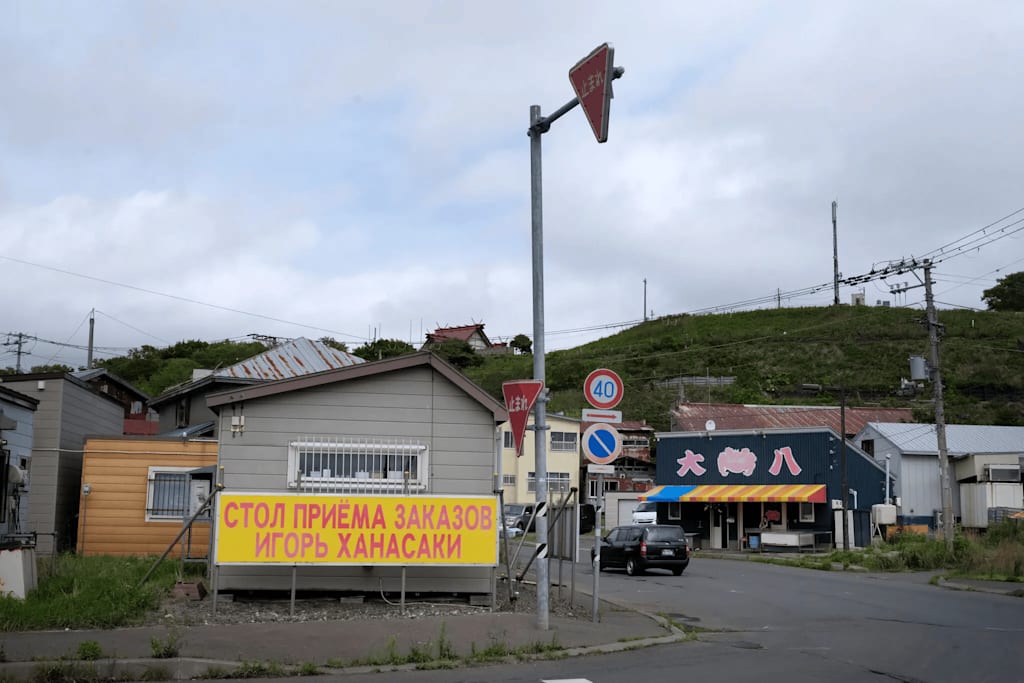
On a clear morning in Nemuro, the disputed islands can appear faintly beyond the water.
The view is part of everyday life in this remote fishing town at the eastern edge of Hokkaido. Nemuro has about 22,000 residents, roughly half the population it had at its peak in the 1960s. Its winters are long and cold. Red spiny king crabs are stacked around the harbor. Fading signs in Japanese, Russian and English hang near the docks. On some days, when the air is clear, the islands claimed by both Japan and Russia can be seen in the distance.
For people in Tokyo or Moscow, the dispute may be a question of sovereignty, treaties and military power.
In Nemuro, it can affect the next fishing season.
The town depends on Russia for trade and fishing ties while also serving as one of Japan’s most visible centers for the campaign to reclaim the four disputed islands. The contradiction is not hidden. It is printed on signs at the port and discussed inside City Hall.
A visit that reached the harbor almost immediately
The news arrived on a summer day in August.
President Vladimir Putin had traveled to Iturup, one of the four islands at the center of the dispute. It was his first personal visit to the Kuril Islands during his quarter-century in power. During the trip, he toured a fish-processing complex, visited a hospital and a school, and was shown on Russian state television receiving caviar and greeting residents.
Japan protested.
Prime Minister Sanae Takaichi called the visit "absolutely unacceptable" and said it had hurt the feelings of the Japanese people. Tokyo also objected to a new map that used the same yellow coloring for Russia and the disputed islands.
In Nemuro, Mayor Masatoshi Ishigaki was watching more than the diplomatic exchange. He was thinking about what another confrontation between Japan and Russia might mean for the town outside his office window.
"When friction arises between Japan and Russia, the pain is felt here immediately," he told The New York Times. The islands are only a few miles from Nemuro’s southern edge.
The dispute has been unresolved since 1945, when Soviet forces seized the islands in the final weeks of World War II. Japan calls them the Northern Territories. Russia calls them the southern Kurils. Tokyo has continued to demand the return of four islands, or at least a negotiated settlement involving them, while Moscow has resisted. The two countries still have no formal peace treaty ending World War II.
Putin’s visit brought the dispute back into the center of the political conversation. Analysts cited by The New York Times said the move could pressure the Japanese government and strengthen nationalist sentiment inside Russia. Russian military activity in nearby waters had also increased in frequency and scale.
For Nemuro, none of that stayed far away.
The Russians who used to fill the streets
There was a time when Russian sailors were familiar faces in Nemuro.
They came into town from nearby Russian ports. Some shops stocked refrigerators, ovens, bicycles, smartphones and televisions for them. Local schools still teach Russian, a remnant of a period when the language had a practical purpose in daily commerce. Posters in Cyrillic still hang around the port, even as the paper fades and the edges curl. One tells foreign sailors to navigate safely.
Then the traffic thinned.
Relations between Japan and Russia deteriorated, and many Russian visitors stopped coming. Restaurants lost customers. Bars became quieter. Seafood processors felt the decline. The Russian vessels that still arrive bring sea urchin, mackerel and kelp, but the people on those ships are no longer part of the same steady flow into town.
Alexey Dudka, a sailor from Kholmsk, stopped in Nemuro while his ship was being repaired.
"It feels like we’re the last of the Russians," he said.
For a port town built partly around that traffic, the absence can be measured without a statistic. Fewer people at the restaurants. Fewer Russian voices in the commercial streets. Fewer purchases in the shops.
Nemuro’s demographic problems were already severe. Young people have left for schools and jobs in Tokyo and other cities. At the same time, Russian restrictions on salmon and trout fishing and a decline in trade have added pressure to the local economy. The population is now about 22,000, compared with roughly 50,000 in the 1960s.
The town’s connection to Russia has therefore become harder to separate from the dispute over territory.
Nemuro wants the islands back.
Nemuro also wants customers.
A political cause carried by people who are getting older
The campaign over the Northern Territories is visible throughout the town.
Posters declare that the islands are Japanese territory. Museums display old books and maps that are intended to document Japan’s historical ties to them. Japan traces its claim to the 17th century.
For decades, former residents of the islands have been among the strongest voices in that campaign.
Their numbers are shrinking.
About 4,700 former residents are still alive in Japan, down from roughly 17,000 people who were expelled by the Soviet Union after the war. Their average age is around 90.
Hiroshi Tokunou is 92.
He was 11 when Soviet troops arrived in 1945. For a short period, he lived and studied alongside Soviet residents. He and his relatives were later sent to an internment camp to make room for incoming Soviet families. In 1947, they were allowed to return to Hokkaido.
Tokunou still wants Japan to deal firmly with Russia. He also speaks about leaving room for relations to improve in the future.
The tension is not theoretical for him. It comes from the fact that he remembers the islands as a place where people lived before they became the center of an argument between states.
He also worries about what happens when his generation is gone.
Outside a local supermarket, 34-year-old Natsumi Nishita offered a different view.
Nishita teaches English at a cram school in Nemuro. She said it is difficult for people her age to feel the same attachment to the territorial dispute as older residents do. There are other pressures, she said, especially the local economy.
Putin’s visit, in her view, was simply one political event among many.
"People here don’t think it’s a big deal," she said.
That gap between generations matters because the political campaign depends heavily on memory.
Memory does not stay the same when the people carrying it age.
The islands also exist as an economic calculation
Ishigaki, Nemuro’s mayor, looks at the dispute in another way.
For him, the islands are not only historical territory. They also represent economic activity that Japan does not currently control. The Nemuro municipal government estimates that fisheries, seafood processing and related activity could generate about $462 million a year if Japan controlled the islands.
The number is an estimate, not realized income. It describes what the local government believes could be generated under a different political and territorial arrangement.
Ishigaki is 75.
"We want to resolve this issue while we are still alive," he said.
That sentence carries two different clocks.
One is political. The dispute has lasted more than eight decades.
The other is personal. The people who remember the islands before 1945 are now in their eighties and nineties.
At the same time, Nemuro still has practical reasons to keep its relationship with Russia from collapsing further.
Japan imports about 10 percent of its liquefied natural gas from Russia, according to the New York Times, and Tokyo is also dealing with energy concerns linked to the war involving Iran. The wider Asian LNG market has faced supply disruptions and higher prices in 2026 as fighting around the Gulf has affected shipments and pushed buyers to look for other sources.
Against that backdrop, the Japanese government has not imposed new penalties on Moscow simply because Putin visited the disputed islands. The government had also appeared interested earlier in 2026 in restoring some trade and cultural exchanges with Russia, though the visit has complicated those efforts.
The strategic problem is visible from a small town on the edge of Hokkaido.
A harder line may satisfy one political demand while creating new economic costs.
A softer line may reduce those costs while leaving the territorial dispute unresolved.
Nemuro experiences both sides at once.
The islands are also a place people remember by smell
Every year, Nemuro holds ceremonies for ancestors buried on the disputed islands.
The ceremonies used to take place at graves on the islands themselves, with Moscow’s permission. After Japan imposed sanctions on Russia in 2022, Putin suspended those visits. The memorial rituals now take place at sea.
On a stormy morning this month, 81-year-old Taiko Kodama boarded a ferry called the Puffin.
Kodama was born in the disputed territory.
She left in 1947, when she was three years old.
She carried two black stones from the islands in her purse.
On the boat, she prayed for her parents and grandparents and laid flowers in their memory. She said she still remembers the smell of kelp from the place where she grew up.
"Our homes were taken from us unfairly," she said.
The stones are small enough to disappear inside a wallet or a pocket.
The political dispute is not.
It reaches from Tokyo ministries to Russian military exercises, from energy imports to fishing rights, from old maps inside a museum to the quiet streets around a harbor where Russian sailors no longer come as often.
In Nemuro, those things sit next to each other.
A Russian vessel can still arrive with seafood.
A Japanese sign can still demand the return of the islands.
A younger resident can look at the dispute and think about wages and prices instead.
An older resident can still carry two black stones from home.
The islands remain visible on a clear day.
The people who remember living there are becoming harder to find.
About the Creator
Jin
Writer of reamstories
https://reamstories.com/jin
Enjoyed the story? Support the Creator.
Subscribe for free to receive all their stories in your feed. You could also become a paid subscriber, letting them know you appreciate their work.
Comments
There are no comments for this story
Be the first to respond and start the conversation.