
I Grew Up in Nanjing and Still Get Lost. That’s How I Found It.
I Grew Up in Nanjing and Still Get Lost. That’s How I Found It.
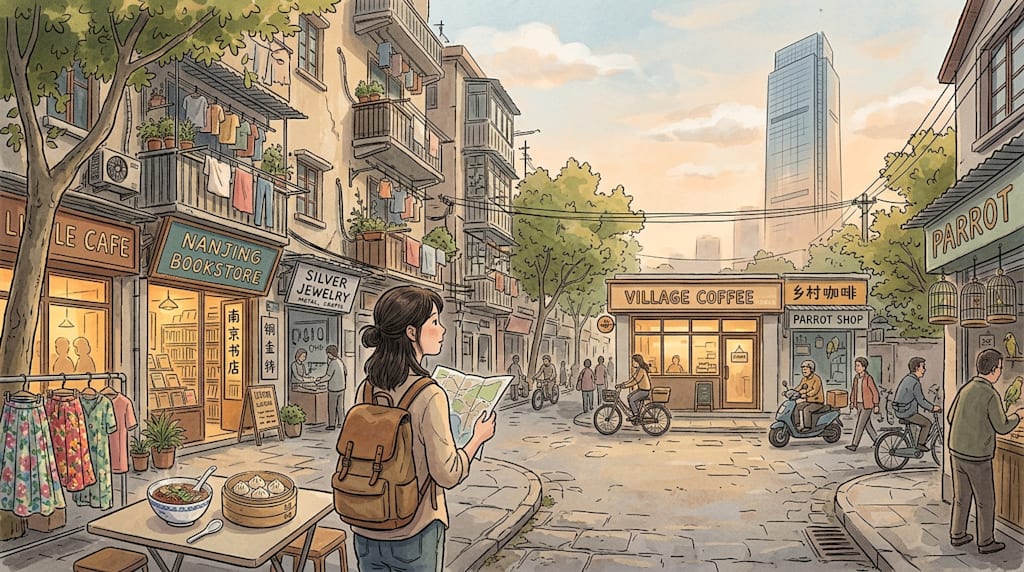
You grew up in Nanjing and still get lost there. That used to be annoying. Now it gives you a reason to wander.
You have already been to Ganxi, Mendong, and Jiming Temple. Those places are fine. They are also crowded, polished, and easy to see in one afternoon. What you want now is the rest of Nanjing: small streets, outer districts, coffee, duck fat, and wrong turns.
Start with an alley.
Jinyin Street and Taogu Xincun: the artistic pulse beside the university
Take the metro to Yunnan Road or Gulou. Walk into Jinyin Street.
There is a wall that says, “We love Nanjing so much.” People line up for photos. You can skip the line and walk to Taogu Xincun instead.
Taogu Xincun sits behind Nanjing University. Old apartment blocks, small shops, plane trees, and students share the same streets. It is a neighborhood you can drift through.
Vintage shops hang old shirts and floral skirts. In one handmade shop, someone makes velvet flowers. The cafes seat four or five people. The owner may not look up. They might only ask, “What are you drinking?” That suits you. You do not have to explain why you are there. You order, sit down, and watch the street.
Jinyin Street and Taogu Xincun are not tourist sights. They are where young people in Nanjing actually spend a Saturday.
You grew up here, so you may not have looked at the city this way. Nanjing does not always act like a Six Dynasties capital. Sometimes it sells strangely named coffee in an alley and plays a song you have never heard.
Xiqiao and Yihe Road: old and new facing each other
From Taogu Xincun, walk to Xiqiao.
Stand at the alley entrance. On one side are old apartment buildings with laundry on the balconies. On the other side is Zifeng Tower, bright with glass. Old and new Nanjing fit in one photo.
Go between 4 and 6 p.m. for the best light. You do not need a special angle. Wait for an electric bike to pass. Watch an aunt carry groceries home. Let the sunset turn the rooftops orange.
Yihe Road is next. Plane trees form a long arcade. In summer they shade the street. In autumn they cover it. Republican-era villas line both sides. Most doors are closed. The stories stay behind the walls.
It is quiet without feeling empty. A car rolls past. An old man walks a dog. A couple takes photos.
On Yihe Road, look for Yinwuji. It sits in a former celebrity residence and makes silver jewelry by hand. Walk in. Watch the craftsman tap the metal. Listen to the small sound. Nanjing’s history stops being a textbook word. It becomes a cool piece of silver in your palm.
Bookstores and art spaces: quiet is a luxury
If you want to spend an afternoon in one place, try these.
Librairie Avant-Garde on Yihe Road occupies a Republican-era building. The second floor has a cafe. Outside are plane trees. Inside are books and low music. You can stay for hours without buying anything.
Puyue Bookstore hides in the Old Academy Creative Park. It used to be a factory. The space is large. There is a reading area, a cafe, and a terrace. Next door is the former site of the Jiangnan Naval Academy, where Lu Xun once studied. Sit on the terrace with a book. Time feels layered, like plane tree leaves.
Jinchuang Book City Yihe STATION is small but well designed. It looks like an old waiting room. You half expect a slow train to the Republican era. Coffee, postcards, and small exhibitions fill the space.
T80 Science and Technology Culture International Community sits at the foot of Purple Mountain. It used to be a Republican-era school from 1934. Puzhu Caotang is woody and quiet. Degassing serves coffee. Plane trees and old villas surround the area. Few people go. Walk slowly.
These places do not shout at you. You can sit without spending much. No one forces you to check in. They give the city room to breathe.
Another side of the suburbs: walk Nanjing into a distant place
She Village is in Jiangning. It is a Ming and Qing village with six hundred years of history. It has not been over-commercialized. More than thirty rural coffee shops have opened there. Yeyou also has a wide window. Nanfeng Xiaowu is quiet. Xiangye lets you make incense. Backyard sells handmade goods. Old people pick vegetables at their doors. Young people drink coffee and take photos. Old and new live together without much tension.
Qiqiao Ancient Village in Gaochun is older. It has more than two thousand years of history and is called “Nanjing’s first ancient village.” There are no chain stores. People still live there. The stone slabs are polished by footsteps. You are not touring a set. You are walking through someone’s daily life.
Huaishi de Feng in Liuhe was built from an abandoned mine pit. It has a country courtyard, a wild garden, and a lawn for sunsets. Granary π in Yuhuatai District is a cultural park made from red-brick warehouses. It holds contemporary art seasons. Feiyan Culture Industry Block in Lishui District used to be a piston ring factory. The old plant remains.
None of these places are in the main city. That is why they feel like another Nanjing.
Eating: Suojin Village, Tongjia Lane, and Sanpailou
You cannot walk Nanjing without eating.
Suojin Village is a local food spot. Jinghua Soup Dumplings serves five-flavor soup dumplings. Jinyuan Duck Blood Vermicelli Soup has its main store there. Yixiangxuan Clay Pot is nearby. Locals dip soup dumplings into duck blood vermicelli soup. Some buy half a Chenlin duck and half a Zhangzheng braised food and make a table of it. Going alone is fine. Snack shops do not rush you.
Tongjia Lane has the Halal Northwest Qiaotou Noodle King. People call it the hidden king of potstickers by Xuanwu Lake. Sanpailou is where Nanjing University of Posts and Telecommunications students eat late at night. Mingwalang sits in the middle of Xinjiekou. It is a maze of snack stalls and small shops. Walk and eat. No plan needed.
Creativity and special destinations
Sanniaocang Art Space is in Huashu Village, Qixia District. It used to be a gypsum mine factory. Old gasoline barrels become sofas. Bicycles hang on walls. Gas tanks become flower pots. A woman born in the 1990s turned the ruins into a studio.
Guochuangyuan YARD9 Block sits by the city wall. It looks like a courtyard house. After renovation, it became a slow spot for art and small shops. Parrot Kindergarten is beside Xinghu Park in Jiangbei. You can get close to parrots. A person born in the 2000s runs it.
These places are small. Each one says: Nanjing can be like this too.
A walking plan for people who get lost
You do not have to finish everything in one weekend. Getting lost means you will not obsess over the endpoint.
Try this route: Yunnan Road, Jinyin Street, Taogu Xincun, Xiqiao, Yihe Road, Librairie Avant-Garde. It is all walkable. Stop in a cafe when you are tired.
Or try: T80, Puyue Bookstore, the foot of Purple Mountain. Or: Suojin Village, Xuanwu Lake, Tongjia Lane, and eat all day. Or take a Sunday bus to She Village or Qiqiao. Make Nanjing feel far away.
If you get lost, get lost. Nanjing is not a checklist. You grew up here. You can still find a new street on an ordinary Saturday. Take the metro. Walk into an alley. Order something. See where you end up.
About the Creator
Jin
Writer of reamstories
https://reamstories.com/jin
Enjoyed the story? Support the Creator.
Subscribe for free to receive all their stories in your feed. You could also become a paid subscriber, letting them know you appreciate their work.
Comments
There are no comments for this story
Be the first to respond and start the conversation.