
I Drove G318 Into Tibet With a Dog, an Oxygen Cylinder, and a Plan I Had to Break
What the road from Kangding to Lhasa taught me about altitude, hotel rooms, bad pavement, and the small stops that keep a trip from becoming a rescue story.
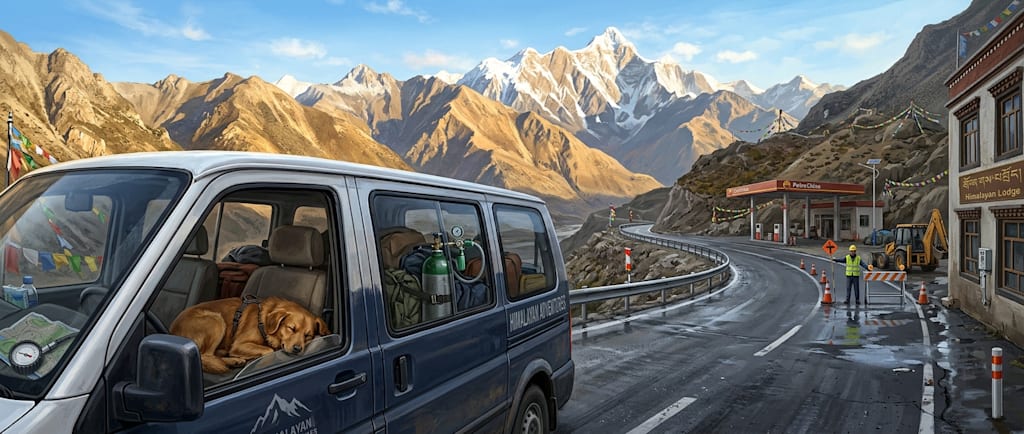
At the Tianquan Service Area, the dog was sprawled on its back in the passenger seat, asleep. I unscrewed a bottle of water and tucked the tire-pressure gauge back into the door pocket. G318 was everywhere: on the walls, on the pillars, at the entrance to the convenience store. Someone was holding up a phone to take pictures. Someone else was squatting beside a car, strapping on snow chains. The gas-station attendant had seen it all before and pointed ahead. “Go inside. Hot water is behind the restrooms.”
G318 begins with a tank of gas, a bottle of water, a dog, and a decision about where to sleep that night.
Before setting out, I made an itinerary:
D1, D2: departure to Kangding, 1,700 km, 19 hours, elevation 2,600 m
D3: Kangding to Yajiang, 150 km, 4 hours, 2,600 m; Zheduo Pass, Xinduqiao
D4: Yajiang to Batang, 300 km, 6 hours, 2,570 m; Maoya Grassland, Genyen, Sisters Lakes
D5: Batang to Rumai Town, 150 km, 4 hours, 2,630 m; Jinsha River Bridge
D6: Rumai Town to Basu, 300 km, 7 hours, 3,275 m; Meiyu Grassland, Nujiang 72 Turns
D7: Basu to Bomi, 250 km, 5 hours, 2,750 m; Ranwu Lake, Midui Glacier
D8: Bomi to Suosong Village, 300 km, 6 hours, 3,300 m; Lulang, Sejila Pass, Yani Wetland, Buddha Palm Dune, Namcha Barwa
D9: Suosong Village to Lhasa, 500 km, 6 hours
In practice, I made two changes. After leaving Kangding, I did not rest in Yajiang. My mind and body were still fine that day, so I drove overnight to Batang and saved a day. After leaving Batang, I did not stop in Rumai Town, and I did not push all the way to Basu. I stayed one night in Zogang and drove from Zogang to Bomi the next day.
Those changes show that a plan needs room to move. But one warning belongs up front: beginners should not copy the overnight-driving part. Mountain roads at night bring falling rocks, trucks, and fatigue. The risk is much higher than in daytime. I could make those changes because my condition allowed it. When your condition is average, driving less is a better deal than forcing yourself onward.
Where you stay determines whether you can drive well the next day
Accommodation is the part most worth planning. First, look at how far you plan to drive that day. On G318 in peak summer, 300 km can easily take eight hours, even with relatively smooth traffic. If there is a crash, roadwork with one-way releases, or a landslide, you cannot calculate time by the navigation app anymore. Speed cameras, checkpoints, and scenic stops all eat up time.
Then look at altitude. If you sleep badly at high altitude, you will be in poor shape the next day, and road safety suffers. When I book a room, I do a few concrete things. I check the hotel’s elevation on a map. I call the front desk and ask whether the room has an oxygen concentrator or an oxygen outlet. I note the night’s fuel level, the next day’s fuel level, and gas-station locations in my phone.
On the way into Tibet, I stayed overnight in Kangding, Batang, Zogang, Bomi, and the Yarlung Tsangpo Grand Canyon. Kangding is 2,600 m, Batang 2,570 m, Bomi 2,750 m, and Suosong Village 3,300 m. These are generally suitable for rest. Zogang is relatively high. The hotel I stayed in had an oxygen concentrator outlet on the wall. Only after I connected the tubing at night did I sleep soundly. Zogang is not my first choice for low altitude. It was an adjustment based on time and energy. Beginners who follow Rumai and Basu will have a steadier altitude plan.
Any car can enter Tibet, but drivable and easy to drive are different
You see every kind of vehicle on G318: gasoline cars, electric cars, business vans, SUVs, motorcycles, bicycles, and even a person walking a dog. The main road has fuel, food, and lodging. I was driving a business van, and it was fine on the main route.
Some sections are plainly bad. There are potholes and roadwork with one-way alternating traffic. Getting through at all is already good. On bad roads I kept my speed down and gripped the wheel tightly. Nearby, off-road vehicles on all-terrain tires seemed to glide over the surface. A reliable off-roader or SUV is preferable, and the tires give you a higher margin of safety.
The things I carried were nothing fancy: a tire-pressure gauge, an air pump, tire-repair tools, a tow rope, a jump starter, windshield washer fluid, a spare tire, offline maps, and cash. In a gasoline car, refuel when the tank is half empty. In an electric car, plan charging in advance and leave a buffer. The dog was secured with a seatbelt, and its water bowl sat where it could reach it without spilling. Ask before booking whether a hotel accepts pets. Do not wait until you reach the front desk to argue.
First time entering Tibet: stick to the G318 main road
If time is tight, finish the G318. It is the main road into Tibet, with the fullest supplies and services, and it is the most friendly to first-time self-drivers. Side routes have richer scenery and higher risks. Unpredictable factors are the biggest safety issue.
As you approach Nyingchi, you can detour into the Yarlung Tsangpo Grand Canyon. Look at Namcha Barwa. Look at the surging Yarlung Tsangpo below. Construction on the Yarlung Tsangpo hydropower project has caused traffic jams from time to time. I parked at a proper viewing area, turned off the engine, and waited for the clouds to clear. One look at Namcha Barwa was worth it.
In the rainy season, watch for geological hazards and traffic control. Check the weather and road conditions before setting out. When traffic is released, wait your turn. Do not cut in. Do not park for long periods to take photos on landslide traces, beside cliffs or water, or along riverbanks. Do not stop on curves, narrow roads, or at tunnel entrances. Cattle, sheep, and motorcycles can enter the road without warning. Keep your foot ready over the brake.
Altitude sickness does not pick people. Oxygen is your fallback.
Altitude sickness does not pick people. Above 4,000 m I need oxygen. Above 5,000 m I am almost collapsed. On the way into Tibet, 4,000 m is normal, and there are plenty of places above 5,000 m. I carried a car-mounted oxygen concentrator and several oxygen cylinders. I restocked along the way. The oxygen outlets on hotel walls and the oxygen tubing borrowed from the front desk are useful in an emergency.
Beyond oxygen, a few other things matter. Ascend slowly. Move little. Do not catch a cold when you first reach the plateau. Do not wash your hair or shower and get chilled. Do not exercise strenuously. Do not drink alcohol. Clip a pulse oximeter on your finger. If the numbers drop badly, sit down, open the oxygen cylinder, and do not tough it out. For severe headache and vomiting, confusion, or difficulty breathing, descend immediately. Oxygen is your fallback. It is not a reason to prove how tough you are.
The most comfortable places on this route were Suosong and then Bomi. The altitude was low, and I barely needed oxygen. This summer in Lhasa felt better than my winter trip. I attribute that to more oxygen, or maybe I had just slept enough those few days.
Eat and drink well, and keep a bite in the car
The car needs fuel, and people need food. As a northwesterner, Tibetan food is no problem for me. Friends from southeastern China may not be used to it. Along the way, there is more Sichuan food, with heavier flavors that easily cause internal heat. Food costs are not low. Climate and transport costs are what they are.
In Lhasa I ate stone-pot chicken. Authentic Tibetan food includes Tibetan noodles, beef buns, dumplings, and fried pancakes. In Nyingchi I also joined Liu Kanshan for Nepali food. The advantage of self-driving is that you can carry things you like in the car. When you do not want to sit down in a restaurant, you can eat in the car, which improves travel efficiency a little. But a trip like this does not come often. Local food is still worth sitting down for.
Finally, safety shows up as actions you can take with your hands
Leave time for speed limits and checkpoints. For Everest, Ngari, Medog, and other directions, confirm border permits in advance. Buy travel insurance that covers altitude and rescue. Save rescue and hotel phone numbers along the route. Carry your trash with you. Do not drive over grasslands. Do not photograph local people or religious sites without permission. Pay attention to no-fly zones for drones.
There are not thousands of roads into Tibet. G318 is the most important one. Safety shows up as the question “Does the room have an oxygen concentrator?” when booking, the turn into a gas station when the tank is half empty, the brake pressed before a bad road, and the stop at night instead of pushing on.
I tightened the oxygen cylinder, tucked the tire-pressure gauge back into the door pocket, and filled the dog’s water bowl. I set the navigation to the next stop.
About the Creator
Jin
Writer of reamstories
https://reamstories.com/jin
Enjoyed the story? Support the Creator.
Subscribe for free to receive all their stories in your feed. You could also become a paid subscriber, letting them know you appreciate their work.
Comments
There are no comments for this story
Be the first to respond and start the conversation.