
Hong Kong Doesn’t Look Cyberpunk Because It’s From the Future
It looks that way because two hundred years of history got squeezed into a few square miles.
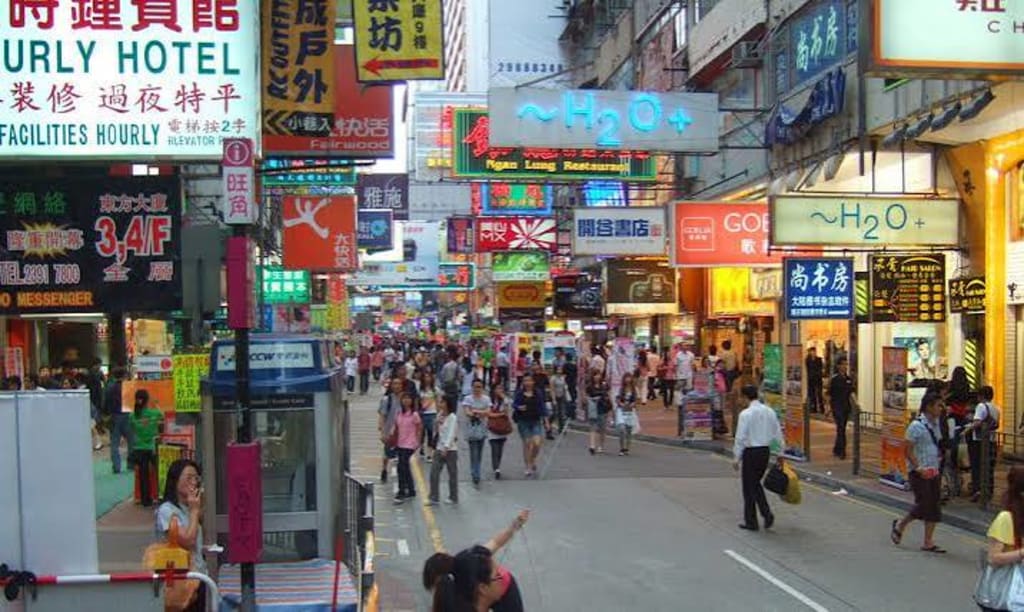
Sai Yeung Choi Street South, Mong Kok, 4 p.m. A young Westerner with a backpack stands outside a pharmacy. He raises his camera at the neon sign jutting three meters over the street. Red background, yellow characters: “大药房.” Under it, “COSMETICS & PHARMACY.” He shoots three frames. He checks the screen. He steps back two paces and nearly hits a delivery handcart. The worker says something in Cantonese. The young man does not understand. He nods, smiles, and keeps shooting.
He does not know the sign now runs on LED tubes. The original glass neon came down through the 2010s. Maintenance cost too much. It drew too much power. It shattered in typhoon season. The photo, with a filter, still looks like Los Angeles in Blade Runner. He posts it: “Hong Kong is cyberpunk.”
The post will get two hundred likes. Nobody will tell him that three generations live above the pharmacy. Nobody will tell him the rent: HK$12,000 for twenty-eight square meters. Nobody will tell him that the Chinese sign in his frame is not inscrutable to the people who pass it every day. They have read it their whole lives.
The West named the city first
Westerners find Hong Kong cyberpunk because they arrive with a visual grammar already built. Ridley Scott and Mamoru Oshii helped build it. Blade Runner came out in 1982. Its art design borrowed from Hong Kong and Tokyo. Hong Kong had not seen the film yet. By Ghost in the Shell in 1995, the template was set: rain, Chinese signs, dense towers, rich and poor in one frame, old buildings beside new technology.
The mismatch is simple. Hong Kong did not design itself for cyberpunk. Cyberpunk borrowed Hong Kong. Western science fiction named the city’s mix “the future.” Later visitors brought that name back as a filter. When the young man shoots the pharmacy sign, he photographs a picture already in his head.
Hong Kong supplies the street. The West supplies the label. Hong Kong supplies the life. The artwork takes the spectacle.
Old buildings are layers, not ruins
Hong Kong looks old because a lot of it was built between the postwar years and the 1980s. That part is true. The city did not stop. It got too dense, too expensive, and too fragmented in ownership to renew all at once.
Walk down Fuk Wa Street in Sham Shui Po. A 1960s tong lau has peeling paint and rusted iron gates. The ground floor holds a coffee shop that opened in 2023. Pour-over Yirgacheffe costs HK$48. On the second floor, laundry poles push out of windows with school uniforms and towels. On the third floor, a small trading company has an “export customs clearance” sticker on the door. Above that, some flats sit empty. Some have had the same residents for decades. Next door is a 1990s condominium. Next to that is a nano flat completed in 2018: eighteen square meters, HK$6 million.
High land prices, fast commercial turnover, and tiny flats forced this stack. Old and new sit above and below each other, and side by side. Replacement is rare. The “old building” you see may have a renovated ground floor, forty years of residents upstairs, and an iron-sheet addition on the roof. It has layers. That is the point.
Kowloon Walled City was an exception
Kowloon Walled City sits at the center of the cyberpunk image. At its peak, thirty-three thousand people lived in 0.026 square kilometers. That is 1.2 million people per square kilometer. No elevators. No property management. Alleys so narrow two people had to turn sideways. A school on the rooftops. Pipes and wires in knots. In the 1980s, Japanese photographers and Western reporters went in and came out with words like “maze,” “city of darkness,” and “anarchist architecture.”
The Walled City came down between 1993 and 1994. The site is now Kowloon Walled City Park. There are pavilions, a pond, and elderly people doing tai chi. Stand there and the old stock-image library is hard to picture.
The visual force was real. The concrete was massive and dense. Standardized blocks collided with unplanned additions. The pressure was real. So was the industrial beauty. But the Walled City was an enclave under special historical conditions. It was not ordinary Hong Kong life. To treat it as the whole city turns an exception into the city’s essence. Locals would say it was “over there,” “from before,” “demolished.”
The neon sign has left Hong Kong
Hong Kong’s neon signs helped build the cyberpunk look. In tight space, signs had to avoid blocking one another and still show themselves. The result looked like order inside chaos. Many “cyberpunk Hong Kong” photos today were not shot in Hong Kong.
LED spread. Sign rules tightened. Rents rose. Commercial formats changed. Glass neon declined. Some photos are color-graded in post. Some come from other cities. Some stitch signs from different locations. The note that “the following photos were taken in China but not necessarily in Hong Kong” makes the point. “Cyberpunk Hong Kong” has become a repeatable symbol set: rain, neon, Chinese characters, narrow alleys, old buildings, pink-blue and pink-red exposure.
Once symbols leave geography, anyone can use them. Bangkok, Taipei, Chongqing, and Kuala Lumpur can all “look like Hong Kong” with the right filter. The grammar travels well. That is why it wins.
The clash comes from history stacking up
The mismatch between the messy and the orderly shows up in street details. Walk through the Ladies’ Market. Dense buildings hang overhead. Shops push out below and squeeze the street until two people can barely pass. Glass neon throws pink and blue-green. A bagua shopfront sits under English LED letters. Bicycles and cars crowd a doorway. An old tram passes a glass curtain wall.
“Order inside chaos” does not cover this. History stacked the pieces: colonial rule, entrepôt trade, manufacturing, finance, migrants, public housing beside private towers, English beside traditional Chinese, Chinese signs beside British trams. Two hundred years of history, three or four cultures, five or six classes, and people from seven or eight countries got packed into an area the size of a small county town.
One moment the city looks dilapidated. The next it looks like an avant-garde model of human development. Nobody designed that effect. Density squeezed it out.
Composure can be discipline
Hong Kong people can seem to carry a clash in their bearing. They do not move like mainland boomtowns, where everyone rushes to make money. They do not look like urban village residents, whose poverty shows in skin, face, and clothes. They do not carry the old Beijing or Shanghai pride, with its mix of disdain and nostalgia for a city that changed under them. Hong Kong can feel like one large company. People settle into a position, do the work, and merge into the city. Even in cramped conditions, they keep a kind of ease.
That ease deserves care. Professional training, contract habits, rules, and long practice can produce it. High rents, long hours, and tight space can also produce it. A cha chaan teng owner sets down char siu rice during the lunch rush and says “慢慢食,” eat slowly. He is not calm. He sets down two hundred plates a day. The phrase is muscle memory. A tram driver stops, opens the doors, closes them, and starts again to the ding-ding. He has done it for twenty years. The sequence no longer needs thought.
Read all of that as elegance and you turn structural pressure into style. The calm surface is real. What sits under the surface cannot be judged from the surface alone.
Resilience lives in habits
In a city full of English, some older people still keep traditions from the past century. An old man holds a newspaper few people read. He wears clothes from a dozen years ago. He sits in a shop with a century-old façade. He eats instant noodles with fried ham. He looks unhurried. You could call it cultural confidence. It also looks like stubbornness, as if forgetting these things would cut something out of the family line.
“Cultural resilience” fits better. It is not an essential bloodline. It is a hybrid identity formed under colonial history, an English-language environment, finance, and migration. People keep traditional characters, Cantonese, festivals, old shopfronts, and cha chaan teng habits. The practice is daily. Under pressure, they keep certain things in life.
The old man eats instant noodles with fried ham because he has eaten them for fifty years. The habit holds. He reads the paper every afternoon. Skip it and the day has a hole. No manifesto. No slogan. No words about confidence. The actions last longer than any manifesto.
The surface and the noodles
Hong Kong can feel Chinese and global, trendy and conservative, industrial and retro. It also feels like spectacle and ordinary life at once.
The young man in Mong Kok finishes shooting the pharmacy sign. He walks into a cha chaan teng and orders wonton noodles. He does not know the price. He does not know what “细蓉” means on the menu. He does not know why the old man at the next table has turned to the horse-racing page. He eats, pays, leaves, and raises the camera again.
The Hong Kong he photographs and the Hong Kong he eats are two cities. They share one frame, one street, one bowl. The cyberpunk look is a surface. The noodles are underneath. Sit down and eat before you decide you know the place.
About the Creator
Jin
Writer of reamstories
https://reamstories.com/jin
Enjoyed the story? Support the Creator.
Subscribe for free to receive all their stories in your feed. You could also become a paid subscriber, letting them know you appreciate their work.
Comments
There are no comments for this story
Be the first to respond and start the conversation.