
China’s 5A Rating Is a Crown That Doesn’t Always Fit
A 5A plaque promises clean toilets and full parking lots. It doesn’t promise a view worth the trip. Here’s how to tell the difference before you book.
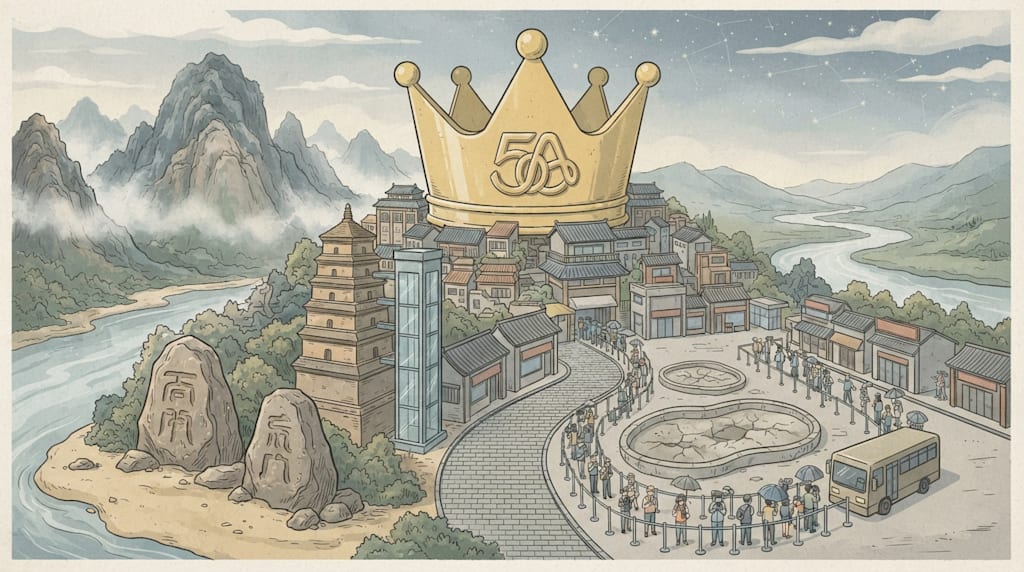
A 5A rating measures toilets, not clouds. Parking lots, not stars. Visitor centers, not history.
When I pick a place to visit, I check three lists: the 5A list, the World Heritage list, and “The Most Beautiful Places in China.” Each list measures something different. 5A sets a floor for facilities. World Heritage sets a ceiling for cultural and natural value. “Most Beautiful” sets a ceiling for visual appeal.
Only a dozen or so places appear on all three: Huangshan, Mount Tai, Mount Emei, Wuyishan, West Lake, Jiuzhaigou, the Li River, Wulingyuan, Sanqingshan. They do not need the 5A plaque. The plaque needs them.
Most 5A sites do not manage that. Some sit on only one list. Some sit on none. They wear the crown anyway.
I. Official Red Cards
In 2015, Shanhaiguan in Hebei became the first 5A site stripped of its rating. The ministry cited price fraud, poor sanitation, and a sharp drop in service. Shanhaiguan anchors Great Wall history. Its management did not match the name “First Pass Under Heaven.”
In 2016, Orange Isle in Changsha and Shenlongxia in Chongqing lost 5A status. The notices listed serious safety hazards, poor sanitation, and missing tourist services. Orange Isle is Changsha’s postcard. Shenlongxia is a natural gorge. A postcard is not an experience. A rating is not competence.
In 2019, the Qiao Family Compound in Shanxi lost 5A status. The reason was over-commercialization. A courtyard that should tell the story of Shanxi merchants was wrapped in shops, stalls, and fake attractions. After the delisting, many people cheered. Shanxi merchant culture deserved 5A. The souvenir stalls did not.
Other 5A sites have been warned or named: Lijiang Old Town, Yulong Snow Mountain, Hukou Waterfall, the Li River in Guilin, Songshan Shaolin Temple, Huangguoshu Waterfall, Wudang Mountain, Tianzhu Mountain, Longhu Mountain, Changbai Mountain, Daocheng Yading, and Laoshan. Their problems include price disputes, crowds, stranded visitors, poor service, weak safety planning, bad shuttle bus routes, and long waits.
Some of these are globally known landscapes. The Li River. Zhangjiajie. Shaolin Temple. Huangguoshu. The scenery is not the problem. Management is. Scenery is a gift. Service is a choice.
II. Tourist Complaints
Official punishments are not the whole story. Tourists leave their own reviews.
Name does not match reality. Tianya Haijiao in Sanya is two inscribed rocks. A common joke says it is the most generous 5A site: it writes “Tianya” and “Haijiao” for you, so you do not have to imagine anything. Wuhan’s Yellow Crane Tower was rebuilt in the 1980s. It has an elevator. The old poem says the immortal rode the yellow crane away. Now tourists ride the elevator up. Huaqing Pool in Xi’an draws people who know the line about warm spring water and smooth skin. They find dry cement pools.
Over-commercialization. Gulangyu in Xiamen once drew artists and romantics. Many tourists now see it as a place to be overcharged. The island is full of identical internet-famous shops, milk tea stands, and souvenir stores. The Piano Museum and old villas remain. The commercial noise drowns them out. Around Yangshuo and the Li River, the scenery is globally famous. The experience suffers from dual-price menus, restaurant ripoffs, poor transport, and traps. Tourists will spend money. They will not spend it blind.
Chaotic management. Zhangjiajie has extraordinary scenery. Wulingyuan is a World Natural Heritage site. Tianmen Mountain is a wonder. Holiday management is the weak point: long queues, crowds, stranded visitors, poor service. A common tourist line says the scenery is heaven, the management is earth, and the queue is hell. Fanjing Mountain in Guizhou gets called a sad place in Guizhou tourism. Tickets are hard to get. Queues are brutal. One hour of scenery can cost five hours of waiting.
Fake antiques. The Three Kingdoms Red Cliff Ancient Battlefield often gets called the weakest 5A candidate. A few real relics sit among shoddy fake antique buildings with rust and bad paint. Many city “ancient streets” are the same. New gray bricks. New archways. Shops selling the same internet snacks and Yiwu trinkets.
City parks with crowns. Nantong’s Hao River Scenic Area sits on flat land. Local visitors call it watery. Harbin’s Sun Island gets described as a big park. Some visitors say Nanjing’s Confucius Temple is a snack street in a cultural coat. Tianjin Ancient Culture Street often gets called too commercial. Shenzhen’s Window of the World and Happy Valley are theme parks. They are commercial by design. That makes their 5A status a different argument.
III. Why the Mismatch
First, the rating system weighs facilities more than scenery. 5A sets high standards for toilets, parking, visitor centers, signs, and service. It gives less weight to whether the view is unique. A site with good hardware and ordinary scenery can still pass.
Second, local governments want the plaque. 5A brings attention, investment, visitors, higher ticket prices, and land value. Local budgets pay for infrastructure, paperwork, and review preparation. Once the plaque arrives, it becomes a cash machine. It should be a service promise.
Third, the exit door is narrow. Few sites lose 5A. Many get warnings. After rectification, they return. Once the news cycle moves on, the old problems often stay.
Fourth, bundled applications dilute quality. Laojun Mountain and Jiguan Cave. Yuelu Mountain and Orange Isle. Penglai Pavilion, Sanxian Mountain, and Eight Immortals Crossing the Sea. Mulan Cultural Tourism Area. These are packaged 5A sites. The core can be strong. The attached parts can be weak. Tourists go for the core and get stuck with the rest.
Fifth, ticket economics and shuttle bus economics. Shuttle buses should help visitors. They often become revenue tools. Routes are badly designed. Prices are high. Queues are long. Tourists do not hate shuttle buses. They hate being shuttled.
Sixth, the lists do not line up. A 5A site is not always beautiful. A beautiful place is not always 5A. World Heritage and “Most Beautiful” measure natural and cultural value. 5A measures facilities and service. When the standards split, the crown looks loose.
IV. How to Avoid a Bad 5A
Check the overlap. If a place is on all three lists, it is usually safe. Huangshan, Jiuzhaigou, West Lake, Mount Tai, Mount Emei, Wuyishan, and the Li River are hard currency.
Read the bad reviews. If the same words keep appearing, pay attention: shuttle bus, queue, ripoff, commercialization, fake historic site, expensive ticket, park-within-a-park.
Check whether the core sight is thin. If the whole place hangs on one rock, one building, or one pool, the 5A may come from hardware, not scenery.
Check for bundled 5A. Find the core. Find the attached sites. Decide what you actually want to see.
Check the punishment history. A site that has been delisted, severely warned, or named for rectification should get lower expectations.
Check peak season management. Some places are fairylands off-season and battlefields on holidays. 5A service often cracks under holiday pressure.
V. Conclusion
5A should be a service benchmark. It can be a floor for facilities. It should not be a ceiling for scenery. The best places stay with you after you leave. Not because you waited in line, but because you saw clouds, stars, history, and mountains.
Some sites treat 5A as a finish line. They lie flat. Others treat it as a starting line. They maintain, repair, and improve. The first group gets bad reviews. The second group earns its crown.
A crown is not a mountain. A rating is not a view. The Li River does not need the plaque. The plaque needs the Li River.
About the Creator
Jin
Writer of reamstories
https://reamstories.com/jin
Enjoyed the story? Support the Creator.
Subscribe for free to receive all their stories in your feed. You could also become a paid subscriber, letting them know you appreciate their work.
Comments
There are no comments for this story
Be the first to respond and start the conversation.