
United States Next-Generation Sequencing Market Set for Explosive Growth Through 2034
Precision Medicine, Technological Innovation, and Genomics Investment Drive a Transformative Era in U.S. Healthcare

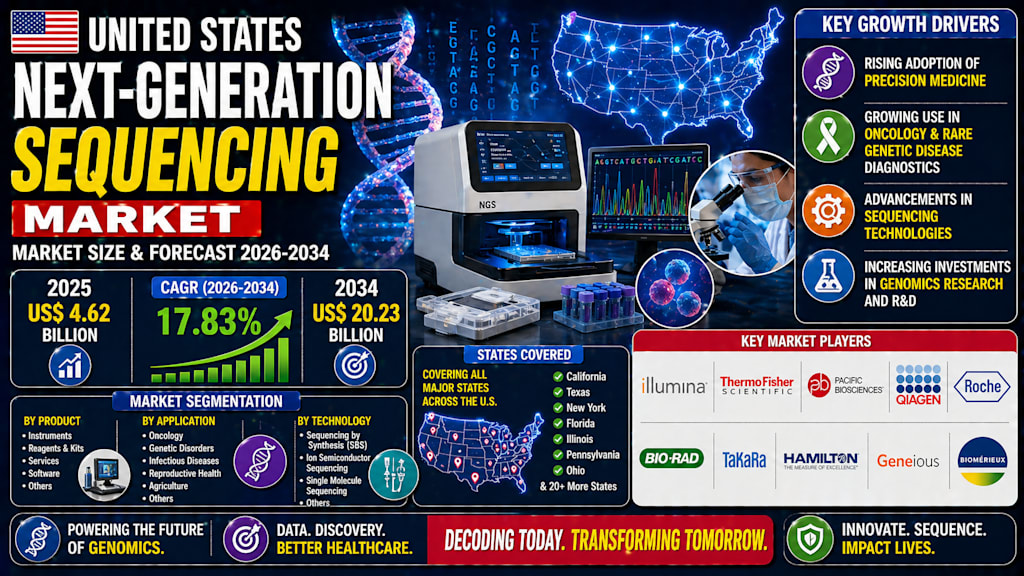
The United States Next-Generation Sequencing (NGS) market is entering a phase of remarkable expansion, redefining how healthcare, diagnostics, and drug discovery operate. Once confined to advanced research labs, NGS has now become a cornerstone of modern medicine—powering breakthroughs in cancer care, rare disease diagnosis, and personalized therapies.
According to Renub Research, the U.S. NGS market is projected to surge from US$ 4.62 billion in 2025 to US$ 20.23 billion by 2034, expanding at a striking CAGR of 17.83% from 2026 to 2034. This rapid growth reflects not just technological evolution, but a broader shift toward data-driven, individualized healthcare.
What is Next-Generation Sequencing and Why It Matters
Next-Generation Sequencing, often referred to as NGS or second-generation sequencing, is a high-throughput technology that enables the simultaneous sequencing of millions of DNA and RNA fragments. Unlike traditional sequencing methods, NGS is faster, more scalable, and increasingly cost-effective.
This capability has opened the door to applications that were once unimaginable. From mapping entire genomes to detecting minute genetic mutations, NGS is transforming fields such as:
- Oncology research and diagnostics
- Rare disease identification
- Infectious disease surveillance
- Fertility and reproductive health
- Drug discovery and development
In simple terms, NGS allows scientists and clinicians to “read” the genetic blueprint of life with unprecedented accuracy—and use that information to guide real-world medical decisions.
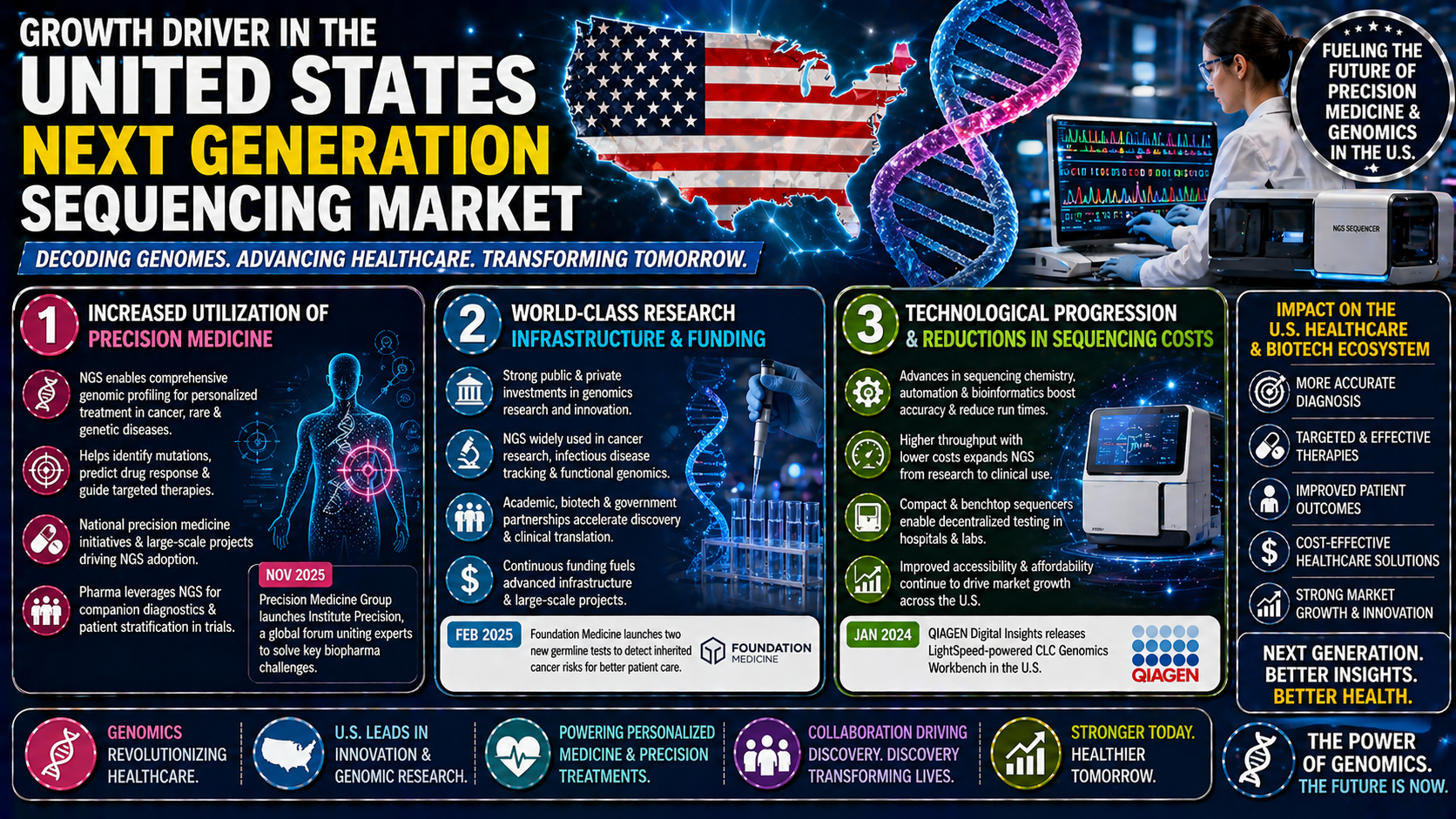
Market Growth Fueled by Precision Medicine
One of the most powerful drivers of the U.S. NGS market is the growing adoption of precision medicine. Rather than applying a one-size-fits-all approach, precision medicine tailors treatment based on an individual’s genetic makeup.
NGS plays a central role in this shift. It enables healthcare providers to:
- Identify disease-causing mutations
- Select targeted therapies
- Predict patient response to drugs
- Monitor disease progression
As precision medicine initiatives expand across the United States, demand for high-quality sequencing platforms continues to rise. Pharmaceutical companies are also leveraging NGS to develop companion diagnostics and improve clinical trial outcomes.
A notable development in this space includes the launch of collaborative platforms like Institute Precision, which brings together scientists, regulators, and biopharma leaders to tackle complex challenges in drug development and genomics.
Strong Research Infrastructure Strengthens Market Leadership
The United States maintains a dominant position in the global NGS landscape, largely due to its robust research ecosystem. Public institutions, academic centers, and private biotech firms collectively invest billions into genomics research each year.
This ecosystem supports:
- Large-scale population genomics studies
- Advanced cancer research programs
- Infectious disease monitoring systems
- Functional genomics and biomarker discovery
Recent innovations, such as new germline testing solutions for inherited cancers, demonstrate how research investments are translating into clinical applications.
Additionally, government funding and venture capital continue to fuel innovation, ensuring that the U.S. remains at the forefront of genomic science.
Technology Advancements Lower Costs and Expand Access
Technological progress is another key catalyst driving the NGS market. Over the past decade, advancements in sequencing chemistry, automation, and bioinformatics have significantly improved performance while reducing costs.
Key innovations include:
- Faster sequencing run times
- Higher accuracy and throughput
Compact benchtop sequencers for clinical settings
Advanced bioinformatics tools for data analysis
These improvements are making NGS more accessible to hospitals, diagnostic labs, and even smaller research facilities. The transition from large-scale sequencing centers to decentralized clinical use is a major milestone in the industry’s evolution.
Lower costs are particularly important, as they enable wider adoption across healthcare systems and support the integration of genomics into routine medical care.
Expanding Applications Across Healthcare and Life Sciences
The versatility of NGS technology is one of its greatest strengths. It is no longer limited to research—it is now deeply embedded in multiple sectors:
1. Clinical Diagnostics
NGS is widely used for:
- Cancer profiling
- Prenatal screening
- Rare disease diagnosis
- Infectious disease detection
Its ability to provide comprehensive genetic insights makes it invaluable in clinical decision-making.
2. Drug Discovery and Development
Pharmaceutical and biotech companies rely on NGS for:
- Target identification
- Biomarker discovery
- Pharmacogenomics research
- Companion diagnostics development
This accelerates drug development timelines and improves success rates in clinical trials.
3. Academic and Research Applications
Universities and research institutions use NGS for:
- Genome mapping
- Evolutionary studies
- Agricultural genomics
- Environmental research
The technology’s flexibility ensures its relevance across diverse scientific domains.
Market Segmentation Highlights
The U.S. NGS market can be segmented into several key categories:
By Product
- Instruments
- Reagents & Consumables
- Services
By Application
- Diagnostics
- Drug Discovery
- Personalized Medicine
- Agriculture & Animal Research
By Technology
- Sequencing by Synthesis (dominant segment)
- Ion Semiconductor Sequencing
- Nanopore Sequencing
- Single Molecule Real-Time Sequencing
By End User
- Academic & Research Centers
- Pharmaceutical & Biotechnology Companies
- Hospitals & Clinics
Among these, sequencing by synthesis remains the leading technology due to its accuracy, scalability, and widespread adoption across research and clinical settings.
Regional Dynamics Within the United States
The growth of the NGS market is not uniform across the country. Certain states have emerged as major hubs of innovation and adoption:
California
A global leader in biotechnology, California hosts numerous genomics companies and research institutions. Strong venture capital funding and early adoption of advanced technologies make it a key driver of market growth.
New York
With world-class medical facilities and large patient populations, New York plays a critical role in clinical research and precision medicine initiatives.
Texas
Rapid population growth and expanding healthcare infrastructure are fueling NGS adoption in Texas, particularly in cancer diagnostics and infectious disease research.
New Jersey
Known for its pharmaceutical industry, New Jersey is a major center for drug discovery and clinical trials, where NGS plays a crucial role.
These regional ecosystems collectively strengthen the national market and support innovation across multiple sectors.
Challenges Hindering Market Growth
Despite its strong growth trajectory, the U.S. NGS market faces several challenges:
1. Data Management Complexity
NGS generates massive volumes of genomic data, requiring advanced bioinformatics tools for analysis and interpretation. Many healthcare institutions struggle with:
- Data storage
- Integration with existing systems
- Shortage of skilled bioinformaticians
This complexity can increase costs and slow adoption.
2. Regulatory and Reimbursement Issues
The regulatory landscape for NGS is evolving, and reimbursement policies remain inconsistent. Challenges include:
- Uncertain approval processes
- Variation in insurance coverage
- High compliance costs
These factors can delay the commercialization of new tests and limit accessibility.
Rising Demand for NGS Services
As NGS technologies become more sophisticated, many organizations are choosing to outsource sequencing and data analysis services rather than invest in expensive infrastructure.
This trend is particularly strong among:
- Pharmaceutical companies
- Research institutions
- Clinical laboratories
Service providers offer end-to-end solutions, including sequencing, data interpretation, and reporting—making NGS more accessible to a broader range of users.
Future Outlook: A Genomics-Driven Healthcare Revolution
The future of the U.S. Next-Generation Sequencing market is undeniably promising. With continued advancements in technology, increasing adoption of precision medicine, and strong investment in genomics research, NGS is set to become a foundational element of modern healthcare.
Key trends shaping the future include:
- Integration of AI and machine learning in genomic analysis
- Expansion of liquid biopsy and non-invasive diagnostics
- Growth in population-scale genomics projects
- Increased focus on preventive and personalized healthcare
As these trends converge, NGS will not only improve patient outcomes but also redefine how diseases are diagnosed, treated, and prevented.
Final Thoughts
The United States Next-Generation Sequencing market is more than just a rapidly growing industry—it is a transformative force reshaping the entire healthcare ecosystem. From enabling personalized treatments to accelerating drug discovery, NGS is at the heart of a new era in medicine.
While challenges such as data complexity and regulatory hurdles remain, the overall trajectory is clear. With a projected market size exceeding US$ 20 billion by 2034, NGS is poised to become an indispensable tool in both clinical and research settings.
About the Creator
Enjoyed the story? Support the Creator.
Subscribe for free to receive all their stories in your feed.
Comments
There are no comments for this story
Be the first to respond and start the conversation.