vintage
A look back at gender politics throughout history including vintage feminism, misconceptions about women, the evolution of women's rights and more.
The Way of Being Grateful
Virtues are just as strong as vices. I ask myself if I'm a virtuous woman. I ask myself "Am I patient? Am I honest? Am I compassionate? Justified? Prudent? Faithful? Virtues are not easy. Vices are easy. I can easily say I can be too proud sometimes and I've known wrath. I can easily admit that envy, lust, and gluttony have caused much grief in my life. Roman philospher Cicero claimed that "Gratitude is a parent of the other virtues" although in many books written about virtues or vices, gratitude is not mentioned. Maybe that's because in November many of us celebrate the official holiday called "Thanksgiving Day" which was made an official holiday in 1863 by Abraham Lincoln. "The holiday was permanently fixed to the fourth Thursday of November by a law signed by President Franklin D. Roosevelt in 1941." (per google, 11/1/25)
By Shanon Angermeyer Norman12 months ago in Viva
Lessons I Wish I Had Learned
Yesterday I had a melt down. I just flipped out all by myself because I couldn't find my favorite dress. I threw all the clothes in my closet and dresser looking for it. Then I realized it was in the dryer and I was so relieved even if I had a lot of clothes to pick up off the floor and put away again. It's a silly dress by fashionista standards. I paid about $20 for it at one of those hard-to-get-to unique stores. It's like that dress that Charlotte was wearing in Vegas when her best gal pals (a scene from Sex and the City) were making fun of her. They said it wasn't classy, kinda cheap looking, kinda "sluttyish"... Charlotte just shrugged. She liked the dress and the way she looked in it. That's exactly how I feel in my favorite dress. It's size XL and stretchy polyester material. It's lightweight and cool and comfortable. It's a simple pattern style design and it accentuates the curvy body. It's perfect for my body. Do you know how hard it is for an inverse triangle body to find a dress that looks good on? Almost impossible. The dresses that they sell at the big name brand department store that go for $50 or more and have the sizes that cater to the above size chart, don't care about my body or the bodies of plus-sized women or the bodies of curvy women who defy that size chart. They never have. And we have driven ourselves crazy trying to keep up with the Jones's and the Kardashians with all the reindeer games of "What are you wearing?" and "Where did you get that thing?" instead of just finding what really looked good on us. Who cares what other's think? How do you feel in it? Do you feel fabulous? Then you found the right dress.
By Shanon Angermeyer Normanabout a year ago in Viva
Old lady grumbling about work
Happy October! May the leaves change colors in glorious autumn fashion and may you enjoy a tasty pumpkin spiced latte or donut this morning. I am here at my desk with a Maxwell House coffee brewed out of the cheapest coffee maker on the Walmart shelf. I like it. One button and will brew the cheapest coffee on the shelf. Good. I'm broke and I'm cheap just like my coffee maker.
By Shanon Angermeyer Normanabout a year ago in Viva
"Bera Sum Na Ijaazat e Numay." (Only the permission to shoot is yours.)
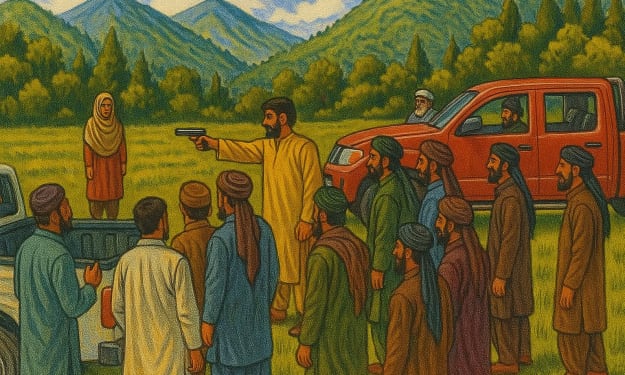
Almost two hundred years ago it is Balochistan. And inside the mountains of Balochistan is a purely tribal area called Kohlu. The interesting thing is that the year is also 1825. That is, exactly two hundred years ago from today. In a house of Kohlu, a child is born. He is named “Lal Han”... Growing up, he becomes a shepherd. It is the monsoon season (just like nowadays)... This shepherd is outside his area with his sheep and goats. A stormy rain begins. In the midst of those mountains, a house is seen. He goes toward that house to seek shelter. The men of the house are not there. According to the customs of that time, the woman of the house becomes the host. She is a newlywed bride. The woman tries to save her tent from the storm. The strong winds take away her dupatta. She is trying to save the belongings. Lightning flashes. In the thousandth part of a second, Lal Han's eyes fall on that woman whose hair is open and the storm has taken away her dupatta, but she, unaware of the world, is trying to save her shelter. In this thousandth part of a second, Lal Han’s life changes and he becomes “Mast Tawakali” and “Sammu Beli”. That woman is none other than “Sammu”. Imagine that it is a purely tribal time from two hundred years ago. Mast Tawakali not only falls in love with a married woman, but also mentions her name in his poetry. He even calls himself “Sammu Beli” meaning friend of Sammu. But no one’s “honor” awakens to go and kill that shepherd. Rather what happens is that they are called “Hazrat Mast Tawakali”. After his death, people come to his grave with great respect and his grave becomes a spiritual center. No one knows the real meaning of the name “Sammu”, but even today thousands of women in Baloch society are named “Sammi”. It is a time fourteen hundred years ago. In Makkah, a woman does business. She is independent. She sends her goods with a young man to Syria. She is impressed by his honesty. She initiates. Sends a proposal through her slave. Yes, fourteen hundred years ago, a woman is sending a marriage proposal. They both get married. That woman is Umm-ul-Momineen Hazrat Khadija (may Allah be pleased with her) and the young man is Hazrat Muhammad (peace be upon him). Here, every year hundreds of women and men are killed in the name of “honor”. These people derive the concept of this “so-called honor” either from tribal customs or from religion. Both of these events negate this idea. Fast forward. It is the developed era of 2025. It is the age of social media. A video is circulating on social media. The time and place of the video are unknown. There is a group of so-called honorable men. A “Sammu” is brought. A Qur’an is in her hands. A wretched one takes the Qur’an from her hands. She is not scared. She is not panicked. She is not pleading or begging. She says one sentence. She makes an explosion. “Bera sum na ijaazat e numay” (Only the permission to shoot is yours.) This is not just a sentence. It is a philosophy, a declaration, a rebellion. She is not asking for permission, she is giving permission. She is issuing an order. She is announcing a verdict. She is declaring that I am not anyone's property. I am not a domesticated animal. I am a living, breathing human. I have the right to live on my own terms, and the right to die on my own terms too. She walks seven steps ahead. And then she becomes free. With the rattling of bullets in the air, the echo of one sentence is heard: “Bera sum na ijaazat e numay” This one sentence is enough to shatter the walls of this so-called honor. There should be poetry written on this, stories should be written, books should be compiled, films and dramas should be made. Bera sum na ijaazat e numay.
By Ikram Ullahabout a year ago in Viva
History of Brow Lamination - From Its Origins to Today’s Fluffy Brow Trend
Eyebrows have always reflected the spirit of the times — from the razor-thin arches of the 1930s to the bold, defined brows of the 2010s. In recent years, a new trend has taken the beauty world by storm: brow lamination. Known for creating lifted, full, and fluffy brows, this technique has revolutionized how we style our brows today.
By Alysaa Healyabout a year ago in Viva