feminism
At its core, feminism is the simple conviction that women are equal to men in every regard, and should be treated as such.
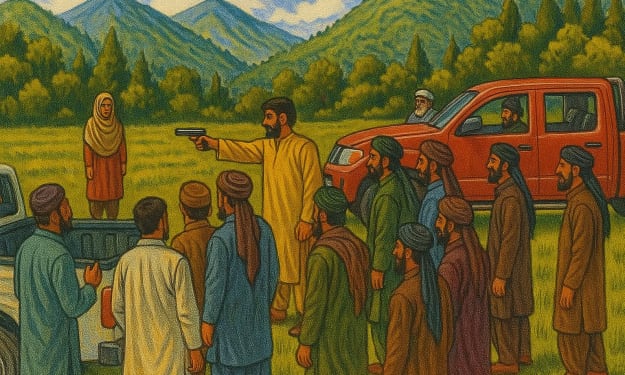
"Bera Sum Na Ijaazat e Numay." (Only the permission to shoot is yours.)
Almost two hundred years ago it is Balochistan. And inside the mountains of Balochistan is a purely tribal area called Kohlu. The interesting thing is that the year is also 1825. That is, exactly two hundred years ago from today. In a house of Kohlu, a child is born. He is named “Lal Han”... Growing up, he becomes a shepherd. It is the monsoon season (just like nowadays)... This shepherd is outside his area with his sheep and goats. A stormy rain begins. In the midst of those mountains, a house is seen. He goes toward that house to seek shelter. The men of the house are not there. According to the customs of that time, the woman of the house becomes the host. She is a newlywed bride. The woman tries to save her tent from the storm. The strong winds take away her dupatta. She is trying to save the belongings. Lightning flashes. In the thousandth part of a second, Lal Han's eyes fall on that woman whose hair is open and the storm has taken away her dupatta, but she, unaware of the world, is trying to save her shelter. In this thousandth part of a second, Lal Han’s life changes and he becomes “Mast Tawakali” and “Sammu Beli”. That woman is none other than “Sammu”. Imagine that it is a purely tribal time from two hundred years ago. Mast Tawakali not only falls in love with a married woman, but also mentions her name in his poetry. He even calls himself “Sammu Beli” meaning friend of Sammu. But no one’s “honor” awakens to go and kill that shepherd. Rather what happens is that they are called “Hazrat Mast Tawakali”. After his death, people come to his grave with great respect and his grave becomes a spiritual center. No one knows the real meaning of the name “Sammu”, but even today thousands of women in Baloch society are named “Sammi”. It is a time fourteen hundred years ago. In Makkah, a woman does business. She is independent. She sends her goods with a young man to Syria. She is impressed by his honesty. She initiates. Sends a proposal through her slave. Yes, fourteen hundred years ago, a woman is sending a marriage proposal. They both get married. That woman is Umm-ul-Momineen Hazrat Khadija (may Allah be pleased with her) and the young man is Hazrat Muhammad (peace be upon him). Here, every year hundreds of women and men are killed in the name of “honor”. These people derive the concept of this “so-called honor” either from tribal customs or from religion. Both of these events negate this idea. Fast forward. It is the developed era of 2025. It is the age of social media. A video is circulating on social media. The time and place of the video are unknown. There is a group of so-called honorable men. A “Sammu” is brought. A Qur’an is in her hands. A wretched one takes the Qur’an from her hands. She is not scared. She is not panicked. She is not pleading or begging. She says one sentence. She makes an explosion. “Bera sum na ijaazat e numay” (Only the permission to shoot is yours.) This is not just a sentence. It is a philosophy, a declaration, a rebellion. She is not asking for permission, she is giving permission. She is issuing an order. She is announcing a verdict. She is declaring that I am not anyone's property. I am not a domesticated animal. I am a living, breathing human. I have the right to live on my own terms, and the right to die on my own terms too. She walks seven steps ahead. And then she becomes free. With the rattling of bullets in the air, the echo of one sentence is heard: “Bera sum na ijaazat e numay” This one sentence is enough to shatter the walls of this so-called honor. There should be poetry written on this, stories should be written, books should be compiled, films and dramas should be made. Bera sum na ijaazat e numay.
By Ikram Ullahabout a year ago in Viva
What Feminism Means to Me
Feminism is not loud lipstick or louder voices. It is not a hashtag printed on a T-shirt, or a viral reel crafted for applause. It is not a flash of skin sold as power — because skin still sells, and that’s why the focus stays there. It is not just a legacy of burning bras or raising fists.
By Srilata Amirthanabout a year ago in Viva
I’m 18 With a Body Count of 10 — None of Them Were Random Hookups
I feel shame, and I’m tired of pretending that I don’t. I’m 18, and I’ve slept with ten people — to some, that’s a lot, to others, it’s nothing. To me, it’s quite a high number. I feel shameful about it. Not really because of the number, but because of how they happened — how I let some of them happen.
By Scarlett R. 🍁about a year ago in Viva
I Don’t Want to Be Called a Strong Woman Anymore
There was a time when being called a “strong woman” felt like a badge of honour. Now, it feels like a weight I no longer want to carry. I used to wear it with pride, you know; the title, the praise. People would look at me, sometimes with pity, sometimes with admiration, and say, “You’re so strong.” And I’d nod politely, even smile, because what else could I do? We’ve been taught that strength is noble. That pain is part of being good. That women who endure are women worth respecting. I grew up hearing that phrase often in conversations, in stories, even in prayers. “God, give her the strength to endure.” “She’s strong. She’ll get through it.” “Strong women don’t break.” And all those other carefully-wrapped, emotionally manipulative sentences. It sounded comforting at first. Until I realised it often meant: “Keep enduring.” “Keep absorbing.” “Don’t complain.” “Don’t be weak.” “Stay in pain or die slowly but make it look graceful.” But lately, I’ve started to question it. What exactly do we mean when we say a woman is strong? In Nigeria, where I come from, it rarely means she’s bold, brave, or assertive. It doesn’t mean she’s standing tall, chasing her dreams, or speaking her truth. Most times, it means she’s been through a lot silently. (That emphasis is needed because, in the real sense, everyone is going through a lot. But if you dare to speak about it, you’re seen as weak. If you cry out, you’re dramatic. If you ask for support, you’re needy.) Here, a woman is considered strong when she’s carrying everyone else’s burdens and not asking for help with hers. When she stays in an unhappy marriage “for the children.” When she tolerates disrespect “for the sake of peace.” When she holds her grief in her chest and shows up smiling like nothing is wrong. She’s strong because she’s endured heartbreaks that would crush the average person. She’s strong because she’s never raised her voice, even when she should have screamed. She’s strong because she cries behind closed doors and cooks jollof rice for everyone the next morning. But what kind of strength is that? She's called strong not because she’s thriving, but because she’s surviving. And I’ve come to realise that there’s a difference. Somewhere along the line, “strong woman” became code or euphemism for “ an unhappy woman who doesn’t complain.” A woman who doesn’t demand better. A woman who is easy to ignore because she never asks for anything. A woman who has been taught that her silence is her superpower. And honestly? I don’t want that kind of strength, not now not anymore. I don’t want to be admired for the way I kept quiet when I should have spoken. I don’t want applause for swallowing sadness. I don’t want to be celebrated for staying in places that drained me just because I could “handle it.” That’s not strength. That’s suffering with makeup on. Yes, I’ve faced challenges. Yes, I’ve been stretched emotionally. Yes, I’ve known pain. But I’m learning that healing is also strength. That walking away can be courage. That setting boundaries is brave. That softness is not weakness. That asking for help does not mean I’m failing. I want to be known as a happy woman. Not a woman who “carried everything and didn’t break,” but a woman who chose peace. A woman who chose joy. A woman who knew when to put things down. I want to be seen for who I am not just what I survive. Not as the woman who endured, but as the woman who evolved. Because true strength isn’t how much you can take. It’s knowing when enough is enough. It’s being able to say, “I deserve better,” and actually believe it. It’s choosing yourself in a world that tells you you must always be available to others. I want to rest without guilt. I want to say “no” without explanation. I want to choose myself and not feel selfish for it. I want to cry openly if I need to, and not be called dramatic. I want my strength to show in how gently I love myself. Sometimes, I imagine the little girl I used to be; quiet, observant, eager to please. She was always praised for being “well-behaved.” But no one asked her if she was okay. She became the girl who kept secrets, who didn’t want to be a burden. She learned to carry heavy things too early. And the world applauded her for it. Now, I mourn her. Because she deserved to be held, not hardened. She deserved to be comforted, not congratulated for her silence. And so do I. I want to be called soft. Safe. Free. I want to wake up and not feel like I have to brace myself for the day. I want a life where I don’t have to survive everything. I want a world where my strength is not measured by how much pain I can endure. When did “strong” become another word for exhausted? When did “strong” start meaning “alone”? Why is the standard of strength tied to how invisible our suffering can be? Let’s stop calling women strong only when they’re unhappy and quiet about it. Let’s stop giving them medals for swallowing grief, pain, and abuse. Let’s teach our daughters that their softness is not a flaw. Let’s teach our sons that women deserve support, not just admiration from a distance. Because true strength isn’t about hiding your pain. It’s being able to speak your truth—trembling voice and all. It’s choosing joy, even if it means walking away from everything familiar. It’s knowing that breaking down doesn’t make you broken. So no, I don’t want to be called a strong woman anymore; at least not by that definition. I want to be called free. Soft. Safe. Whole. Happy. And if you must speak of my strength, let it be the kind that healed me, not the kind that hurt me first. Let it be the kind that came from choosing myself. Let it be the kind that made me human again.Start writing...
By Leemarhwritesabout a year ago in Viva
Most Sports Should Not Be Segregated By Gender: Here's Why
As a child, I sat on the floor in front of the TV. Summer sunlight streamed through the windows as I watched my professional baseball team, the Seattle Mariners, play during their record-breaking and epic seasons in the early 2000s. I would go to my first Mariners game on my seventh birthday, and I kept a poster of Bret Boone up in my bedroom until I moved out after college. This period instilled a love of baseball that I still have today.
By Alisan Keeseeabout a year ago in Viva
The Ultimatum: Season 3 Is a Masterclass in Fragile Masculinity
Let’s talk about Netflix’s The Ultimatum: Marry or Move On—or, as Season 3 could more accurately be titled, Red Flags on Parade. If you’ve ever wanted to see what happens when emotionally immature men are forced to relinquish control for three weeks, welcome. This season had everything: possessiveness, projection, passive-aggression, and the kind of fragile masculinity that makes your skin crawl.
By No One’s Daughterabout a year ago in Viva