activism
Feminist activists are not deterred by the daunting statistics so much as they're fueled by them.
Old People Need Different Body Treatment than Young People
Everybody knows that aging changes a body. It is evident in animals and in the human body. We don't have to wonder, we can see it in those who have really aged. They have grey hair, wrinkles, some of them have scars. They dont' move as fast and they seem a lot more cautious in their movements next to a younger person. Are those signs of the privilege of getting old? Maybe. There has been an obsession in many cultures with "looking youthful" as it was attached to an idea of beauty and health. It seemed a common or obvious notion: Young people are healthy, fit, beautiful and if we want to survive or be loved that's what we have to be. So came the health gurus and gym experts. They will sell you any speech or product in the name of "keeping you fit and beautiful" and since culture accepts that being young is better than being old, people blow tons of money on any gimmick directed at that narrative. Old women may be more susceptible to these "advisors" sales pitches because women tend to be vain. I am a vain woman most of the time - some people call it pride. Though it may be considered a vice or an "ugly" part of my personality, it also motivates me to do something good for my body and my self. Pride or Vanity is the only reason I have for "caring" about my body or wanting to keep it in some kind of healthy and/or presentable functioning.
By Shanon Angermeyer Normanabout a year ago in Viva
Eldery people visit profound places
I found this meme today scrolling on Facebook. It was the most profound one I read and decided to write a poem and an article featuring this. Where do you think the elderly or the poor hang out? Some roach infested ghetto apartment or a sparkling clean dazzling condo overlooking the ocean? Both? Some elite gated nursing home featured on Lifestyles of the Rich and Famous or some decaying old building with overworked and underpaid nurses calling it an Assisted Living Facility? A tent in the backyard where Granny fights the dog or the cat to call it "her" tent? A car that's over 20 years old and needs a new transmission and has no air conditioning or heater, but still lets Grandpa take a nap in the Walmart parking lot? Some old dusty hall where they gave the old homeless bum a free pack so he could play Bingo and try his luck? Yeah, I'm sure you can find the elderly at all of the above, but I think the meme is directly referring to places where the elderly have been much more than those younger folks. Typically, young people (child age to say around 30 somethings) are not typically hanging out at the hospital, the prison, or the cemetary unless they are employed there.
By Shanon Angermeyer Normanabout a year ago in Viva
Discipline, Vision, Community: TT Torrez Returns to MCNY to Unlock the Leaders of Tomorrow with #GoGetHer Summit
Full Circle - TT Torrez Returns to MCNY to Unlock Leaders of Tomorrow When Vision Meets Access: The Official Line Up - How TT Torrez Is Redefining Leadership for Young Women of Color
By NWO SPARROWabout a year ago in Viva
Using Viva for My Magazine Ideas
"What it means to be a woman. Viva explores the lives of women, from the workplace to home, family, adventure, ambition, and more." That is the description provided by Vocal for the "Viva" community. I haven't submitted much (if any) to this community although I am a woman who does much "work" at home often thinking about family, adventure, ambitions, and other things. I noticed that in numbers (statistical reports of members and articles) this community is on the low side. So I've decided to FOCUS on this community and narrow my subject matter in my articles to fit this community. I was ambitious enough to want to start an online magazine and call it "Over the Hill" or "Poor People" or "Lonely Old Ladies" but I think this community is sufficient for my writing desires on these subjects.
By Shanon Angermeyer Normanabout a year ago in Viva
The Unseen Viva
M Mehran Sana had always been the kind of student who hid at the back of the classroom, scribbling notes furiously, afraid to raise her hand. She excelled in written exams but dreaded speaking. Words, when written, obeyed her. Words, when spoken, betrayed her. So when the announcement came that her degree would end with a viva voce, she felt her stomach drop. An oral examination—standing alone before a panel, answering questions in real time—was her greatest nightmare. --- The Night Before The night before her viva, Sana barely slept. She stared at her thesis spread across the desk, highlighted and dog-eared. She whispered definitions under her breath, rehearsed explanations in the mirror, but every time she imagined facing the professors, her voice cracked. At 3 a.m., she closed her notes and whispered, “If I fail, at least I’ll know I tried.” But deep down, she wondered if trying would ever be enough. --- Walking In The next morning, the corridor outside the examination room buzzed with nervous energy. Her classmates paced, flipping through last-minute notes. Sana sat silently, her palms damp, her heart hammering. When her name was called, she felt the world tilt. She stood, legs trembling, and walked into the room. Three professors sat behind a long table, her thesis placed in the center like evidence in a trial. “Good morning, Miss Sana,” one said, adjusting his glasses. “Shall we begin?” --- The First Question The first question was simple enough: “What motivated you to pursue this research?” Sana’s lips trembled as she spoke. “I wanted to understand how small changes in community education programs could… could transform literacy rates.” Her voice wavered, but the words came. The professors nodded. Encouraged, she exhaled slowly, gripping the edge of the chair. Then came the harder ones. --- Cracks in the Armor “Can you explain why you chose this methodology?” She stumbled, trying to recall her notes. Her throat tightened. The silence in the room grew heavier. Another professor leaned forward. “What limitations do you see in your findings?” Her mind went blank. For a horrifying moment, she thought she might faint. She wanted to disappear into the floor, to run from the room and never return. But then, she remembered something her grandmother used to tell her: “When you can’t find courage, borrow your honesty.” So she took a breath and said, “The biggest limitation was me. I was nervous about whether my methods were strong enough. But I learned from those mistakes and corrected them as I went.” The panel didn’t frown. In fact, one professor smiled. --- The Turning Point As the questions continued, something shifted. The more Sana spoke honestly, the steadier her voice became. She stopped trying to be perfect and started explaining like she would to a friend. When they asked about the future scope of her work, she lit up. She spoke passionately about how her findings could help design better literacy programs for rural schools. She forgot her fear. She forgot herself. She spoke only about the work she loved. By the end, her voice was no longer trembling—it was alive. --- The Verdict “Thank you, Miss Sana,” the chair said at last. “Please wait outside while we discuss.” The corridor was suffocating. Every second stretched like an hour. She clasped her hands tightly, whispering prayers. Finally, the door opened. One professor stepped out, smiling warmly. “Congratulations. You’ve passed.” Sana blinked, stunned. Her chest filled with a rush of relief so powerful that tears sprang to her eyes. For the first time, she realized she hadn’t just passed an exam—she had passed a barrier inside herself. --- Beyond the Viva That day, Sana learned the viva was not simply a test of knowledge. It was a test of presence, of courage, of owning your voice even when it shakes. And she realized something else, too: life itself is full of vivas. Job interviews. First dates. Difficult conversations. Every moment we’re called to speak our truth is its own oral examination. The questions may change, but the challenge is the same—to stand tall, to be honest, and to let our voice carry who we really are. --- Final Thought The viva is more than an academic ritual. It is a rite of passage that strips away rehearsed answers and demands authenticity. Sana walked in terrified, but she walked out transformed—not because she knew everything, but because she finally believed in herself. And maybe that’s the real lesson of every viva: the answers matter, but the voice matters more.
By Muhammad Mehranabout a year ago in Viva
The Viva That Changed Everything
M Mehran he exam hall smelled of polished wood, nervous sweat, and the faint trace of chalk dust. For weeks, Ayesha Khan had buried herself in textbooks, notes, and past papers, yet now, sitting in the stiff wooden chair, she felt the familiar grip of panic squeezing her chest. Today was the day of her final viva, the oral exam that could determine whether she graduated at the top of her class or stumbled into mediocrity. Ayesha wasn’t just nervous—she was terrified. Oral exams were different. Written tests could be revised, errors erased. A viva demanded presence, confidence, and instant answers. No hiding behind paper, no correcting mistakes silently. Every word, every pause, every nervous glance mattered. As she waited, she watched the others. Some sat with calm smiles, flipping through their notes as if they owned the room. Others tapped pens nervously, whispered reassurances to themselves. Ayesha drew a deep breath, trying to calm the storm inside. She reminded herself: knowledge was one thing; confidence was another. Today, she had to master both. When her name was called, her legs trembled as she stepped forward. The examiners, three professors known for their stern reputations, nodded politely but gave no indication of warmth. The first question hit like a sudden gust of wind: “Explain the significance of your thesis in the context of current research.” Ayesha’s mind raced. She had memorized definitions, formulas, case studies—but putting it all together, articulating it clearly under scrutiny, was another matter. She swallowed hard, forced herself to speak: “My research examines the impact of renewable energy adoption in urban environments, highlighting both economic and environmental benefits. In the context of current studies, it bridges the gap between theoretical models and practical implementation strategies, offering actionable insights for policymakers.” Silence followed. Then, the second examiner leaned forward. “Can you justify your methodology? Why did you choose these specific parameters?” Ayesha felt the sweat on her palms. She repeated the rehearsed explanation, but halfway through, the words stumbled. She faltered, and for a moment, panic threatened to overtake her. She wanted to apologize, to start over—but then she remembered something her mentor had told her: “A viva is not about perfection. It’s about clarity and honesty. If you don’t know, explain your reasoning.” Taking a steadying breath, she adjusted her tone. “While these parameters may seem limited, they were selected to isolate variables that could most accurately reflect urban energy consumption. I considered alternatives, but constraints in data availability guided this choice. Here, I discuss potential limitations and how future research could address them…” She paused, scanning the faces of the professors. Something shifted. Instead of stern judgment, she saw curiosity. The questions became less about trapping her and more about discussion. Slowly, she realized the viva wasn’t an enemy—it was a conversation, an opportunity to share what she had learned. As the exam continued, Ayesha found her rhythm. When a particularly tricky question on statistical modeling arose, she paused, smiled faintly, and walked the examiners through her reasoning, step by step. She admitted where assumptions were made, where results might vary. By the end, the room felt less like a battlefield and more like a workshop, each question a tool to refine her ideas rather than a weapon to expose flaws. When the viva finally concluded, the examiners nodded, scribbled a few notes, and dismissed her with a polite, “Thank you.” She stepped out into the hallway, heart still racing, palms still damp—but a smile was slowly spreading across her face. She had survived. More than that, she had learned something invaluable: the viva was never just a test of knowledge—it was a test of courage, composure, and the ability to communicate under pressure. Weeks later, when the results were announced, Ayesha saw her name at the top of the list. She had not only passed; she had excelled. But even beyond the grades, the viva had changed something in her. She no longer feared speaking up in class, presenting ideas, or defending her research. She had faced the ultimate challenge of her academic journey and emerged stronger, more confident, and ready for the next stage of her life. The experience taught her a universal lesson: life, much like a viva, is unpredictable and demanding. It will ask questions we aren’t always prepared for. It will test our patience, our knowledge, and our resolve. But courage doesn’t mean having all the answers—it means facing uncertainty, reasoning clearly, and trusting in one’s preparation and judgment. And so, the viva, a moment that had once seemed terrifying, became a turning point. Ayesha walked away not just with a grade, but with a story of resilience, a story that reminded her—and everyone who hears it—that true success is as much about composure under pressure as it is about what you know. For anyone sitting in a chair, waiting for their name to be called, the lesson is clear: breathe, think, and speak with honesty. Because the viva, like life itself, rewards those who face it bravely.
By Muhammad Mehranabout a year ago in Viva
Why I Just Joined the “We Do Not Care Club”
This morning, I discovered the “We Do not Care Club,” inadvertently started by Just Being Melani. It’s sort of an unofficial club for women who have entered the perimenopausal era of their lives. You know, the beginning of the time in life when “women of a certain age” discover how tired they are, and how tired of being tired they are.
By Suzy Jacobson Cherryabout a year ago in Viva
Braids, Pride & Power: How Joetta Dugbo’s Independence Day Hairstyle Went Viral and Honored Liberia’s Legacy
In the world of creative expression, few can braid culture, art, and identity into a single vision the way Joetta Dugbo , known widely as Queen Jo, can. A self-taught hairstylist, fashion design graduate, body art visionary, and rising podcaster, Queen Jo wears many crowns. But this past July 26, she added another jewel to her collection with a bold and symbolic hairstyle that went viral across social media in celebration of Liberia’s Independence Day.
By NWO SPARROWabout a year ago in Viva
Whispers of Freedom: The Brave Women Guiding Tours in Afghanistan
In Afghanistan, life has been very hard for women since the Taliban took control again in 2021. Many girls are not allowed to go to school, and women are told to stay at home. They are not allowed to work or even walk outside without a man from their family.
By Inzamam Ul Haqabout a year ago in Viva
"Bera Sum Na Ijaazat e Numay." (Only the permission to shoot is yours.)
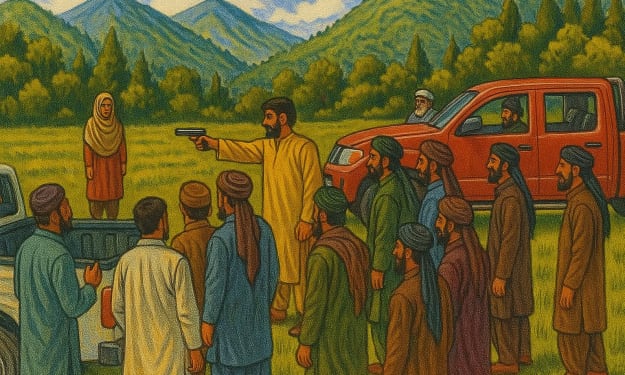
Almost two hundred years ago it is Balochistan. And inside the mountains of Balochistan is a purely tribal area called Kohlu. The interesting thing is that the year is also 1825. That is, exactly two hundred years ago from today. In a house of Kohlu, a child is born. He is named “Lal Han”... Growing up, he becomes a shepherd. It is the monsoon season (just like nowadays)... This shepherd is outside his area with his sheep and goats. A stormy rain begins. In the midst of those mountains, a house is seen. He goes toward that house to seek shelter. The men of the house are not there. According to the customs of that time, the woman of the house becomes the host. She is a newlywed bride. The woman tries to save her tent from the storm. The strong winds take away her dupatta. She is trying to save the belongings. Lightning flashes. In the thousandth part of a second, Lal Han's eyes fall on that woman whose hair is open and the storm has taken away her dupatta, but she, unaware of the world, is trying to save her shelter. In this thousandth part of a second, Lal Han’s life changes and he becomes “Mast Tawakali” and “Sammu Beli”. That woman is none other than “Sammu”. Imagine that it is a purely tribal time from two hundred years ago. Mast Tawakali not only falls in love with a married woman, but also mentions her name in his poetry. He even calls himself “Sammu Beli” meaning friend of Sammu. But no one’s “honor” awakens to go and kill that shepherd. Rather what happens is that they are called “Hazrat Mast Tawakali”. After his death, people come to his grave with great respect and his grave becomes a spiritual center. No one knows the real meaning of the name “Sammu”, but even today thousands of women in Baloch society are named “Sammi”. It is a time fourteen hundred years ago. In Makkah, a woman does business. She is independent. She sends her goods with a young man to Syria. She is impressed by his honesty. She initiates. Sends a proposal through her slave. Yes, fourteen hundred years ago, a woman is sending a marriage proposal. They both get married. That woman is Umm-ul-Momineen Hazrat Khadija (may Allah be pleased with her) and the young man is Hazrat Muhammad (peace be upon him). Here, every year hundreds of women and men are killed in the name of “honor”. These people derive the concept of this “so-called honor” either from tribal customs or from religion. Both of these events negate this idea. Fast forward. It is the developed era of 2025. It is the age of social media. A video is circulating on social media. The time and place of the video are unknown. There is a group of so-called honorable men. A “Sammu” is brought. A Qur’an is in her hands. A wretched one takes the Qur’an from her hands. She is not scared. She is not panicked. She is not pleading or begging. She says one sentence. She makes an explosion. “Bera sum na ijaazat e numay” (Only the permission to shoot is yours.) This is not just a sentence. It is a philosophy, a declaration, a rebellion. She is not asking for permission, she is giving permission. She is issuing an order. She is announcing a verdict. She is declaring that I am not anyone's property. I am not a domesticated animal. I am a living, breathing human. I have the right to live on my own terms, and the right to die on my own terms too. She walks seven steps ahead. And then she becomes free. With the rattling of bullets in the air, the echo of one sentence is heard: “Bera sum na ijaazat e numay” This one sentence is enough to shatter the walls of this so-called honor. There should be poetry written on this, stories should be written, books should be compiled, films and dramas should be made. Bera sum na ijaazat e numay.
By Ikram Ullahabout a year ago in Viva
10 Best Translation Services of 2025. AI-Generated.
In today's interconnected world, effective communication across languages is more crucial than ever. Translation services act as the bridge between cultures and languages, facilitating global business, travel, and information exchange. Whether you're expanding your business internationally, publishing academic research, or simply trying to communicate across language barriers, finding the right translation service is essential.
By Cary Johan about a year ago in Viva