
Why Women’s Tennis Has a Training Advantage Men Can’t Buy
A low-ranked male hitting partner can change a top woman’s training. The same market does not work for top men.
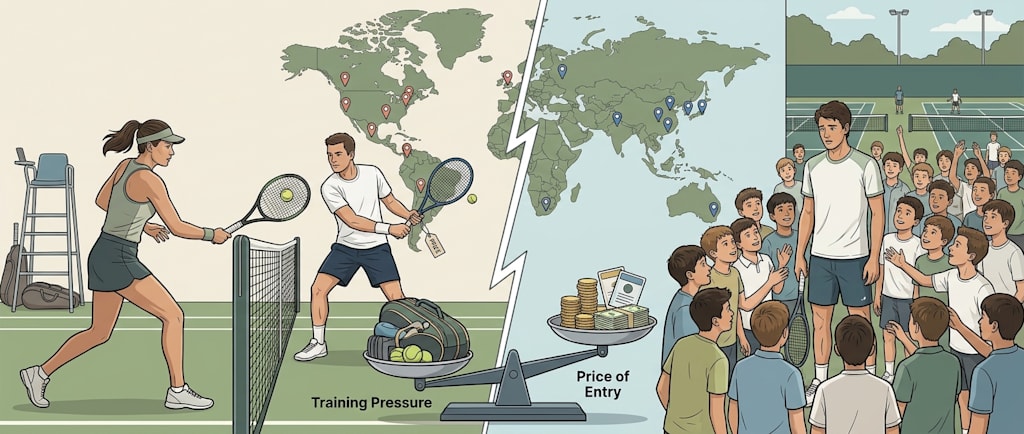
A popular argument says women’s tennis has a more mixed national map than men’s tennis because top women can hire high-level male sparring partners. A woman ranked in the top ten can pay an ATP player ranked around 800 to 900, or a male pro with no tour-level ranking, to hit with her. That man may earn little from prize money. He can still give her pace, spin, weight of shot and physical pressure that she does not face every week on the WTA tour. A top man cannot use the same solution. If he wants a hitting partner at his level or above, that partner has his own schedule and income. If he hires someone below his level, the training quality falls.
The argument has a workable mechanism. It overreaches when it turns that mechanism into the main cause of the entire nationality split. A narrower claim holds: the male sparring market lowers the cost for a top woman from a weak tennis country to buy training pressure she cannot find at home. It reduces her dependence on her domestic tennis system. It does not erase the gap between strong and weak tennis countries. It does not replace tournaments, coaching, fitness work, recovery, travel money or WTA match experience. It cannot by itself explain why the women’s top ten looks more mixed than the men’s top ten.
The sparring market is lopsided
Tennis is a hitting sport. Training quality depends on the ball coming at you. A player who spends her teenage years hitting against weak opponents learns a different set of reactions from a player who faces heavy pace, deep spin and aggressive movement every day. This is why competitive density matters. It is also why a good sparring partner can be worth more than another hour with a coach holding a basket of balls.
For a top woman, the pool of useful male sparring partners is large. A male player ranked around 800 to 900 in the world is not a star. He may struggle to cover costs from prize money. He can still serve faster, hit heavier and move with more explosive power than most women on the WTA tour. In the Chinese discussion around Zheng Qinwen, one long-term sparring partner was identified as Xiao Lin’ang, a player from the Shanghai team and a student at Southwest University, with a highest ATP ranking somewhere around 800 to 900. The exact number matters less than the economics. A player at that level can be hired, and he can give a top woman a training ball that is hard to find elsewhere.
Li Na’s case often comes up. Her husband, Jiang Shan, was a professional male player. “No ATP ranking” does not mean “no professional training.” It means he was not a tour-level singles player. A former professional man can still give a top woman a hard session. The claim that he crushed Li Na is rhetorical. The useful point is training pressure, not a contest.
For a top man, the same solution is harder. He does not need a man who can hit hard. He needs a man who can hit hard and return his serve, read his patterns, expose his backhand and punish his second serve. That is a peer or a superior. A peer has his own career. A superior has even less reason to become a long-term paid hitting partner. The market for elite male sparring partners is thin, expensive and unstable. A top man can use retired players, college players, coaches and temporary hitting partners. The further he goes, the more he depends on the competitive system around him: challengers, tour events, academies and a dense pool of male players trying to beat him.
This is the sparring dividend. It is a cost advantage, not magic. Women can buy a certain amount of male training pressure. Men at the top cannot buy the same pressure at the same price.
Why the women’s map looks more mixed
The top-ten nationality chart that circulates in these debates does show a more mixed women’s field. The men’s top ten is dominated by players from countries with long tennis traditions, with Daniil Medvedev as the usual exception. The women’s top ten has included players from Kazakhstan, China and Belarus, among other places that are not traditional tennis powers. That contrast needs an explanation.
The sparring market is one explanation. It is not the only one. Women’s tennis has a global professional structure. The WTA tour, the ITF circuit and international academies let a talented girl from a non-traditional tennis country leave home early, train abroad, hire a team and build a ranking. National investment matters. Olympic strategies matter. Family wealth and sponsorship matter. A single talented player with a determined family and a foreign coach can do what a whole national system might struggle to produce. The women’s game also has a different commercial and competitive depth from the men’s game. Top women earn large sums, but the depth below the top is thinner. That makes customized teams and hired hitting partners more important, and more feasible, for a small number of elite women.
The top ten is also a small sample. It changes with ranking cycles, injury, form and the timing of the chart. One player from a small tennis country can make the women’s top ten look more global than the underlying system is. The chart is a useful prompt. It is not a controlled experiment.
The precise claim is this: the male sparring market lowers the penalty for a top woman who comes from a country with weak domestic hitting partners. It gives her a private solution to a public problem. It does not remove the need for a full professional team, a tour schedule, sports science, coaching and match experience. It compresses one part of the gap. It does not compress all of it.
Men need a crowd, not a hire
The men’s side is not a world where no one can find a hitting partner. Top men can find hitting partners. The issue is where the pressure comes from in the years before the top. A young male player needs a daily environment full of other young male players trying to beat him. He needs matches that punish his weaknesses. He needs to lose, adjust and play again. That environment is concentrated in traditional tennis countries and in large international academies.
Spain, the United States, France, Australia and Italy have not produced top men by accident. They have clubs, coaches, junior tournaments, challenger events and a large pool of players. A talented boy in such a system can find a hard match on a Tuesday. A talented boy in a weak tennis country may have to travel to find the same match. He can do it. The cost is higher, and the number of failures is larger.
The examples in the original argument show this. Medvedev was sent to France at six. Djokovic went to Germany at twelve. Nishikori went to the United States at thirteen. Those moves do not prove that national systems do not matter. They show that families and federations can buy access to a denser competitive environment. Russia, Serbia and Norway are not traditional tennis superpowers in the same way as the United States or Spain. Their top men still found pathways into international training and competition. A weak-country male player is not locked out. He faces a higher cost of entry and a narrower margin for error.
That is the difference. A top woman can hire one man and get a useful training stimulus. A top man needs a network of men. One is a purchase. The other is a system.
Several claims need correction
Women’s tennis has not erased the gap between strong and weak tennis countries because of male sparring partners. It has given a small number of well-funded women a private workaround. That workaround still requires money, management and access to the tour.
The men’s top ten is not made up only of developed countries and traditional tennis powers, with Medvedev as the sole exception. Djokovic is Serbian. Ruud is Norwegian. Neither Serbia nor Norway is a traditional tennis superpower in the usual sense. The men’s map has its own globalization.
The Jiang Shan formulation needs care. “No ATP ranking” is not the same as “no professional ability.” He was a professional male player. A low-ranked man can give a top woman a hard session. That does not make the session a demolition. The useful point is training pressure, not a contest.
The football analogy also needs care. Countries with many players in the five major leagues tend to have strong national teams. The relationship is not a simple causal law. League wealth can attract foreign players and reduce opportunities for local players. Brazil and Argentina have strong national teams without depending on the five leagues as their main development base. Youth coaching, national-team cohesion, tactical style and player export pathways all matter. Football supports the general point that competitive density helps. It does not prove that league player counts determine national-team results.
A better account
The argument works when it is split into parts. Top women can buy male training pressure at a lower price than top men can buy peer-level male pressure. A talented woman from a country with a thin tennis base can use a private team to import the hitting quality she lacks at home. That lowers the cost of developing a top woman outside the traditional tennis map.
Sparring is not competition. It does not teach a player how to manage a scoreline, handle a bad call, close a match or survive a third set against an opponent who has adjusted. Those lessons come from tournaments. A hired man can improve the training ball. He cannot replace the tour.
Traditional tennis countries have an advantage in the men’s game because their young men grow up in a denser competitive environment. They can find hard matches without buying a plane ticket. They can lose in front of coaches who know how to fix the problem. They can play a challenger without rebuilding their entire life.
Nationality distribution in the top ten is a result of many forces: tour globalization, national investment, family money, academy networks, migration, ranking cycles and sample size. The sparring market is one force. It is easy to miss. It is not the whole picture.
The useful claim is narrower than the viral version. The male sparring market reduces one cost of developing a top woman outside the traditional tennis map. It does not erase the map. It changes the price of entry.
About the Creator
Jin
Writer of reamstories
https://reamstories.com/jin
Enjoyed the story? Support the Creator.
Subscribe for free to receive all their stories in your feed. You could also become a paid subscriber, letting them know you appreciate their work.
Comments
There are no comments for this story
Be the first to respond and start the conversation.