
Why LeBron Walked Away From $98 Million
He didn’t do it for legacy. He did it to feel alive again. Inside the most radical pay cut in NBA history and the fragile dynasty being built in Philadelphia.
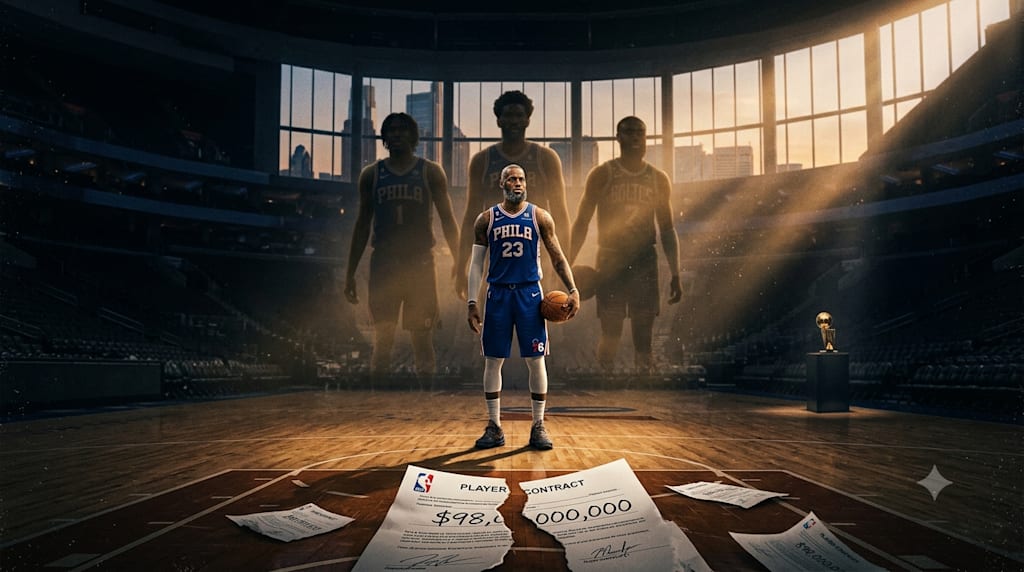
On July 26, 2026, LeBron James posted a short statement on his social media accounts. No live broadcast, no front-office leaks — just a few paragraphs and one bottom line: he was signing with the Philadelphia 76ers. Two years, $8 million total, with a player option on the second.
Compare that to his final Lakers salary of roughly $53 million for the 2025-26 season. His new deal pays him about 7.5% of what he earned the year before.
On the same day, someone dug up the rookie contract of Yang Hansen, a young Chinese center for the Qingdao Eagles. Yang's four-year deal: $4.42M (2025-26), $4.64M (2026-27), $4.86M (2027-28), $7.46M (2028-29). Two seasons alone add up to over $9 million.
LeBron James will make less annually than a Chinese teenager who hasn't played a single NBA summer league game. That's not a headline. That's arithmetic.
I. He Voluntarily Gave Up $48 Million
LeBron said three things in his post:
"I don't play for money."
"I don't play for my family's sake."
"I'm still willing to sacrifice, to train, to grind."
Translate that into numbers: He walked away from roughly $106 million he could have earned over the next two years (if he'd opted into his Lakers deal) and took $8 million instead. The difference is over $98 million. In the first year alone, he left about $48 million on the table.
No one has done this in NBA history. Previous star pay cuts — Draymond Green, Kevin Durant — were usually in the $5-10M per year range and often involved "hometown discounts" to stay with their current teams. LeBron opted out, changed teams, and signed for near-minimum money. His sole objective: give the Sixers enough cap space to sign him while keeping their full rotation intact.
Philadelphia had already cleared room. They'd traded for Jaylen Brown (who will make roughly $53 million in 2025-26), re-signed Tyrese Maxey to a max deal, and still had Joel Embiid on a super-max. If LeBron had signed for his market value, the Sixers would have triggered the second apron, preventing them from adding any meaningful role players. At $8 million, he fits neatly into the mid-level exception, allowing the team to pursue complementary pieces like KCP and Nick Richards.
This isn't "ring-chasing" in the usual sense. It's carving flesh from his own leg to feed his teammates.
II. What Philadelphia Actually Built Around Him
Here's what the Sixers had already done by summer 2026:
They'd acquired Jaylen Brown from Boston. Brown averaged 26.7 points, 6.2 rebounds, and 4.3 assists last season. In the Finals against New York, he put up 28.4 per game. His defensive matchup difficulty ranked first on the team.
They'd drafted V.J. Edgecombe with their lottery pick. He's 6'6" with a 7'0" wingspan, averaged 2.3 steals in college, and graded as a top-three athlete in his class.
They'd kept Tyrese Maxey, who delivered 24.8 points and 6.1 assists per game on 41.7% from three. 38% of his offense came off movement without the ball.
Add Joel Embiid (34.2 points, 11.6 rebounds, 38.9% from deep, but only 42 games played) and you get a starting five whose combined salaries (estimated for the new season) sit at roughly: Embiid $51M, Brown $53M, Maxey $35M, James $4M, Edgecombe rookie ~$7.5M. Total about $150 million, comfortably under the cap with the current tax line.
The numbers tell you how they fit:
Philadelphia ranked 6th in offensive efficiency last season, 12th on defense.
LeBron played "point forward" in L.A., averaging 78.4 touches, 8.7 assists, and 2.4 turnovers, a career-best 3.6 assist-to-turnover ratio.
Brown excels at catch-and-shoot and transition offense. 45% of his scoring came without dribbling.
Maxey shot 43.2% on catch-and-shoot threes.
That means LeBron can run the offense, Maxey and Brown space the floor, and Embiid operates from the elbow. No one fights for the ball. LeBron's usage will drop, but his efficiency could rise because he finally has three teammates who can create their own shots.
The one glaring risk is Embiid. His regular-season games missed over the last three years: 27 in 2023-24, 31 in 2024-25, and 18 in 2025-26 (though he got hurt in the second round of the playoffs). Philadelphia is now looking to sign Nick Richards (10.3 points, 8.7 rebounds for Charlotte last year) as a backup center, aiming to cap Embiid's minutes at 30 per game during the regular season.
III. The Fourth Team: A Path No One Has Walked
If LeBron wins a title in Philadelphia, he'll become the only player in NBA history to lead four different franchises to a championship.
He already has two with Miami, one with Cleveland, and one with the Lakers. That's four total, tied with LeBron himself. But the "four-team" label? Jordan doesn't have it (six with Chicago). Kareem doesn't (Milwaukee + L.A.). Kobe doesn't (five with L.A.). Duncan doesn't (five with San Antonio).
Some will call it "superteam hopping." But examine each team before he arrived:
2010 Miami: 47 wins the previous season, first-round exit, never won a title.
2014 Cleveland: 33 wins, third-worst in the East.
2018 L.A. Lakers: 35 wins, five straight years out of the playoffs.
2026 Philadelphia: 49 wins, lost in the Eastern Conference semifinals to New York (4-2), never reached the Finals.
He picks teams with potential but no track record, never an established dynasty. When Durant joined Golden State in 2016, the Warriors were 73-win Finals runners-up. Durant won two rings there, but the criticism never stopped. LeBron chose a Sixers squad that hadn't even sniffed the conference finals last season.
If he pulls it off, the narrative shifts: "Give him one All-Star big and one two-way wing, and he'll take you to the Finals." That argument is harder to counter than "six rings" because no one else can replicate it.
IV. Why Not Minnesota? Why Not Cleveland?
In the final days, rumors pointed to the Timberwolves. Anthony Edwards publicly said, "LeBron, come to Minnesota." The Wolves had Towns, Gobert, and a young core. LeBron said no.
The West has Oklahoma City (67 wins last season), San Antonio (Wembanyama + Fox), Denver (Jokić + Murray). The grind to get out of the West is far heavier than anything the East can offer.
Minneapolis is a small market with brutal winters. For a star nearing retirement, its commercial upside doesn't compare to Philadelphia.
Cleveland was another option, but the "homecoming" narrative had already been used once in 2014, and again (briefly) in 2018 before he went to L.A. A third return in 2026 would feel tired. More importantly, the Cavs had traded Darius Garland at the deadline for draft picks, signaling a rebuild, not a title chase.
Philadelphia offers an easier Eastern path (Boston lost Brown and downgraded; New York's frontcourt is aging), a major media market, and a governor who publicly welcomed him. The Pennsylvania governor posted a photoshopped image of LeBron in a Sixers jersey. And Joel Embiid, back in his rookie season (2014), tweeted: "Come to Philly LeBron we can win." That tweet resurfaced after the signing and racked up over half a million retweets.
V. What "Final Chapter" Actually Looks Like
LeBron called this his "last chapter." Not a farewell tour. A chapter.
He's 41. He'll likely play 55-60 regular-season games, sitting out back-to-backs. The goal isn't seeding. It's arriving at the playoffs healthy. In his final Lakers season, he still averaged 26.4 points, 8.2 rebounds, and 7.9 assists, but his defensive efficiency had dropped to league average. In Philly, his defensive load shrinks. Brown and Edgecombe will guard the opponent's best scorers. LeBron only needs to rotate and direct traffic.
The real test comes in the playoffs. In the East, New York has Brunson, Randle, and Anunoby but an interior defense that's vulnerable. Boston, without Brown, relies on Tatum alone, and their outside shooting is inconsistent. Miami's Butler is older, and they lack reliable three-point shooters.
Philadelphia's ceiling doesn't depend on LeBron. It depends on how many rounds Embiid can survive. If Embiid stays healthy, this roster has roughly a 70% chance of reaching the Finals. If Embiid goes down in the conference finals, LeBron may have to finish the last few games without a true interior anchor — just like 2024 with the Lakers, when Davis got hurt and LeBron went for 34 a night against Denver, but still lost.
LeBron closed his statement with this line: "I want to stand on the court, compete, win, and feel that sense of accomplishment again."
He didn't say "legacy." He didn't say "greatness." He didn't say "surpass Jordan." He used the verb "feel," a physical, tangible sensation.
That's the most honest part of this contract. He gave up money, comfort, the L.A. sunset — all for another chance to feel that championship moment. That moment lasts only a few minutes. He seems to think it's worth $98 million.
About the Creator
Jin
Writer of reamstories
https://reamstories.com/jin
Enjoyed the story? Support the Creator.
Subscribe for free to receive all their stories in your feed. You could also become a paid subscriber, letting them know you appreciate their work.
Comments
There are no comments for this story
Be the first to respond and start the conversation.