
Why Fighters Never Beat Themselves With Whips, Jian, and Hammers
The Iron Shirt looks brutal on screen. In real training, it would break your spleen, your kidneys, and your career.
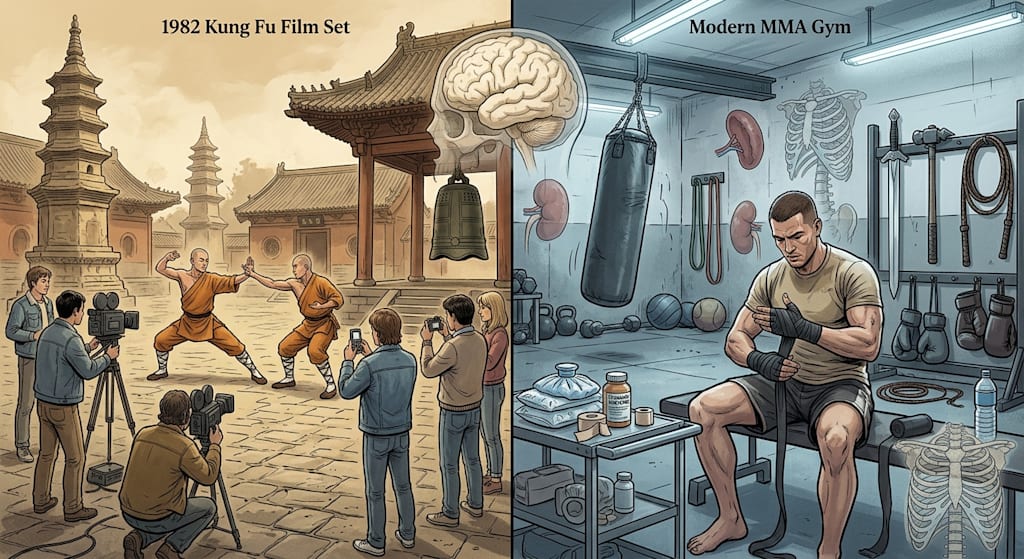
In the documentary, the director said that when they went to Shaolin Temple to shoot, the temple was desolate. Only two monks lived there. Many of the training methods in the film, such as hanging upside down like a golden bell, two-finger Zen, and iron head skill, were invented by the crew. Later Shaolin Temple prospered. Tourists came. The warrior monk troupe came. Performance programs came. The silver-screen spectacles were absorbed into a brand, into a persona, into something visitors had to capture on their phones.
That loop is telling. Many training methods serve narrative first and the body second. They have to look good, feel mysterious, and make people believe that a human being can do this. Fighting is not narrative. Fighting is win or lose. So why do fighters not use whips, jian, and hammers to beat themselves?
Look at what whips, jian, and hammers are. Jian are usually four-edged metal short weapons. Hammers include war hammers and meteor hammers. Whips include hard whips and soft whips. They share three traits: large mass, high hardness, and small contact area. In the age of cold weapons, they were made for armored targets. A sword or saber slides off armor. A whip, jian, or hammer can send impact through armor, shatter bone, and damage organs. Their job is to break bone, damage organs, and end fights.
Using one on yourself aims your enemy’s most brutal tool at your own body. At best, you get bruising under the skin and muscle contusions. At worst, you get rib fractures, a ruptured spleen, kidney contusions, or a concussion. Repeated beating brings chronic trauma, organ fibrosis, joint degeneration, and chronic traumatic encephalopathy.
The body is not an anvil. Brain tissue is like tofu. The skull is like a hard box. When a hammer hits the head, the box may survive, but the tofu breaks first. The spleen sits in the upper left abdomen. It is fragile. If it ruptures, you bleed heavily. The kidneys sit in the lower back. A heavy blow can put blood in your urine. A cracked rib can puncture a lung. These are not supercompensation. They are trauma. Gym shelves hold ice packs and stomach medicine. Nobody keeps a hammer next to the heavy bag.
Someone will say that repeated hitting raises pain threshold, thickens skin keratin, and adapts the shinbone surface. Locally, changes can happen. Pain is an alarm, not an enemy. If you disable the alarm, you are not fireproofing. You are waiting for the house to burn down. Patients with diabetic neuropathy can have rotting feet and feel nothing. That is not strength. That is danger. If a fighter beats away pain perception with heavy blows, feeling no pain in a fight does not mean the tissue is healthy. He may keep fighting with a cracked rib, keep wrestling with a kidney contusion, keep taking punches with a concussion.
When you hit yourself, you can predict the strike, tense your muscles, choose the angle, and control your breathing. In a fight, your opponent does not cooperate. He hits your ribs while you inhale. He kicks your liver while your weight is on your front foot. He slams your head while his hand blocks your vision. Fighting durability is not standing still and letting someone hit you to see who falls first. It is a system.
The first layer is defensive technique. Distance control, footwork, slipping, blocking, guard, parrying, interception. The best durability is making your opponent miss. If he cannot hit you, you do not need to take the shot.
The second layer is body structure. Neck strength, core stability, chin tucked, rib protection, weight control. When a strike lands, can your body disperse the impact, stay on its feet, and answer back?
The third layer is physiological adaptation. Bones may increase density under progressive load. Connective tissue may get stronger. Pain threshold may rise. Adaptation has limits. It must be gradual, and it must recover.
The fourth layer is psychology. Do not blink. Do not turn away. Do not panic. Do not fall apart. Take a punch and keep executing the plan.
None of these four layers needs a whip, jian, or hammer. Specificity rules training. You adapt to what you practice. If you want to adapt to glove strikes, do conditioned sparring with gloves. If you want to adapt to kicks, train kick defense and shin conditioning. If you want to adapt to wrestling, train grappling. Smashing yourself with a hammer adapts you to the hammer, not to your opponent.
Muay Thai has shin conditioning. It usually means kicking heavy bags, rolling, and adding load over time. It does not mean smashing the shin with a hammer. Boxers train neck, core, and defense. They do not tap their heads with a jian. MMA fighters train grappling, wear protective gear, and do light sparring. They do not pound their chests with a hammer. Traditional martial arts have pounding drills. These often use palms, soft sticks, sandbags, and medicinal wine. They avoid the head, spine, and kidney area. Many belong to sect performance, religious ritual, or cultural inheritance. They are not sports science.
Why do people still perform Iron Shirt, break a large stone on the chest, or break a steel plate with the head? Performance has its own logic. Breaking a large stone on the chest is not the chest resisting a hammer. The stone has large mass. When the hammer strikes, the stone absorbs momentum and cracks first. Pads underneath cushion the body. The person’s lying posture, breathing, and muscle tension all matter. Breaking a steel plate with the head works because the plate is brittle, the head is curved, contact time is short, and force distribution is skillful. Throat against steel rebar works because the rebar bends. It does not pierce. These are combinations of mechanics, props, long training, and visual impact.
Film goes further. Editing, angles, stunt doubles, props, and sound effects can make any action look lethal. Audiences love spectacle, pain, body limits, and Eastern mysticism. Martial arts schools and scenic spots need to survive. They intensify the spectacle. Iron Shirt, iron head skill, and two-finger Zen become personas and selling points.
The 1982 film Shaolin Temple was directed by Zhang Xinyan and starred Jet Li. It helped Shaolin Temple move from decline to prosperity. It made Shaolin Kung Fu a global cultural symbol. The training methods in the film were absorbed by later warrior monk troupes, performance programs, trademark licensing, and the tourism economy. They became a brand. Traditional martial arts training mixes religion, military practice, fitness, performance, combat, and business. Those pieces need to be separated. Which are spiritual practice, which are performance, which are battlefield remnants, which are film inventions, which are tourism economy needs? They cannot be stewed together.
If a fighter did use whips, jian, and hammers to beat himself, we could lay out a timetable. First week: he might feel adapted. First month: pain threshold rises, bruising recurs. Third month: rib fractures, kidney contusions, splenic subcapsular hematoma. After half a year: chronic pain, organ damage, post-concussion syndrome. After a year: early retirement and lifelong problems.
His opponent would be happy. You injured yourself. He does not have to lift a finger. You disabled your own alarm. He only needs a light strike, and you go down. You treated your body as an anvil. An anvil does not recover. A person does. The body cannot be replaced. You can buy new whips, jian, and hammers. You cannot buy a new liver, spleen, or kidneys. You can change a heavy bag. You cannot change brain tissue.
Fighters do not use whips, jian, and hammers to beat themselves because they can do the math. Training time is limited. Recovery capacity is limited. The body cannot be replaced. Making your opponent miss is better than blocking. Blocking is better than taking the shot. Taking the shot depends on scientific training, conditioning, technique, psychology, and recovery. It does not depend on self-harm.
The hammer goes back on the weapon rack. The gear gets strapped on. Tomorrow there is sparring.
About the Creator
Jin
Writer of reamstories
https://reamstories.com/jin
Enjoyed the story? Support the Creator.
Subscribe for free to receive all their stories in your feed. You could also become a paid subscriber, letting them know you appreciate their work.
Comments
There are no comments for this story
Be the first to respond and start the conversation.