
Why a Barcelona Bus Driver Got Cursed Out by a Grandma
And what I learned about rules, rage, and kindness on buses in Rome, Kyoto, and Beijing.
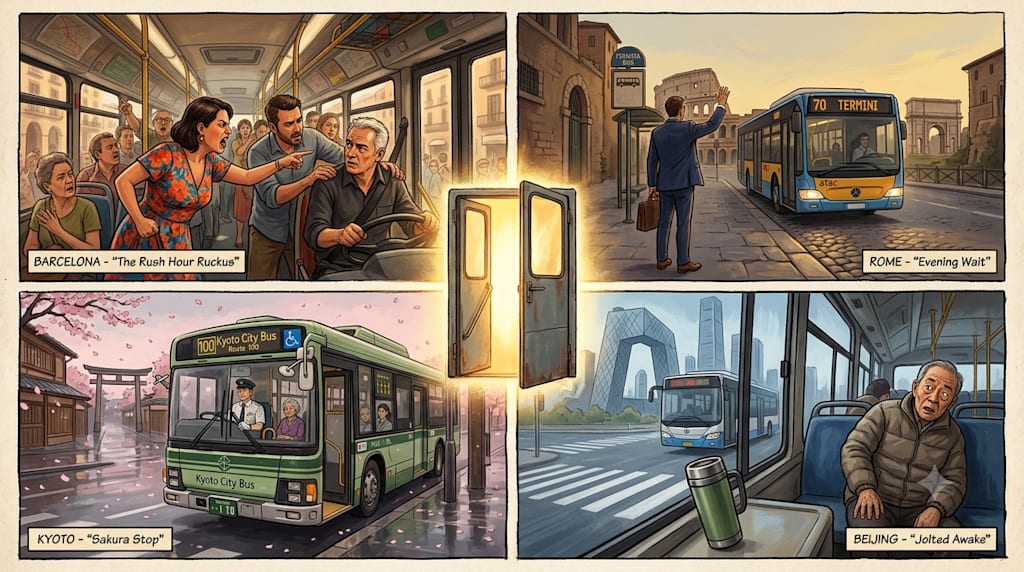
The three-door accordion bus in Barcelona had yellow arrows painted on its body: enter through the front, exit through the middle and rear. The three of us darted in through the back door, bent over, and circled the cabin looking for the card reader. The driver glanced at us in the rearview mirror and said nothing.
Next stop. He opened only the middle and rear doors. The front stayed locked. Someone on the platform pounded on the door, bang bang bang, but the driver didn't move. A woman in a floral dress stood up in the cabin, pointed at the driver, and fired off a rapid string of Spanish. I caught only one word, repeated three times. A young man in the front row turned his head and joined in, followed by an old lady carrying a shopping basket. Six or seven people in the cabin were all speaking at once. The driver rested both hands on the steering wheel and stared ahead.
We sat in the last row. No one looked at us. Everyone's attention was on the driver. The woman said a couple more things, her voice not loud, but each time she finished a sentence, someone nearby nodded. The driver reached out and pressed the door-release button. The front doors opened. The people on the platform surged in, and as they passed the driver's seat, someone patted him on the shoulder, like patting a child who'd done something wrong. The bus moved on. The woman sat back down, smoothed her skirt, and pulled a comb out of her bag to run through her hair.
That platform in Rome. The first bus came, slowed, coasted, and sailed past. Its taillights disappeared at the intersection. Five or six people were still on the platform. No one spoke. When the second bus appeared in the distance, a man in a suit next to me raised his right hand slightly, chest-high, like a greeting or like hailing a cab. The bus pulled over, the doors opened. I got on and looked back. The people left on the platform hadn't raised their hands.
Later, back in China, I visited a city that operated a request-stop system. I saw the bus coming from afar and raised my hand. A friend laughed at me for being nervous. I said the last bus hadn't stopped. My friend said, "Look at the sign—it says 'hail and stop.'" I hadn't seen that line.
The bus in Kyoto. We were seated, the doors open, the bus not moving. About forty meters ahead, a traffic light. Red. The driver rested both hands on the lower rim of the steering wheel, his thumbs tapping lightly, no rhythm, like waiting for water to boil. Someone in the back stood up and sat back down. No one urged him on. The light turned green. The driver pressed the door-close button, released the handbrake, and pulled away. The whole thing took half a minute.
There's a stop near my home, too, right after the stop, a traffic light. Our drivers close the doors once everyone's on, coast to the light, and wait in the queue. Occasionally someone pounds on the door at that exact moment. The driver waves them off, the bus moves forward, and pulls into the line of traffic. In that half-minute, the person who pounded stands on the platform, windows closed, his words unheard.
A bus in Beijing. Intersection, crosswalk, no one on the sidewalk, no one on either side. Just past morning rush hour, the road surface gleamed. The driver hit the brakes. The body of the bus lurched forward, and an old man dozing in the back woke up, glanced out the window, and closed his eyes again. A pause of a little over a second. The driver released the brakes, the bus heaved back into motion, the engine note deepened, climbing from first gear.
On the same route, I rode another bus. Empty platform. The driver pulled to the curb anyway, opened the doors, the electronic female voice announced the stop, the doors closed, and the bus pulled away. Twelve passengers on board. No one moved, no one got off, no one got on. The whole sequence took eleven seconds. I counted.
That driver in Barcelona opened the doors normally at every stop afterward. When we got off at our stop and passed his seat, he was wiping dust off the edge of the dashboard with a gray rag. He didn't look up. The man in the suit in Rome got off at the next stop. He pressed the bell before getting off; the bell rang once and stopped, very short.
The driver in Kyoto, during that half-minute wait at the red light, had his fingers on the steering wheel, thick knuckles, nails clipped short. When the light turned green, he checked the right-side mirror before closing the doors. That mirror reflected a corner of the platform. No one was running over.
The driver in Beijing, after braking at that crosswalk, picked up a thermos from the cup holder, took a sip, and screwed the lid back on with an extra turn. These details have nothing to do with rules, nothing to do with regulations. They're just one person, at a specific moment, doing something specific.
I went back to Rome again later. Same platform. When the bus came, I raised my hand. It stopped, but two meters earlier than I expected, and I had to jog a couple of steps to catch up. The driver leaned out the window and said something in Italian, his tone flat, as if saying take your time, no need to run. I probably understood that. Or maybe I didn't. Anyway, I got on.
About the Creator
Jin
Writer of reamstories
https://reamstories.com/jin
Enjoyed the story? Support the Creator.
Subscribe for free to receive all their stories in your feed. You could also become a paid subscriber, letting them know you appreciate their work.
Comments
There are no comments for this story
Be the first to respond and start the conversation.