
Wang Chuqin Doesn’t Know Why He’s Tired. That’s the Most Honest Thing a Champion Can Say.
After a 0-4 loss in Nagoya, the Chinese table tennis captain described an exhaustion that sleep and practice cannot fix.
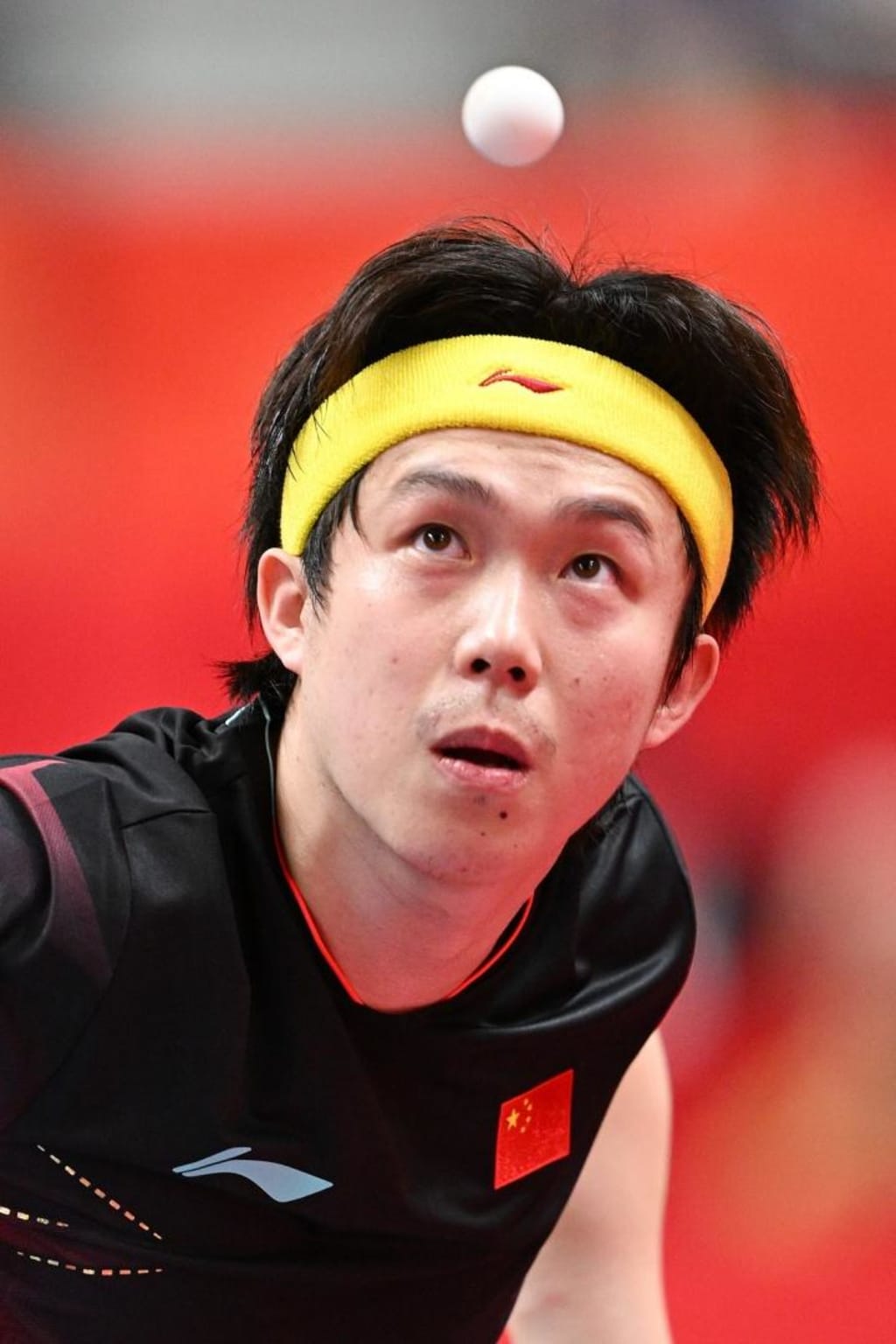
When the lights came down in Nagoya, Wang Chuqin did not go for that ball.
Lin Shidong’s final smash landed on his backhand side, at a wide angle. He moved one step, then stopped. The ball hit the barrier behind him, bounced once, and rolled onto the floor. 0-4.
In the mixed zone, a reporter held out a microphone. He kept his head down, voice low. When he mentioned Lin Shidong, he said the other man had “broken through his earlier slump” and that this was good for the Chinese team. Then the reporter asked about him.
He said he didn’t know why, but he just felt tired. He couldn’t quite find the feeling he used to have when he played. The enjoyment, or the liking, of being on the court.
Then he pressed his lips together.
That expression was familiar. Jakarta 2018, after losing to Lin Yun-Ju, he said the burden was too heavy. Liu Guozheng added that he hadn’t slept well the night before. Paris 2024, after losing to Truls Moregard, he said he wasn’t excited enough. When a reporter asked if it was the packed schedule, he said he had entered three events and failed to finish the job, so it was his own ability, not an objective excuse. After losing to Lind at the China Grand Smash, he said he had no desire, and left behind that line: “Losing a match doesn’t mean you can’t live anymore.” At the Asian Championships, after losing to Faraji, who was not yet fifteen, he said everything felt wrong, that the table and the ball were very different from what he practiced with. At the National Games, after losing to Fan Zhendong, he said he was convinced, that the longer it went, the less he knew where to hit. At the Asian Games team final, he first came back to beat Sora Matsushima, then was swept by Tomokazu Harimoto in the fourth match; afterward he said there was still a gap in ability. In the mixed doubles final, after losing 0-4 to Lin Shidong and Kuai Man, he said the pain got worse during the match.
Line those up and they read like coordinates of a slow sinking: mindset, excitement, desire, environment, opponent, injury. Then the coordinates disappear, leaving one sentence.
I don’t know.
A top athlete saying “I don’t know why I’m tired” points to something deeper than form.
Physical tiredness: sleep. Technical tiredness: practice. Both have solutions. But there is another kind of tiredness that neither sleep nor training can reach. It does not come from muscle, or from a blind spot in technique. It comes from somewhere more hidden: the person has begun to feel that playing has nothing to do with him anymore.
Wang Chuqin is stuck exactly there.
He is the captain of the Chinese men’s team. That identity means winning is expected, losing is unforgivable. Win, and some say he relies on resources. Lose, and some say he is not worthy. Whatever he does gets taken apart and placed into a frame prepared in advance. In that frame, there is no option called “he played well today.”
He once said the environment around table tennis now is “not that pure.” He said it lightly, but for someone surrounded by cameras and comments twenty-four hours a day, those words carry weight. The forty minutes on court do not drain him. The noise outside the court does, and it cannot be turned off.
There is also a more concrete problem. After the material of the ball changed, his old style, firepower at full blast, needed to move toward something more stable, more about connection and transition. That is not solved by changing a rubber. The muscle memory he built since childhood would still make the old movements in matches, and then the ball would not obey. The new set had not yet grown into his body. So matches produced an awkward state: he knew what to do, but his body could not do it; what his body did was not what he wanted.
That friction eats confidence directly.
The old injuries in his shoulder and knee keep returning. Every flare-up changes what he can do. When the body cannot support the quality of shot he wants, frustration doubles.
His way back may not be a single fix.
In August he took more than forty days off. When he came back, his form still had not returned. That says one thing: simply pausing is not enough. He needs to disconnect. That means no racket. No video. No scrolling through posts with his name in them. Let the nerves that have been stretched for so long actually loosen.
Then he needs to find the feeling of “liking” again. That cannot be done by thinking. It has to be done by doing. It can be trying something new in informal training, without counting wins and losses. It can be putting down the identities of “captain” and “number one” for a while and going back to being someone who simply likes to play. Even if he finds only one moment in a day, a beautiful rally, a clean strike, it is worth remembering. Liking the sport again is the only thing that pushes back against the drain.
He also needs to take the word “tired” apart. “I don’t know why I’m tired” is the most exhausting state of all. He can work with a coach he trusts, or a sports psychologist, to break the vague fatigue into specific problems. Is recovery not keeping up? Is some technical link always stuck? Is he avoiding a certain opponent or situation? The more specific the problem, the more likely there is a solution. Counseling is maintenance for a professional athlete.
He also needs to accept the technical transition. He does not have to force an immediate return to the old “full firepower” mode. He can set smaller process goals. For example: “In this match, I focus on bringing out the rhythm of transition,” instead of “I must win.” Winning and losing are results. The process is what he can control. Allowing himself to look “not good” for a period is how a new system slowly grows.
As captain, he can also try to share the responsibility. Let Lin Shidong and the others charge, make mistakes. It is good for the team in the long run, and it takes weight off him. The men’s team cannot become “if Wang Chuqin loses, the whole team loses.” He needs to move from “I must carry everything” to “we carry it together.”
Finally, he can limit what he reads. Comments will not get kinder if he reads more. They will get quieter if he reads less. Protecting attention is protecting form.
One day after training, while picking up balls, he flicked a ball out of the corner with his wrist. It arced into the basket. He had done that motion ten thousand times. This time he paused and looked at his wrist.
Then he said nothing, and walked away.
That pause did more than any interview.
About the Creator
Jin
Writer of reamstories
https://reamstories.com/jin
Enjoyed the story? Support the Creator.
Subscribe for free to receive all their stories in your feed. You could also become a paid subscriber, letting them know you appreciate their work.
Comments
There are no comments for this story
Be the first to respond and start the conversation.