
They Stood for Their Flag. They Heard the Wrong Anthem.
A 5-0 win couldn’t erase the moment before the whistle, when a routine pre-match ritual at the 2026 Asian Games turned into a diplomatic flashpoint and exposed deeper cracks in the event’s organization.
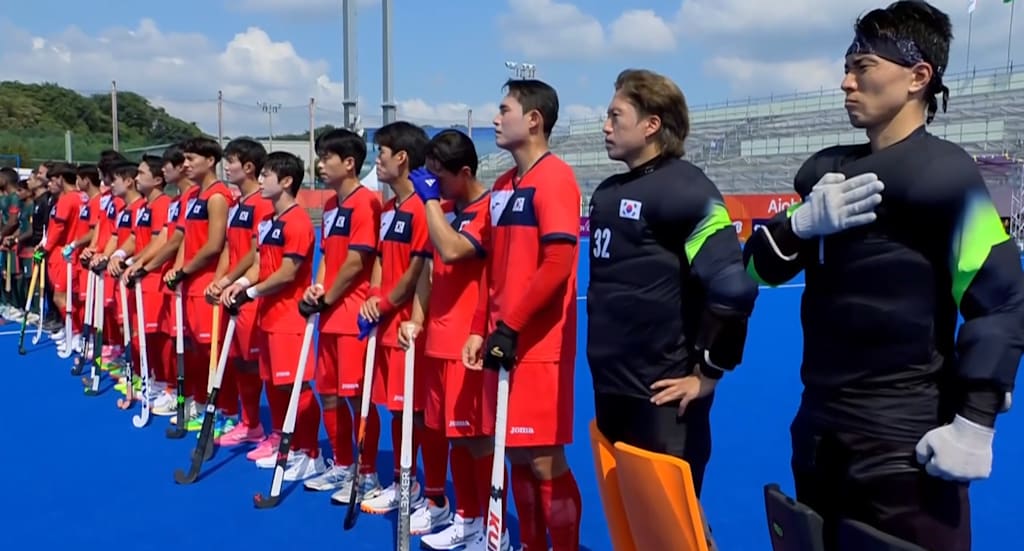
When North Korea’s anthem played before South Korea’s match
The wrong melody
On September 18, 2026, South Korea’s men’s field hockey team lined up for its Group A match against Bangladesh at Green Stadium in Kakamigahara, Gifu Prefecture. The players placed their hands over their hearts. The anthem began.
It was North Korea’s anthem.
Both countries call their anthem “Aegukga” or “Aegukka,” but the melodies do not sound alike. South Korea’s was composed by Ahn Eak-tai. North Korea’s was composed by Kim Won-gyun. Any Korean in that line would have known within a second.
Video from the scene shows the players looking confused. They lowered their hands and turned toward officials. The organizers stopped the music and played Bangladesh’s anthem instead. South Korea’s anthem was played later, after the teams exchanged greetings and just before the match started.
South Korea won 5-0. The error still dominated the pre-match footage. An official with the Korean Sport & Olympic Committee said the delegation had collected video evidence and planned to file a formal protest. Korean Olympic Committee President Yoo Seung-min called it “an absolutely unacceptable incident.”
Why the mistake carried weight
At most events, a wrong anthem is a technical error. An apology follows. The match goes on. This case is harder to dismiss.
An anthem is a national symbol. On the Korean Peninsula, both governments claim to be the sole legitimate government of the whole peninsula. The anthem, the flag, and the official name all carry that claim. South Korea is still legally at war with North Korea. Its government classifies the North as an anti-state group.
So South Korean athletes were asked to stand at attention, hands over hearts, facing their own flag, while the anthem of the other Korea played. That moment collided with their identity in public. The fact that both anthems share a title makes the mistake easier to make, but it also makes the verification step more important. A continental games should have a system for that. The organizers did not.
Seoul’s protest
The Korean Sport & Olympic Committee moved quickly. It gathered video evidence, confirmed the anthem was North Korea’s, and prepared a formal protest. Its demands were narrow: an apology, an explanation, and a guarantee that it would not happen again.
South Korea did not demand a replay. It did not pull its team. The players finished the match and won. That restraint kept the tournament moving, but it also showed how seriously the delegation took the error. The wronged party treated it as a line crossed.
That evening, two senior organizers went to the South Korean delegation’s office and apologized in person. The apology helped. It did not undo the moment. The video already existed. The players already had the memory.
This has happened before
International events have confused the two Koreas before.
At the 2024 Paris Olympics opening ceremony, an announcer introduced South Korea’s delegation as North Korea. The International Olympic Committee later apologized. At the 2012 London Olympics, South Korea’s flag was displayed before a North Korean women’s football match. North Korea’s team briefly refused to play. These cases show why organizers need a separate check for North and South Korea. The issue is not ordinary.
Nagoya repeated the error anyway.
The bigger organizational problem
The anthem mistake did not happen in a well-run event with one bad moment. It happened inside a broader organizational mess.
Before the Games opened, the organizing committee had already run into trouble. Budget overruns forced athletes into container-style housing and cruise ships. Delegations from several countries were stuck at airports for more than five hours because of system failures and transport delays. A Japanese delegation official said rooms were assigned “by number of people, not by gender.”
When basic housing and transport are unreliable, a precise cultural task like playing the correct anthem becomes fragile. One staff member may have pressed the wrong file. The deeper problem is a system that cut corners in the wrong places.
What this means for major events
Major sporting events need money and staff. They also need clear procedures. They need cultural knowledge. That is part of the job.
Playing an anthem requires a verified file, a rehearsal, and an on-site check. For North and South Korea, it requires a second check. If the organizers had built that, the error would not have happened. Instead, the same event that could not reliably house or transport athletes also could not identify a national anthem.
International sports bodies should ask harder questions when they award events. Hardware and commercial plans matter. So does the ability to treat every delegation with basic care. When a budget shrinks after it has already grown too large, athletes feel it first.
No clean ending
For the South Korean players, the wrong melody is already part of the record. An apology cannot remove it. The organizers damaged their own event and raised doubts about how well Japan can run the next major competition it bids for.
On September 18, they failed to protect the people who competed. The match ended 5-0. The anthem still played first.
About the Creator
Jin
Writer of reamstories
https://reamstories.com/jin
Enjoyed the story? Support the Creator.
Subscribe for free to receive all their stories in your feed. You could also become a paid subscriber, letting them know you appreciate their work.
Comments
There are no comments for this story
Be the first to respond and start the conversation.