
They Changed the Race
Phar Lap, Lisa Bluder, and the weight they keep putting on Caitlin Clark

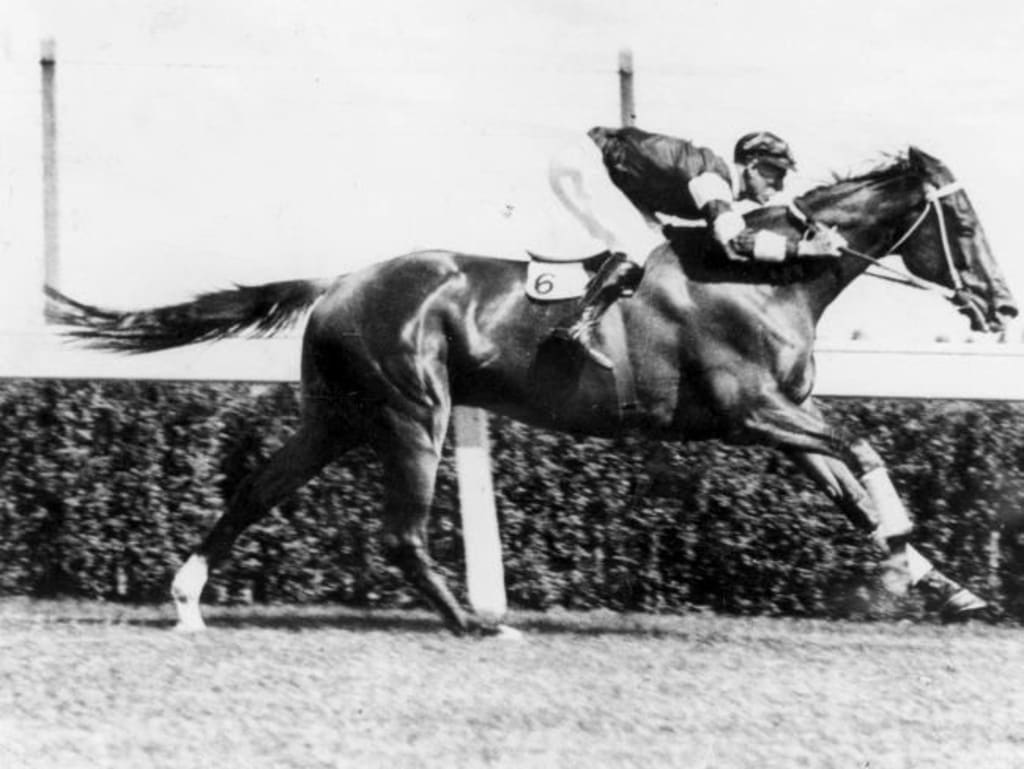
In the fall of 1926, in New Zealand, a Thoroughbred named Phar Lap was born. He was a scrawny, unimpressive colt who inspired almost no confidence. Trainer Harry Telford arranged the purchase for 160 guineas—roughly $800 to $850 U.S. dollars at the time—on behalf of an American businessman, David Davis, who had never seen the horse. Telford liked the pedigree on paper. Phar Lap’s sire, Night Raid, would also produce Nightmarch, the horse that won the 1929 Melbourne Cup the year before Phar Lap’s own victory.
When the colt arrived, Davis was furious. Despite the low price, the skinny, wart-covered yearling looked so poor that Davis wanted nothing to do with him. Telford saw something others didn’t. He leased the horse for three years, agreeing to cover the costs in exchange for a share of any winnings.
Telford’s training methods were old-school and hard. Phar Lap was considered lazy by the standards of the day and didn’t respond well. It wasn’t until the young strapper Tommy Woodcock took over his daily care that the horse began to change. Woodcock treated him with unusual patience and affection. Under that care, Phar Lap transformed into an extraordinary racehorse. He started winning and kept winning, becoming a Depression-era folk hero in Australia. His success angered gamblers and racing officials who felt threatened by a horse that simply refused to lose.
Sound familiar?
Phar Lap’s dominance put a serious damper on betting. Instead of celebrating a generational talent, the racing authorities responded the way the system often does with a horse that is too good: they began adding weight to his saddle. This practice, called handicapping, was common then and still exists today in many countries. The idea is simple—better horses carry more weight so lesser ones have a realistic chance. In the 1931 Melbourne Cup, they loaded Phar Lap with 10 stone 10 pounds (about 150 pounds), an unusually heavy assignment even for that era. He went to the front but faded to eighth.
They didn’t make him a worse horse. They just made the race harder than the one he was built to run.
Phar Lap was a great horse who had the weight of a system piled on him until the race no longer favored what he was built to do. They didn’t make him less. They just changed the conditions.
Caitlin Clark is a great player who is being asked to run a different race than the one that made her special. The difference is she never needed to prove she belonged. She only needed the freedom to keep being what she already was.
At Iowa, Lisa Bluder saw the light early and chose not to cover it. She gave Clark room to be herself—even when that self was stubborn, imperfect, and hard to coach. In the WNBA, the light is still there. But the system around her has increasingly asked her to play a more controlled, off-ball game, to fit an offense that often runs through others, and to succeed in a style that is not the one that made her dangerous in the first place.
The talent hasn’t disappeared. The race has changed.
Caitlin Clark’s arrival in the WNBA in 2024 didn’t just shake up a league that had struggled for relevance for nearly three decades. It also dragged an organization that hadn’t won a championship in twelve years back into the spotlight—in the most unconventional and controversial way possible.
The jump from high school to college wasn’t nearly as big for Clark—or for the game—as the jump from college to the pros. College basketball was still mostly about basketball, not narratives, agendas, and politics, as it is at the professional level, though that atmosphere is changing at the college level faster than it did during her time. In college, Clark had to learn to trust the people around her, and they had to learn to adjust to her. With the help of a very patient coach, Lisa Bluder, those walls came down. That was a testament to Bluder’s maturity. Coaches are supposed to know more than their players. But what Clark has can’t really be coached. Maturity is also being humble enough to accept that your hard-earned knowledge might not apply the same way to someone who was simply born with what took you a lifetime to learn.
There’s been a lot of speculation about Clark’s role with the Fever. After the All-Star break in 2024, it looked like Christie Sides finally gave more ground and let the offense run closer to the way Clark plays. And for the first time since 2016, the Indiana Fever were in the playoffs.
That success only made the larger tension harder to ignore. Clark’s arrival didn’t just change a roster. It strained a league that had grown comfortable managing its own priorities, its preferred narratives, and its sense of who the game was supposed to serve. Something that didn’t fit the existing order had shown up, and the seams started to show.
That something—someone—is Caitlin Elizabeth Clark.
Stephanie White replaced Christie Sides as coach of the Indiana Fever before the 2025 season. At first glance, her résumé looks impressive, especially to someone who doesn’t follow the league closely. She won a national championship at Purdue, and for a lot of people that single word—“champion”—carries real weight. I’m not sure it should. A title says as much about the program, the coaching staff, and the rest of the roster as it does about any one player. Coaching and recruitment have always had as much to do with winning a championship as individual talent.
White was drafted in 1999 by the Charlotte Sting (second round, 21st overall). In the December 15, 1999 expansion draft, the new Miami Sol selected her. The Sol immediately traded White to the brand-new Indiana Fever in exchange for Sandy Brondello and a 2000 first-round pick. Evidently, the Sol saw something in Brondello they didn’t see in White. After a few years as a college assistant at smaller programs, White moved into the WNBA ranks, first with the Chicago Sky and then with the Fever—including a place on the 2012 championship staff under Lin Dunn.
It should be noted that Kelly Krauskopf was the one who initiated the trade that brought White to the Fever from Miami. If you’re starting to notice a pattern, give yourself a pat on the back. Once you understand the history of the franchise and the people who have shaped it, the picture becomes clearer—and so does the question of why Caitlin Clark so often appears to be on the outside looking in. Evidently, loyalty runs deep.
As Fever head coach in 2015, White took the team to the Finals in her first season. They lost in the first round the following year. Then came Vanderbilt. It is here that her coaching style begins to raise questions.
I’m not going to dig deep into her time at Vanderbilt—it’s all out there for anyone who wants to look. White has high standards. She’s blunt. She calls herself a “player’s coach.” You can’t really argue with that label; it just depends on which player you’re talking about. This is where I started to take issue with her approach. She says she wants pace. She says she wants freedom. She says she wants players to “make plays, not run plays.” Except this isn’t the system she is running in Indiana. I never watched her as a coach at Vanderbilt, but something wasn’t clicking. Was it lack of pace, freedom, making plays instead of running them? Whatever the case, the situation was tenuous. The nine players who left Vanderbilt under White did not go on the record about why. The newspapers listed the names and the new schools. They did not print interviews where those starters said they were walking because of the coach. That is common in college basketball. Kids transfer. They stay polite. The reasons stay private. The pattern is still there. The explanations from their own mouths are not.
Stephanie White knows basketball. Like Clark, she’s been around the game her whole life. With the Connecticut Sun in 2023 and 2024, she went 55–25, reached the semifinals twice, and won Coach of the Year in 2023. That is not an accident. She can coach. And yet, in Indiana, something is not clicking. To the casual observer—and to a Fever front office that has worked with her before as a player, coach, and administrator—everything looks fine. They just clinched a third straight playoff trip since Caitlin Clark arrived.
I am not a conspiracy theorist… okay, maybe I am to some extent. All of us are—even you, the person kind enough to read this—but I really try to weigh the evidence. Ducks in a row. You get the point. Patterns, like history, repeat themselves.
If Lisa Bluder is to Clark what Tommy Woodcock was to Phar Lap, then Stephanie White is Harry Telford. There’s a lot of speculation about what would take White from a very successful program at Connecticut to an up-and-coming team like the Fever. If you’re coaching a team that has regressed, a fresh start makes sense. White was winning with Connecticut. She framed it as coming home. “This franchise runs in my blood.” She grew up in Indiana, played for the Fever, coached here before. She has family nearby. She called it a no-brainer once the Sun let her talk. Had Clark not been there, would she have left the Sun?
Stay with me, okay?
At White’s intro presser, and right after the hire, she praised Clark. Called her a generational player. Said she had watched her since eighth grade and through college. She said Clark and Aliyah Boston “are going to go down as the greatest.” She introduced the job as a homecoming, then as the chance to coach that pairing. In an interview with Brendan Suhr on the Coaching U podcast, she talked about giving them “the freedom to make plays, not run plays.” Those are her words, not mine. She was saying the right things. Clark does, in fact, make plays. Bluder saw it and let it happen. From the beginning, White led people to believe the offense would run through Caitlin Clark, supported by Aliyah Boston and that famous pick-and-roll. That was the picture she painted. Mitchell was not part of that first picture.
Now, don’t get the wrong idea. I love Kelsey Mitchell. She is arguably the best shooting guard in the league. She is fearless about taking shots, as if she is not expecting to look over and see her coach on the sideline with arms crossed, or throwing them up in disgust at the mere thought of a three.
I’ve seen Mitchell turn the ball over plenty of times trying to throw Caitlin’s kind of dime. Nothing happens. She isn’t yanked for too many turnovers or for missing too many shots. She can miss six or seven in a row and stay on the floor. From that first press conference to now, it looks like Stephanie White has changed her tune about who the team actually runs through. In the beginning, it was Clark, the generational talent. Now it is Kelsey Mitchell, the loyal veteran who stayed through the losing years. If anyone on that roster has earned a championship—and an MVP—it is Mitchell. White just didn’t make that the story when she walked in the door.
I’m afraid I’m going to need a little more proof, Mark…
Okay, okay. I won’t let you down.
It made sense to make signing Mitchell a priority. She has been with the Fever since they drafted her No. 2 overall in 2018. This part matters: she has always been a prolific scorer, and until Clark arrived, the Fever never had a winning season in Mitchell’s time there. That reinforces the old truth that teams win championships, not a single player’s scoring column. I don’t want to hit this too hard. Before Clark, Mitchell was putting up big numbers on teams that still lost. A record like that does not measure how many points one guard scored. It measures whether the whole team could win. When one player is carrying the scoring load and the losses keep coming, the question is not whether she can shoot. It is whether the ball is moving enough for anyone else to matter.
You could start to see the shift during the 2025 season. Clark played in only 13 games before injuries ended her year. It was during that stretch that her role on the team began to come into question. Without Clark for most of the season, the Fever still made the semifinals and lost to the Las Vegas Aces, 3–2. Mitchell, like years past, carried much of the load. Her performance in that series was not vintage Mitchell all the way through. Game 1 was strong: 34 points. Game 2: 13 on 4-of-14. Game 3: 21 on 8-of-26. Game 4: 25. In Game 5 her body said, “That’s enough.” She went down in the third quarter, her lower body cramping so badly she had to be helped off the floor. She never returned. The game went to overtime without her. The Aces won, 107–98.
Stephanie White admitted they “ran her ragged.” Of course the show goes on. The season doesn’t end when a star player gets hurt.
Perhaps the most controversial thing White said came after a 78–74 win over Seattle, with Clark out with a groin injury and the Fever on a five-game winning streak.
White said:
“I said it early when C was out the very first time. While we don’t like it, sometimes it can be a blessing in disguise, because everybody else finds themselves. No one is afraid to make the big play offensively or defensively.”
She added that the group was unselfish, played for each other, and that when one person doesn’t have it, somebody else does.
She framed it as a compliment to the group. A lot of people heard it as a knock on Clark. That’s the problem with the sentence. Clark is climbing toward the top of the league’s assist lists. You don’t get there playing “hero ball.” Mitchell has always hunted shots. That is her gift. White has praised that fearlessness. When Clark takes over a game, it gets a different name. Same look. Different label.
The season isn’t over. The evidence is already on the floor.
They didn’t make her less. They changed the race. You don’t say whoa to a racehorse.
About the Creator
Mark Elliott
My name is Mark. I've been married going on 5 years now. We moved to Eastern Oregon. My wife is officially retired. I will be spending more time here now. Writing is hard with our schedule, but we make time for what we love!
Enjoyed the story? Support the Creator.
Subscribe for free to receive all their stories in your feed. You could also become a paid subscriber, letting them know you appreciate their work.
Comments
There are no comments for this story
Be the first to respond and start the conversation.