
The Two-Year-Old on Qeshm Island and the Ghosts of Al‑Azraq
Iran says it blew three U.S. F-35s to pieces. Washington says none were even scratched. On July 30, missiles flew, bombs fell, and a child named Sina was killed—but the one truth that matters is still hidden in a satellite image no one will release.
I. Two Completely Contradictory Statements on the Same Day
July 30, 2026, 9:17 a.m. Tehran time. Iran's Islamic Revolutionary Guard Corps (IRGC) released a statement via its official Telegram channel.
The statement said that at dawn that day, U.S. warplanes struck Qeshm Island in southern Iran. Two residential buildings were hit. Three people were killed, including a two‑year‑old boy named Sina. In retaliation, the IRGC Aerospace Force launched "multiple ballistic missiles" within hours at the Muwaffaq Salti Air Base in Al‑Azraq, Jordan. The claimed results: three F‑35 fighters completely destroyed, three others severely damaged, and multiple U.S. technical personnel and officers killed.
About three and a half hours later, U.S. Central Command (CENTCOM) posted a statement of fewer than 80 words on X (formerly Twitter). The wording left no room for ambiguity: "The Iranian Revolutionary Guard Corps claims to have destroyed three U.S. F‑35 aircraft — no U.S. aircraft were destroyed or damaged. All incoming missiles and drones were either intercepted or failed to reach their targets."
Between the two statements lies a missile flight distance of more than 3,000 kilometers — and two entirely parallel narratives of "truth" from two nations.
II. Before July 30: A Timeline Repeatedly Broken
Why this single day became so critical requires stepping back three weeks.
From July 8, the frequency of U.S.‑Iran skirmishes in Iraq and Syria suddenly increased. U.S. drones and fighter jets conducted at least four airstrikes against IRGC Quds Force positions in Iraq's Anbar province. Iran responded with drones and short‑range rockets.
On July 24, U.S. President Donald Trump ordered a "pause in active strikes against targets inside Iran." Iran announced the same day a "suspension of reciprocal strikes against open U.S. military targets." A nominal ceasefire began. But during these six days, U.S. patrols in Syria's Deir al‑Zour region still encountered two roadside bombs, and an explosion of undetermined cause occurred at a ship repair yard in Iran's Bandar Abbas.
Early on July 29, Iran broke the ceasefire. According to a later CENTCOM briefing, Iran fired at least five suicide drones at two U.S. forward outposts in northeastern Jordan — all intercepted by Patriot systems. Tehran did not officially acknowledge the attack that day.
At 20:00 U.S. Eastern Time on July 29 (03:00 Jordan local time on July 30) , the U.S. began airstrikes against targets inside Iran. The strikes covered five locations: Qeshm Island, Kish Island, Bandar Abbas, Abadan, and Bushehr. The U.S. said it hit "dozens of Revolutionary Guard command and control nodes."
Around 05:00 on the morning of July 30, two residential buildings on Qeshm Island were struck. Among the dead were taxi driver Kaisar Jafari, his wife Zahra, and their two‑year‑old son Sina. At least two other children were wounded.
On the morning of July 30, Iranian missiles flew toward Jordan.
The only undisputed physical fact along this timeline: on July 30, missiles did fly from Iran toward Jordan, and U.S. warplanes did strike Iranian territory that same day. The dispute centers entirely on whether any missile hit anything of value.
III. Dissecting the Evidence: Satellite Images Iran Released, and What Went Unsaid
Alongside its statement, Iran published a set of satellite images.
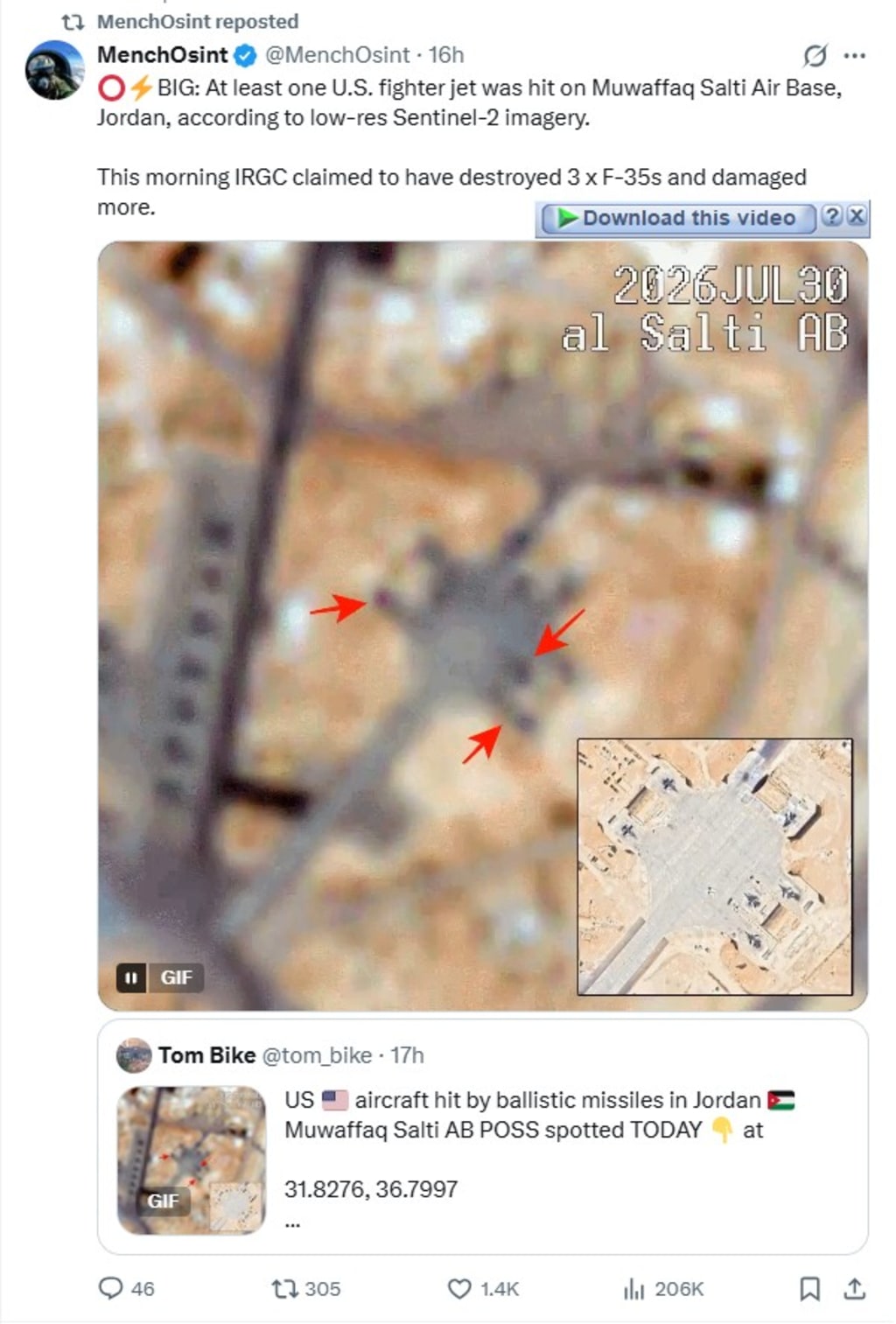
The first, taken on July 25, shows several light‑colored military aircraft parked on the apron at Muwaffaq Salti Air Base. The second, taken on the afternoon of July 30, shows a suspected scorch mark in the same area. The IRGC circled the area in red.
The U.S. side released no on‑site photos or video from the base. CENTCOM's statement did not mention "missiles landing outside the base" or give specific numbers or locations of intercepts.
At this stage, independent observers could mainly rely on open‑source data from the European Space Agency's Sentinel‑2 satellites.
Sentinel‑2 resolution is 10 meters per pixel. At that scale, an F‑35 (about 15.7 meters long, 10.7‑meter wingspan) occupies roughly 2‑3 pixels. You can tell that "a large object is there," but you cannot tell whether it is an F‑35 or a fuel tanker. Nor can you distinguish "destroyed" from "surface coating peeled off" by pixel brightness alone.
A former U.S. military intelligence officer familiar with satellite imagery analysis told Breaking Defense in a widely quoted remark: "Low‑resolution imagery can tell you that something burned there. It can't tell you what burned. "
This is the real reason neither narrative can be falsified at this moment: Iran's evidence supports "something was hit," but not "three F‑35s were hit"; the U.S. denial offers no on‑the‑ground imagery, relying instead on institutional authority.
At noon on July 31, 2026, the London‑based conflict monitoring group Conflict Intelligence Team released a preliminary assessment, using cautious language: "There are notable indications of surface changes in a parking area at Al‑Azraq base around July 30. The nature of the changes cannot be confirmed."
IV. Beyond Jordan: Six Fronts Moving on the Same Day
If you temporarily set aside the F‑35 dispute, five other things happened on July 30.
In Saudi Arabia, the Saudi air defense force reported that two crude oil facilities in the Eastern Province were hit by drones that day. This was the first time Saudi Arabia publicly acknowledged a domestic attack during the current U.S.-Iran escalation. Later that same day, Riyadh announced joint airstrikes with the U.S. against "Iran‑backed militias" inside Iraq — Saudi Arabia's first direct combat involvement in this conflict.
In Egypt, the Egyptian government confirmed that a fire on two LNG vessels off the port of Damietta the previous day was caused by a drone attack. Cairo did not identify the attacker, but an Egyptian security official told Reuters the drones came "from the Red Sea direction."
In Kuwait, a camp facility built by a Chinese company in northern Kuwait was hit by missile debris. No Chinese personnel were reported injured. Kuwait's military said the missile "crossed the border and fell," without explaining why it was not intercepted.
In the Strait of Hormuz, the IRGC naval force forced two tankers to change course temporarily that day. CENTCOM subsequently issued a navigation warning, calling Iran's actions an "immediate threat" to merchant shipping.
In northern Israel, the Israeli military accused Lebanese Hezbollah of launching a drone attack against an Israeli military vehicle that day, violating the ceasefire agreement. Hezbollah did not deny it.
Whether the F‑35s were destroyed may still be sitting in an as‑yet‑unreleased sub‑meter image from a U.S. military satellite. But the Middle East on July 30 was already about far more than the fate of three fighter jets.
V. Known and Unknown
By the afternoon of July 31, 2026, these facts can be independently verified:
The U.S. conducted airstrikes on Qeshm Island and four other locations inside Iran early on July 30.
Two residential buildings on Qeshm Island were hit, killing at least three Iranian civilians.
Iran launched ballistic missiles toward at least one target inside Jordan on the morning of July 30.
Jordanian officials said its air defense intercepted 5 missiles and reported no Jordanian casualties.
Low‑resolution satellite imagery of Al‑Azraq base shows suspected surface changes in a parking area.
CENTCOM publicly denied that any U.S. aircraft were damaged.
These claims remain unverified from each side:
Iran's assertion of "three destroyed, three heavily damaged."
The U.S. assertion of "all intercepted or off‑target."
The type of object struck.
Whether there were any U.S. military casualties at the base.
The next round of key evidence could come from three directions: sub‑meter imagery released by commercial high‑resolution satellite firms (such as Maxar or Planet) within 48 hours; whether the Pentagon releases on‑site photos from the base in the coming days; and whether Iran releases infrared or electro‑optical footage of the moment of impact.
Until any of that emerges, what was parked at Al‑Azraq on July 30, what hit it, and how badly it was damaged — these are questions that can only be judged between two mutually contradictory statements.
What remains beyond dispute: on that day, missiles did fly from Iran toward Jordan, and bombs did fall from U.S. warplanes onto Qeshm Island. Everything else is a matter of competing claims, to be adjudicated only when the evidence arrives.
About the Creator
Jin
Writer of reamstories
https://reamstories.com/jin
Enjoyed the story? Support the Creator.
Subscribe for free to receive all their stories in your feed. You could also become a paid subscriber, letting them know you appreciate their work.
Comments
There are no comments for this story
Be the first to respond and start the conversation.