
The Soil That Waits: Inside Iran’s Silent Revolution of Bones and Basil
The theocracy killed their fathers and called it justice. For decades, ordinary Iranians have been digging up that blood‑soaked earth in the dead of night, hiding it in flowerpots, and waiting. Here’s why the volcano under the black robes is finally about to erupt.
The Iranian clerical regime has never gambled everything on “national destiny” or “resisting aggression.” Those are slogans for the street and the camera. What they have always gambled on is the survival of the Velayat-e Faqih, the absolute monopoly of theocracy over power and wealth. They’ve played this hand for more than forty years with precision, brutality, and methodical calculation, but the chips on the table are almost gone. To see the endgame clearly, you have to go back to the very first hand they dealt.
Clearing the field: absolute safety in a pool of blood
After the 1979 Islamic Revolution toppled the Pahlavi dynasty, Khomeini returned from Paris. On the plane, a journalist asked how he felt. He answered, “Nothing.” That reply became a kind of footnote: not calmness, but absoluteness. He felt nothing about power, only calculation.
The clerical regime’s first task was to annihilate every remnant of the old order. The Shah’s generals, SAVAK secret police officers, high-ranking bureaucrats, and court loyalists were dragged into prison without trial. Many were hanged from cranes, their bodies swaying over the streets of Tehran. This wasn’t an emotional purge; it was a ritual. The old regime had to be completely delegitimized, and even its most loyal servants could not be allowed to live — living witnesses meant another narrative might survive.
But the more important purges were aimed at “their own people.” Karim Dastmalchi, a prominent Iranian businessman and one of Khomeini’s chief financiers during his exile, had once chartered a plane to help Khomeini flee Iraq via Kuwait to France. After the revolution, he believed he was a hero. Khomeini’s religious court charged him with “bourgeois exploitation,” confiscated all his property, and executed him by firing squad. His immediate family in Iran, young and old, were hanged. This wasn’t ingratitude; it was a property-rights declaration. Under the Velayat-e Faqih, all private wealth is illegitimate unless held in custody by the clergy. The merchant is only a custodian, never an owner.
Next came the revolutionary allies. The Tudeh Party, Iran’s communist party, had fought alongside Khomeini’s forces against the Shah, putting bodies and guns on the street. In 1983, the regime outlawed the party and arrested thousands. Five years later, in the summer of 1988, the imprisoned Tudeh members were taken from their cells in batches, led into courtyards, lined up against a wall, and shot in the back of the head. Their bodies were trucked away and dumped into mass graves on the outskirts of Tehran. No trials, no verdicts. The entire purge that year left only one line in official archives: “Elimination of the hypocrites.”
That same summer, leftist guerrilla fighters, student movement leaders, moderate Islamic intellectuals — anyone who dared to link the words “democracy” and “Islam” — vanished. When the elected president Abolhassan Banisadr was secretly sentenced to death by a religious tribunal, his supporters had already been rounded up and killed in batches. Banisadr escaped Iran disguised in women’s clothing; before leaving, he learned that his three-year-old niece had been imprisoned, simply because she carried “Banisadr blood.” Khomeini had once written a personal letter endorsing Banisadr’s presidential campaign. The ink on that letter hadn’t even faded.
The most chilling message to the clerical establishment itself was the treatment of Grand Ayatollah Shariatmadari. The elderly cleric had once been Khomeini’s spiritual rival, commanding millions of followers. He maintained a traditional tolerance toward secular-minded dissenters and refused to sign blanket execution orders. Khomeini didn’t kill him — executing a Grand Ayatollah would have torn the clergy apart. Instead, he chose lifelong house arrest. Shariatmadari’s residence was emptied, his family exiled, his name erased from seminary textbooks. For the last decade of his life, he was forbidden visitors, new books, and even a radio. After his death, his coffin was ordered buried at night, without a gravestone.
The most institutionally terrifying instrument was the “Death Committee” established after the People’s Mojahedin Organization launched Operation Mersad in July 1988. Every administrative district in the country was given a three-man panel: one religious judge and two executive officers. The judge could sentence prisoners to death based solely on the labels on their files — “leftist,” “hypocrite,” “apostate.” He would announce, “This person must be eliminated,” and one officer would record it while the other signed the execution order. The condemned were then taken to makeshift killing sites, mostly prison basements or wastelands on the city outskirts. According to later testimonies from surviving guards, on the busiest nights, a single execution site processed more than forty people an hour. Some prisoners died without ever knowing what crime they’d been convicted of. The charge wasn’t treason; it was “apostasy.” That was the ultimate declaration of the theocracy: the dignity of religious law overrides the will of the nation completely.
When Kurds and Baluchis demanded ethnic autonomy, the response was village-by-village expulsion, bulldozing, and burning. Some Kurdish mountain hamlets have been erased from maps entirely because even their ruins were plowed over and planted with wheat. Survivors fled to Iraq and Turkey; some later took up arms, waging an ethnic insurgency against a religious regime. Through these methods, the clerical rulers carved out a zone of absolute silence inside the country. Any group that might accumulate resources or organize outside the system was preemptively excised, like a surgeon cutting out pre-cancerous tissue — always cutting much wider than the lesion itself.
Maintaining control: proxies, the nuclear threshold, and cheap loyalty
With the interior emptied of threats, external defense became the core problem. The clerical regime understood clearly that the U.S. military was not Saddam’s Republican Guard. A direct military confrontation would be suicide. So they built an “onion-layered” strategic defense system: the outermost layer a web of proxy militias across the Middle East, followed inward by ballistic missile arsenals, the threshold of nuclear development, rugged mountain terrain, and finally, the mobilizing power of theocratic legitimacy.
Hezbollah in Lebanon, Hamas and Islamic Jihad in Palestine, the Houthis in Yemen, Shia militias in Iraq — these groups are branded as terrorist entities by Western security agencies, but on Tehran’s chessboard, they are living pieces. By funneling weapons, funds, training, and technology, Iran has gained the ability to harass and deter Israel and the United States from the Lebanese border all the way to the Red Sea coast without ever declaring war. Hezbollah has more than a hundred thousand rockets; the Houthis can block the Bab el-Mandeb strait with drones and anti-ship missiles. None of this requires Iranian soldiers to die. It only requires the clerical regime to redirect a portion of its oil revenue and dispatch instructors from the Revolutionary Guard.
The nuclear program is another card. Iran’s repeated oscillations at the negotiating table during the JCPOA talks were themselves part of the strategy: maintain an ambiguous nuclear capability that can both modulate the tightness of international sanctions and, if necessary, deter invasion by brandishing a near-nuclear status. Israeli and American intelligence assessments have repeatedly indicated that Iran could be only weeks away from enriching weapons-grade uranium. That “several weeks” window is itself a product — it manufactures strategic hesitation.
At home, the theocracy relied on two things to secure its base: religious indoctrination and resource distribution. A sprawling network of seminaries, mosques, and the Basij militia under the Revolutionary Guard handled ideological control and surveillance. The urban poor and conservative rural families received subsidized bread, gasoline, and basic healthcare through a massive subsidy system — all funded by oil exports. Even in the worst years of sanctions, the government managed to sell oil through smuggling networks and unofficial channels to keep the basics flowing.
This system worked for forty years. It did, in fact, ward off external overthrow. The U.S. invaded Afghanistan and Iraq but never launched a ground war against Iran. Khomeini’s successor, Khamenei, has outlasted eight American presidents: Carter, Reagan, Bush Sr., Clinton, Bush Jr., Obama, Trump, and Biden. In the palaces of northern Tehran, this longevity is routinely invoked as the core proof of the regime’s legitimacy: we endured; we are still here.
Collapse: when oil can no longer buy loyalty
But enduring is not the same as stabilizing. The structural cracks that had been accumulating for four decades started tearing open faster after the U.S. unilaterally withdrew from the nuclear deal in 2018 and reimposed maximum sanctions. By the time the Mahsa Amini protests erupted in 2022 — the “Woman, Life, Freedom” uprising — the fissures could no longer be sutured.
Economic data is just the skeleton, but the skeleton tells the story. The black-market exchange rate of the Iranian rial against the dollar collapsed from 40,000 in 2017 to over 500,000 by 2023. Inflation has stayed above 40% for years; the price of eggs, milk, and meat shifts almost monthly. Official youth unemployment hovers around 25%, but in northwestern and southeastern provinces, the real rate exceeds 50%. University graduates drive ride-shares in Tehran’s streets; chemistry PhDs sell fruit in Isfahan. These aren’t jokes; they’re the daily self-mockery of Iranian youth on Instagram.
The clerical regime itself remains entirely unconstrained by this collapse. According to multiple leaked internal reports by reformist parliamentarians, roughly 500 senior clerical families control about 90% of Iran’s major economic resources. From oil trading, automobile manufacturing, and telecommunications to real estate development, every large business requiring licenses or foreign-exchange quotas has a religious foundation or clerical family behind it. Supreme Leader Khamenei personally controls a conglomerate worth tens of billions of dollars called the Execution of Imam Khomeini’s Order (Setad), a behemoth that operates outside parliamentary oversight and does not disclose its finances. Its holdings span finance, energy, shipping, healthcare, even ice cream production.
General Qasem Soleimani’s niece lives in the United States and posts her party life daily on X: poolside in Palm Beach, luxury boutiques in Beverly Hills, the cabin window of a private jet. Her account is not set to private. Iranian youth scroll through these photos while sitting in rented apartments in southern Tehran’s slums, watching Turkish soap operas via satellite dish. This schism is no secret; it is burned onto everyone’s retina.
Religious indoctrination is also failing. Four decades of forced hijab, gender segregation, and compulsory religious instruction have begun to backfire in an environment of falling birth rates, rising urbanization, and increasing penetration of satellite TV and the internet. In September 2022, a 22-year-old Kurdish woman named Mahsa Amini died after being arrested by morality police for improperly wearing her hijab. Her death detonated nationwide protests that lasted for months. The flames spread from Kurdish towns to the windows of female dormitories at Tehran University. Students burned their headscarves; schoolgirls stood on desks and chanted “Death to the dictator”; oil workers and bazaar merchants joined strikes at various points. It took the Revolutionary Guard months to crush the demonstrations, at the cost of hundreds killed, thousands arrested, and an unbridgeable generational rift.
Even more symbolically, some protesters began chanting “Long live the king” and “Pahlavi, come back.” For a country of over 80 million with a median age under thirty, when the young would rather romanticize a monarchy their grandparents overthrew, the theocracy’s foundation has rotted from the roots.
Infighting: the hidden struggle under black robes
Khamenei is in his mid-eighties, and reports of his declining health have surfaced repeatedly. The power transition is already unfolding behind the curtain. The clerical regime is split into three factions: the hardline conservatives represented by current President Ebrahim Raisi, who advocate maximum internal repression and external defiance, accepting no Western concessions; the moderate technocrats typified by former President Hassan Rouhani, who hope to revive the nuclear deal and allow limited openings to relieve economic pressure; and a faint, extremely weak reformist voice that has surfaced more recently.
Between 2023 and 2025, nuclear negotiations kept cycling through the same pattern: “close to a deal — then abruptly broken off.” The back-and-forth wasn’t merely a dispute over technical details; it was a probe of internal power distribution. Every time Iranian negotiators showed a sliver of compromise in Vienna or Geneva, conservative newspapers in Tehran published editorials painting any concession as “apostasy.” Revolutionary Guard–affiliated media directly threatened that loosening the nuclear program would cause national security to collapse.
But the hardliners have no alternative. The hole torn by economic sanctions has grown so large that even maintaining the proxy network is becoming difficult. By early 2024, weapons deliveries to Hezbollah and the Houthis were reportedly delayed, and fighters’ salaries went unpaid. In Syria, Iran’s military presence was forced to contract under sustained Israeli airstrikes. After Hamas launched its massive conflict with Israel in October 2023, it did temporarily tie down Israeli forces, but the group itself suffered devastating losses that will prevent it from being an effective Iranian proxy for the foreseeable future. The clerical regime has suddenly discovered that its chess pieces are turning into burdens that require constant blood transfusions.
The United States: no redemption, only a nuclear lock
American policy debate on Iran has never genuinely aimed at “saving the Iranian people.” Trump’s first term demonstrated the baseline logic: assassinate Soleimani, exit the nuclear deal, apply maximum pressure — but commit no ground troops. Biden’s term tried to return to diplomacy, only to get stuck between Iran’s nuclear advances and the human-rights crackdown during the protests. No matter who occupies the White House, the two-trillion-dollar lesson of Afghanistan is engraved in their bones. Even if you could shatter the Iranian theocracy, no politician is willing to pay the cost of rebuilding a pro-Western secular state. Washington’s goals are extremely limited and cold: ensure that Tehran does not possess a nuclear bomb or the long-range missiles to deliver one. As long as that red line holds, no matter how much Iranians bleed, no plan for a ground invasion will ever leave the White House drawer.
Israel is more aggressive. Through continuous airstrikes on Iranian targets in Syria, assassinations of nuclear scientists, and cyberattacks on enrichment facilities, it has forcibly turned back Iran’s nuclear clock. But as precise as these strikes are, they cannot destroy the theocracy itself. At certain moments, they even generate a nationalist backlash that the regime exploits as “mobilization through grievance.”
Endgame: a volcano waiting to erupt
All threads lead to the same conclusion: the clerical regime’s old methods of control are spent. They can still crush the streets with force once or twice more, but they cannot solve the daily suffocation caused by economic collapse. They can still summon conservative votes with religious slogans, but they cannot force a university-educated young woman to put her headscarf back on. They can still deploy the Quds Force abroad, but it gets harder to explain to the people at home why butter and medicine are being sacrificed for Gaza and Beirut.
Iran will fall into a prolonged period of disorder and chaos for the foreseeable future. The outer shell of theocracy may persist (after Khamenei is gone, some new Supreme Leader will be pushed forward after brutal internal infighting), but he will inherit an exhausted regime. The funding chains of the proxies will snap, and the strategic outposts will shrink. Hezbollah and the Houthis will gradually devolve into local self-defense militias rather than instruments of Tehran. The nuclear program will be frozen below the threshold by a combination of external strikes and internal constraints.
Society is like a volcano accumulating magma. The crater may be temporarily capped by the guns of the Revolutionary Guard and the Basij, but each act of suppression increases the pressure for the next eruption. In the carpet workshops of Isfahan, in the university labs of Shiraz, in the rented rooms of Mashhad, the younger generation is voting with its feet. Those who speak English are prepping for the TOEFL to get out. Those who can code are taking remote overseas gigs to save escape money. Those who have neither skill scroll through forty-year-old pre-revolutionary videotapes under the cover of a VPN — footage of female judges without headscarves, oil engineers in suits, orchestras playing Beethoven in Tehran’s concert halls. That is an Iran they have never seen but believe once existed.
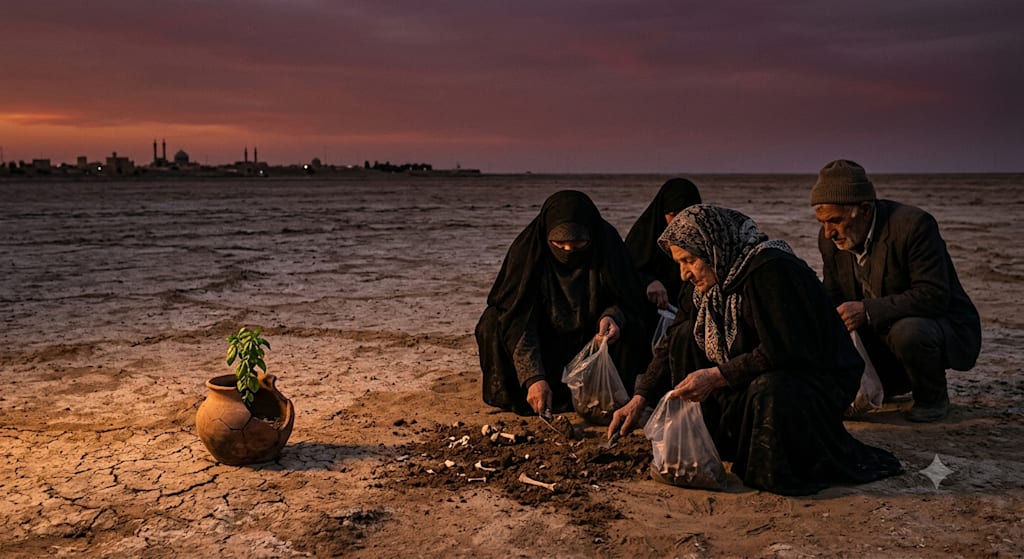
The Tudeh members executed in 1988 left no names behind. Their bones are mixed into the mass graves at the edge of the Kavir Desert, southeast of Tehran. The wind pushes the dunes back and forth, sometimes uncovering bone fragments. Every year around the spring equinox — the Persian New Year of Nowruz — middle-aged people drive out there and dig soil in the dark. They fill plastic bags, put them in their trunks, and take them home. It’s not for memorials. They believe the soil is mixed with the powdered bones of their fathers, to be kept temporarily at the bottom of flower pots until the day they can be buried openly in a cemetery. During the years of waiting, those pots are planted with basil and mint.
This act itself is the final verdict on the clerical regime’s gamble. The absolute silence a regime created through death is being pierced, in the end, by silent digging, collecting, and waiting. This piercing makes no gunshot; it won’t register on the Revolutionary Guard’s radar. But it is more fatal than all the proxy armies and centrifuges combined. When enough people begin quietly collecting the blood and bone of their kin, preparing for another future, the Velayat-e Faqih’s hand is played out. Staking everything to resist aggression? They were staking everything on a set of chains, and those chains are nearly rusted through.
About the Creator
Jin
Writer of reamstories
https://reamstories.com/jin
Enjoyed the story? Support the Creator.
Subscribe for free to receive all their stories in your feed. You could also become a paid subscriber, letting them know you appreciate their work.
Comments
There are no comments for this story
Be the first to respond and start the conversation.