
The Paper Trap: How Australia Hollowed Out Chinese Mining Shares With the Stroke of a Pen
In the race for the rare earths that power F-35s and Teslas, Canberra didn’t just block investment — it erased shareholder rights overnight. This is the anatomy of a financial evisceration.
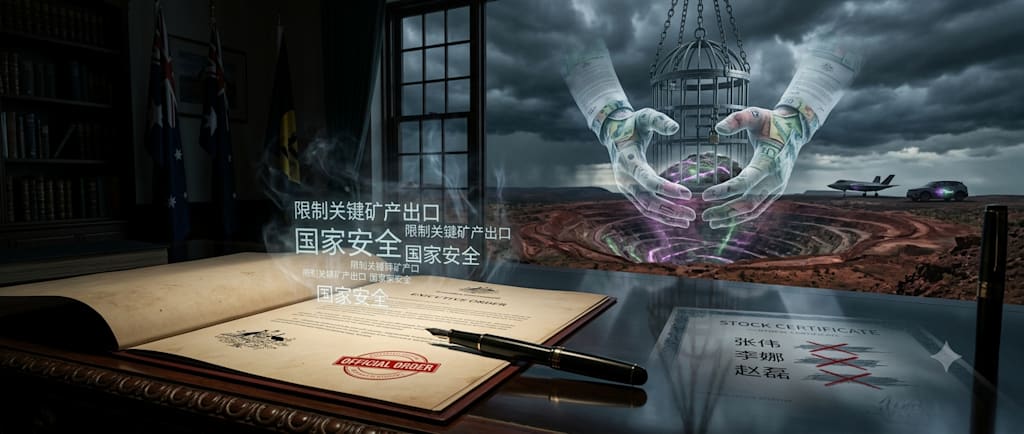
On 14 July 2026, Australia’s Treasurer, Jim Chalmers, signed an executive directive. The document went through no parliamentary debate and no public hearing. It simply froze, with immediate effect, all shareholder rights held by three Chinese stakeholders in Northern Minerals. Voting rights: zero. The right to vote on dividends: zero. Even the right to inspect financial statements: zero. The shares remained in the accounts, but in the eyes of the law they had been turned into worthless paper.
The fuse was buried on the other side of the ocean, beneath the wilderness of the Brown’s Range in Western Australia’s Kimberley region. There lies one of the few heavy rare earth deposits on the planet not yet controlled by Chinese capital—dysprosium and terbium, critical materials for the permanent magnets inside F-35 fighter jets and the motors of electric vehicles. To ensure that this ore body, from the first shovel of earth to the final refined metal, would be touched by not a single cent of Chinese money, Australia deployed every instrument of state power at its disposal.
The story began in 2021. Wu Tao, chairman of the Jinan-based Yuxiao Group, registered the Yuxiao Fund in Singapore and started buying Northern Minerals shares, lot by lot, on the open market of the Australian Securities Exchange. Alongside him, a handful of Chinese nationals—Liu Ximei, Wang Xi—moved in the same rhythm, their names quietly appearing in the company’s share register updates. By the end of 2022, the Yuxiao Fund’s buying finger stopped at a position of precisely 9.81 per cent. Under Australian law at the time, foreign holdings below 10 per cent did not require security screening by the Foreign Investment Review Board. That number was not a coincidence. It was a threshold calculated down to the last decimal—step over it, and you enter a minefield.
By then, the Chinese interests were already Northern Minerals’ largest single strategic shareholder. They had alerted no one. Their stake sat just one minimal purchase away from 10 per cent. But they chose to knock first. In late 2022, the Yuxiao Fund submitted an application to the Australian government: it sought to double its holding from 9.81 per cent to 19.9 per cent and secure seats on the board.
In February 2023, the reply arrived. Treasurer Chalmers’ letter gave only one reason: “national security interests.” Shortly before that, Australia and the United States had signed a Critical Minerals Supply Chain Cooperation Agreement. On the annex list, heavy rare earths were marked as the highest priority.
The door to a larger stake was slammed shut. But the Chinese investors did not walk away. They took a different path. From late 2023 through early 2024, during a routine shareholder register check, Northern Minerals uncovered anomalies: a cluster of offshore companies registered in the British Virgin Islands, the United Arab Emirates, and Hong Kong had begun sweeping up shares in the open market. The names were unfamiliar yet eerily similar—Black Stone Resources, Hong Kong’s Ying Tak. These entities showed no obvious equity links to one another, but the timing of their purchases was highly synchronised. Their combined holding surged close to 27 per cent.
Northern Minerals management pulled account-opening records and trading IP addresses, then couriered a thick stack of material to Canberra. They told the government: all of these offshore shell companies are “white gloves” controlled by Wu Tao. The Chinese side, they said, was attempting to bypass the regulators through nominee arrangements and seize control of the board.
The Australian government’s response was not a warning. It was not a request for a meeting. In June 2024, Chalmers issued the first eviction order: the Yuxiao Fund and four related Chinese entities were ordered to forcibly divest, within a fixed deadline, a combined 10.4 per cent of “illegally accumulated” shares. This was a command; there was no room for negotiation.
Some of the Chinese shareholders chose to resist. From their standpoint, every trade had been executed on the open market, every dollar had moved through lawful channels. On what grounds, they asked, could a commercial investment be forcibly liquidated by an administrative fiat? They did not sell. So the Australian government did something unprecedented: it sued the foreign investors in the Federal Court. In 2025, the court ruled against the Chinese parties and imposed a fine of AUD 14 million, equivalent to roughly USD 10 million.
The matter should have ended there. But compliance officials in the Australian Treasury, tracking the money trail, discovered that the shares that were meant to be forcibly sold had been quietly transferred to new entities—among them, Hong Kong’s Ying Tak. The certificates had changed names; they remained in the same hands.
Chalmers ran out of patience. In May 2026, he sent an ultimatum to six Chinese-linked entities, Ying Tak among them: by 2 July 2026, they must completely divest the entire combined holding of 17.6 per cent. The wording at the bottom of the document was no longer a “request.” It read, “must not continue to hold.”
The 2 July deadline came. Not a single settlement payment arrived in the designated bank accounts. Northern Minerals ran the share register again. The names of the Chinese shareholders had not budged. They had chosen to fight head-on.
Two weeks later, the directive freezing their rights was signed into effect. The three Chinese shareholders would still receive notices of general meetings, but the button to cast their votes had been permanently locked. When the company turned a profit, the dividend list would automatically skip their accounts. They no longer even had the right to request a copy of a full board resolution. The shares had been reduced back to paper; the only way out was to sell them to Western capital.
This was not an isolated case of one mining company. At the same time, rumblings were heard around the Yangibana heavy rare earth project, also in Western Australia. Iron ore magnate Andrew Forrest was planning to sell his 60 per cent stake in Hastings Technology Metals, and Chinese investors were listed as potential buyers. Canberra’s radar had already locked onto the target; a second blocking battle could erupt at any moment.
Further afield, in Indonesia, another front was being pushed forward simultaneously. The world’s largest nickel mines were being told to cut output. The stated reason was ESG environmental standards. The substance was the subsidy clauses of America’s Inflation Reduction Act—Western capital would not touch nickel produced by any smelter under Chinese control. Raising the environmental bar was the mechanism to force Jakarta to tighten quotas and surgically remove the dominant Chinese smelters.
Two fronts, one single logic: use a political iron fist to sever supply chains that the market had built, and replace them with an exclusive system where “national security comes first.”
The last piece of this puzzle was locked into place at the end of May 2026. The Quad—the United States, Japan, Australia, and India—convened in New Delhi and formally agreed on a Quad Critical Minerals Initiative Framework. It mandated that member states deploy every available economic and investment policy tool to accelerate the creation of a critical minerals market that is “not Chinese-dominated.” In its subsequent budget, Australia allocated AUD 1.2 billion to establish a Critical Minerals Strategic Reserve. The US Export-Import Bank simultaneously provided enormous low-interest loans to Australian miners. In every one of these Western funding agreements lay an implicit precondition: the Australian government must first clear out Chinese shareholders, scrubbing the legal space clean for the successor Western investors.
Why was the West willing to pay such a price? The answer lies in a single statistic: more than 90 per cent of the world’s heavy rare earth separation and processing capacity is held in Chinese hands. Australia is racing to build the Iluka rare earth refinery on its west coast—the first heavy rare earth processing line in the Western world that does not depend on Chinese technology. Northern Minerals’ Brown’s Range project is one of the very few non-Chinese ore sources it can secure. Once operational, that deposit could meet roughly 8 per cent of global dysprosium and terbium demand. On Washington’s and Canberra’s strategic map, this mine is the mother’s milk for rebuilding a full rare earth permanent magnet industrial chain in the West. From the first shovelful of ore to the final magnet, every step must be hermetically sealed off from China.
The decision to destroy the credibility of “rule of law and business environment” to forcibly dismantle a shareholding was not made because the Chinese investors had done anything illegal. It was made because China’s ability to choke off rare earth supplies struck exactly where it hurts.
At this moment, on the red dirt of Western Australia, the ore body still sleeps underground. The freezing order signed in Canberra lies quietly in a folder at the Yuxiao Fund’s Singapore office. The Chinese names are still printed on the Northern Minerals share register, but every character has been hollowed out by an administrative decree. And the Western capital now in a hurry to take over has not yet built a single production line that can fully bypass Chinese technology.
The cards are still on the table. It is just that the hand holding them has been pinned down.
About the Creator
Jin
Writer of reamstories
https://reamstories.com/jin
Enjoyed the story? Support the Creator.
Subscribe for free to receive all their stories in your feed. You could also become a paid subscriber, letting them know you appreciate their work.
Comments
There are no comments for this story
Be the first to respond and start the conversation.