
The Lost Art of Political Cinema: A Reflection on the Past and Present
From Costa-Gavras and Theo Angelopoulos to Don't Look Up and contemporary political filmmaking: has cinema lost its critical imagination, or have we forgotten how to recognise it?


Author's note: I originally wrote this article in 2022, following the release of Adam McKay's Don't Look Up. Returning to it in October 2026, I wanted to reconsider some of my earlier observations, revisit the filmmakers who influenced my understanding of cinema, and examine whether the political possibilities of filmmaking have really diminished.
Is Political Cinema Losing Its Voice?
When I first watched Don't Look Up (2021), I enjoyed it. Adam McKay had assembled an impressive cast, the screenplay contained some genuinely funny moments, and the film's central premise offered considerable opportunities for political satire. A comet is approaching Earth, threatening the destruction of humanity, while politicians, business interests and media personalities become increasingly absorbed in their own ambitions and public images. What interested me almost as much as the film itself, though, was the reaction that followed its release. Scrolling through social media, I encountered numerous comments celebrating Don't Look Up as a groundbreaking work of political cinema, a satire that had supposedly exposed the absurdity of contemporary society with unprecedented intelligence.
I found this enthusiasm rather difficult to understand. With all due respect to McKay and the talented actors involved, much of the film's political humour barely surpasses what one might encounter in an episode of Last Week Tonight with John Oliver. The corrupt politician, the misunderstood scientist, the powerful businessman whose interests outweigh the survival of humanity, and the media personalities concerned with maintaining their audiences are familiar figures in contemporary political commentary. This does not make the film unsuccessful. Political satire frequently depends upon exaggeration, and McKay's representation of collective denial has an unmistakable connection with contemporary debates surrounding climate change, scientific authority and political responsibility. I would not demand realism from a film whose central premise involves a comet approaching Earth. My difficulty concerns something else. When almost every character is immediately recognisable as a caricature of an existing social or political type, how much remains for the audience to discover? We recognise the absurdity, laugh at the people responsible, and leave reassured that we have understood the criticism. But have we been encouraged to question anything beyond what we already believed?
This was the question that originally led me to reflect on political cinema. I have never believed that cinema must avoid entertainment to become politically significant. Some of the most memorable films combine humour, suspense and extraordinary storytelling with deeply unsettling observations about the societies in which they were produced. Nor do I wish to suggest that the past was an artistic paradise from which contemporary cinema has irreversibly declined.
There are exceptional political filmmakers working today. Michel Franco's New Order (2020) and Armando Iannucci's The Death of Stalin (2017) were already examples I admired when I first wrote this article. My concern is more specific. Has the political significance of cinema increasingly come to be measured by how recognisable its message is, rather than by the questions its artistic expression makes possible?
Coming from Greece, I cannot approach this subject without returning to two filmmakers who profoundly influenced my understanding of the relationship between cinema, history and political existence: Costa-Gavras and Theo Angelopoulos.
Costa-Gavras: When Cinema Confronts Political Power
Greece possesses a remarkable modern artistic inheritance that is often overshadowed by the attention devoted to its ancient civilisation. Alongside poets such as George Seferis, C. P. Cavafy and Yannis Ritsos, Greek culture has produced filmmakers whose influence extends far beyond the country's geographical boundaries. Costa-Gavras occupies a particularly important position within this tradition. In Z (1969), inspired by the assassination of Greek politician and peace activist Grigoris Lambrakis in Thessaloniki in 1963, Costa-Gavras reconstructs the mechanisms through which political violence can be organised, concealed and defended by institutions supposedly responsible for maintaining public order.
The film was released during the Greek military dictatorship of 1967–1974, lending its political criticism an immediate historical significance. What makes Z remarkable is not simply its condemnation of authoritarianism. The film examines the relationships between political authority, security institutions, individual ambition and the production of an official narrative. The assassination does not end with the death of its victim. Another struggle begins over the meaning of what happened, who bears responsibility and which explanation the public will be permitted to accept. There is something deeply disturbing about a political system in which the institutions responsible for protecting justice may also participate in its destruction. Costa-Gavras does not need to interrupt the narrative to explain this contradiction. It develops through the actions of his characters and the gradual exposure of the relationships connecting them.
His later film Missing (1982) approaches another historical tragedy through a more intimate perspective. Based on the disappearance and killing of American journalist and filmmaker Charles Horman during the Chilean military coup of 1973, it follows his father and wife as they attempt to uncover what happened to him. Their search gradually challenges their confidence in the American diplomatic authorities from whom they seek assistance.
The personal tragedy becomes inseparable from international politics. Yet the film's emotional force emerges from the experience of two people confronting institutions whose explanations no longer correspond to the reality they are discovering. I think this is where Costa-Gavras distinguishes himself as a political filmmaker. He allows us to encounter political power through the people affected by it. His characters are not merely illustrations of a predetermined argument; their experiences expose the contradictions of the institutions surrounding them. This is also where my criticism of Don't Look Up becomes clearer. McKay's film is effective at identifying the absurdities of contemporary public life, but it rarely allows those absurdities to develop into the kind of psychological and political complexity that makes the characters of Costa-Gavras so memorable.

Theo Angelopoulos: History Through the Human Experience
If Costa-Gavras demonstrates how cinema can confront political authority through dramatic investigation, Theo Angelopoulos approaches history through another cinematic language. Angelopoulos has influenced not only my appreciation of cinema but also my understanding of the relationship between individuals, memory and the historical circumstances they inhabit.
His films rarely provide the immediate narrative satisfaction associated with conventional political thrillers. The camera moves slowly, landscapes appear to extend beyond the limits of the characters' lives, and conversations sometimes give way to long periods of silence. For viewers accustomed to rapid editing and uninterrupted action, this can initially feel demanding. But I have always found something profoundly meaningful in his refusal to hurry.
In Eternity and a Day (1998), a terminally ill writer named Alexander wanders through Thessaloniki while reflecting upon his life, his memories and the relationships he neglected. His literary work involves the unfinished poetry of Dionysios Solomos, while his unexpected encounter with an Albanian boy introduces questions about migration, belonging and the circumstances through which individuals become strangers in places that should offer them protection. The relationship between the ageing writer and the child develops against a landscape marked by personal memory and social displacement. What I find fascinating is how Angelopoulos allows political circumstances to enter a story without reducing the individuals to symbols of those circumstances. Alexander's approaching death is an intimate experience, but his encounter with the boy brings him into contact with another human existence shaped by migration, borders and political history.
In Ulysses' Gaze (1995), a Greek-American filmmaker travels through the Balkans searching for three missing reels of film attributed to the pioneering Manakia brothers. His journey unfolds amid the political divisions and violent conflicts of the former Yugoslavia. The search for forgotten cinematic images gradually becomes a search for historical memory, identity and the possibility of seeing the world differently. There is an extraordinary contradiction in this narrative. The protagonist travels through territories where history has produced conflict and destruction, searching for images that might preserve something of the lives that preceded those divisions. And what exactly is he seeking? A lost film, the history of his region, or another understanding of himself? Angelopoulos permits these possibilities to coexist.
This is the quality I admire in his filmmaking. Political history is not simply the background against which his characters act. It becomes part of their memories, their relationships and their understanding of existence. They inherit worlds they did not construct, encounter borders they did not choose, and struggle to recognise themselves within the historical circumstances that have shaped their lives. The poetry of his cinema emerges from this relationship between the individual and history, from what can be expressed through words and what remains in an image, a gesture or an extended silence.

Beyond Greece: Political Cinema and Its Different Languages
Political cinema has never belonged to a single country, political ideology or artistic tradition. Consider The Lives of Others (2006), directed by Florian Henckel von Donnersmarck. Set in East Germany during the final years of the German Democratic Republic, the film examines the surveillance of a playwright and his partner by the Stasi, the country's notorious state security service. Its political significance emerges partly through the transformation of the officer assigned to observe them. A man who initially participates in the machinery of surveillance gradually begins to question his relationship with the individuals whose private lives he has been ordered to investigate. The film received the Academy Award for Best Foreign Language Film and the BAFTA for Film Not in the English Language.
Wolfgang Becker's Good Bye, Lenin! (2003) approaches the collapse of East Germany through humour and family relationships. A young man attempts to conceal the fall of the Berlin Wall from his recovering mother, reconstructing fragments of the vanished German Democratic Republic inside their apartment. The film is amusing, but its political questions reach beyond nostalgia. The disappearance of a political system does not immediately erase the experiences, attachments and identities people developed within it. Historical change can transform the world outside someone's window long before that person has found a way to understand what has happened.
Ken Loach's Land and Freedom (1995) examines the Spanish Civil War through a British volunteer who joins the struggle against Franco's forces. The film does not present the Republican side as a politically homogeneous movement. The conflicts between revolutionaries, communists and other anti-fascist groups become central to its examination of solidarity, ideology and the tragedy of political division.
And then there is Pier Paolo Pasolini, whose work presents another challenge to conventional understandings of political cinema. In Accattone (1961), Pasolini explores poverty, marginalisation and the lives of people existing beyond the respectable image of Italian society. His later The Canterbury Tales (1972) approaches sexuality, religion and social hypocrisy through a radically different artistic form. Salò, or the 120 Days of Sodom (1975), set during the final period of Italian Fascism, remains among his most disturbing films. Its representation of domination, bodily humiliation and absolute authority is difficult to separate from Pasolini's criticism of fascism and the reduction of human beings to objects of power. One does not have to admire every aspect of Pasolini's cinema to recognise the seriousness of the questions he raised. His films also remind us that political cinema need not be comfortable. It can challenge the spectator's moral assumptions, expose experiences normally excluded from public representation and resist the expectation that art should provide an agreeable or easily consumed message.
The Political Film Does Not Always Announce Its Politics
Am I being too demanding when comparing Don't Look Up with filmmakers such as Angelopoulos, Costa-Gavras or Pasolini? Possibly. The filmmakers I have discussed worked in different historical circumstances, employed different artistic methods and frequently pursued objectives that cannot be directly compared. But there is another question worth considering. What makes a film political in the first place?
Must it concern a government, a revolution, a war or an identifiable political ideology? Danny Boyle's Trainspotting (1996) explores addiction, friendship, alienation and the lives of young people in Scotland. Its cultural criticism does not depend upon a conventional political narrative. The film's representation of drug dependency, consumerism and the desperate search for pleasure can also be understood through the social environment in which its characters attempt to construct their identities.
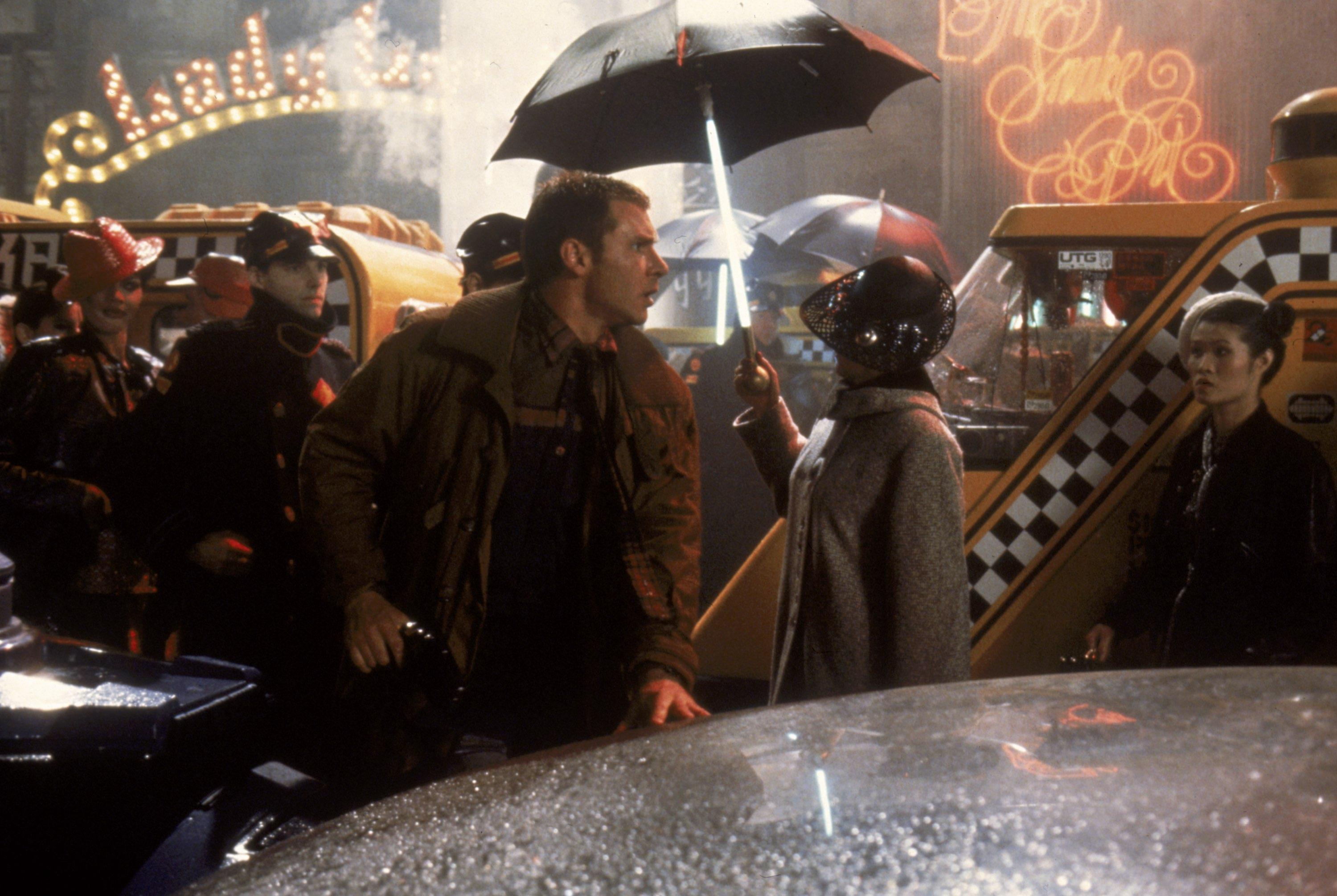
Ridley Scott's Blade Runner (1982) raises questions about technological authority, corporate power and the meaning of human existence. The artificial beings at the centre of the story complicate the distinction between the human and the non-human, while their treatment exposes the violence involved in assigning value to different forms of existence.
Even Star Trek, despite its mainstream popularity, has frequently imagined political and ethical dilemmas through encounters with unfamiliar civilisations. Its speculative future provides opportunities to reconsider prejudice, institutional authority and the principles governing human relationships.
More recently, Janicza Bravo's Zola (2021) brought questions about exploitation, sexuality, race and economic vulnerability into a film that moves between comedy, discomfort and the absurdity of its characters' experiences.
These films remind me that political significance is not necessarily determined by the subject a filmmaker chooses. It can emerge from the way a story is constructed, the experiences it permits us to encounter and the assumptions it invites us to reconsider.
This brings me back to a familiar principle of screenwriting: show, don't tell. I would not treat it as an absolute rule. Cinema has produced extraordinary political works through dialogue, narration and direct argument. There is nothing inherently uncinematic about explaining an idea. The difficulty arises when the explanation leaves little room for the experience itself. A film can tell us that political institutions are corrupt. It becomes more interesting when it allows us to understand how corruption develops, why people participate in it, how they justify their behaviour and what happens to those who confront it. That difference matters to my understanding of political cinema. The most memorable films do not simply provide an opinion about society. They allow us to encounter circumstances through which familiar explanations become insufficient.

Returning to the Present: Has Political Cinema Disappeared?
Revisiting this article in 2026, I find it difficult to defend the suggestion that political cinema has simply disappeared. Jonathan Glazer's The Zone of Interest (2023) portrays the domestic life of Auschwitz commandant Rudolf Höss and his family, whose comfortable existence unfolds beside the concentration camp. Rather than depicting the atrocities through conventional dramatic spectacle, the film confronts the audience with the disturbing coexistence of ordinary domestic behaviour and organised mass violence.
Walter Salles's I'm Still Here (2024) returns to Brazil's military dictatorship through the experience of a family confronting the disappearance of its father. Its political importance rests upon the relationship between state violence, memory and the lives of those left behind.
In 2025, Iranian filmmaker Jafar Panahi won the Palme d'Or at Cannes for It Was Just an Accident, a film examining imprisonment, revenge and the moral uncertainty of individuals confronting someone they believe participated in their persecution. Panahi's own experience of imprisonment and censorship gives this achievement a particularly significant context. Such films demonstrate that contemporary cinema continues to produce works capable of investigating political power through complex human experiences. The problem may therefore concern something other than the disappearance of politically engaged filmmakers. There is a difference between a film existing and a film becoming part of the cultural conversation.
Streaming services have transformed the ways in which films circulate, offering opportunities for international distribution while also making audiences dependent upon catalogues, licensing arrangements and systems of recommendation. Independent filmmakers may find new viewers through these services, but visibility is not distributed equally, and access to a platform does not guarantee meaningful attention.
The European Audiovisual Observatory reported that cinema attendance across Europe declined by approximately 5.5% in 2025. Such figures do not demonstrate a decline in the quality of political filmmaking, but they remind us that the conditions through which audiences encounter cinema are changing. The history of political cinema also complicates my earlier argument. Costa-Gavras achieved considerable international recognition, while Angelopoulos received some of the highest honours of European cinema. At the same time, many political filmmakers have always depended upon festivals, independent distributors and audiences willing to seek out work beyond mainstream commercial releases. Its visibility has always been uneven.
What concerns me more is the possibility that the increasing speed of contemporary cultural consumption encourages us to approach cinema through immediately recognisable messages. A film becomes important because it represents the correct political position, exposes an obvious injustice or confirms the beliefs of an audience already sympathetic to its argument. Yet political cinema should be capable of something more demanding. It should also allow us to confront the limitations of our own interpretations, encounter experiences we do not immediately understand and recognise contradictions within the institutions, histories and identities that shape our lives.
The Art We Should Not Forget
Returning to Don't Look Up after several years, I would not dismiss its political significance. Its satire of collective denial and the relationship between scientific knowledge, political authority and commercial interests remains relevant. I still believe its artistic possibilities are limited by the ease with which its characters and political positions can be recognised. But that criticism need not diminish the filmmakers' intentions or the importance of reaching an audience that might otherwise remain indifferent to the issues being examined.
It would also be mistaken to turn the cinema of Costa-Gavras, Angelopoulos or Pasolini into an untouchable artistic ideal. Their works emerged from particular historical circumstances, and their political interpretations remain open to criticism. What I admire in them is their willingness to allow cinema to become an investigation rather than merely a demonstration. The films that stay with me are rarely those that provide the most immediate moral reassurance. They are the ones that disturb an explanation I had previously accepted, bring me closer to an experience I had not understood, or leave me questioning the relationship between the individual and the society in which they live.
I return to Angelopoulos's wandering figures, Costa-Gavras's encounters with institutional power, and Pasolini's uncomfortable representations of human domination because they reveal how cinema can communicate through the relationship between images, history and human experience. Political cinema is not lost. Its artistic traditions remain alive, even when particular forms of filmmaking receive less attention than they deserve. The greater danger may be that we gradually become satisfied with recognising a political message instead of questioning the circumstances through which that message acquires meaning. After all, if cinema can do nothing more than confirm what we already know, what becomes of its capacity to change the way we see the world?
Written and published by Sergios Saropoulos
Originally published in 2022. Revised and expanded in October 2026.

Sources and Selected Bibliography
Costa-Gavras. Missing (1982). Film information, historical context and essays on Charles Horman's disappearance. The Criterion Collection.
https://www.criterion.com/films/769-missingPettey, Homer B. “Z (1969) and Nationalism.” In The Films of Costa-Gavras: New Perspectives, 2026. A scholarly examination of the film's relationship to the assassination of Grigoris Lambrakis and Greek political history. Cambridge University Press.
https://www.cambridge.org/core/books/abs/films-of-costagavras/z-1969-and-nationalism/5FF6D3B7EE214738EAAB6495B957FE00Thessaloniki International Film Festival. Eternity and a Day (1998), directed by Theo Angelopoulos. Film synopsis, production details and distinctions.
https://filmfestival.gr/en/films/eternity-and-a-day-2/Festival de Cannes. To Vlemma tou Odyssea (Ulysses' Gaze) (1995). Film synopsis, artistic credits and Grand Prix recognition.
https://www.festival-cannes.com/en/f/to-vlemma-tou-odyssea/British Academy of Film and Television Arts (BAFTA). 2008 Film Awards. Official record of the award for Film Not in the English Language, won by The Lives of Others.
https://www.bafta.org/awards/film/?award-year=2008Golden Globes. The Lives of Others. Official record of the film's 2007 nomination.
https://goldenglobes.com/film/the-lives-of-others/British Film Institute. Good Bye, Lenin! (2003), directed by Wolfgang Becker. Film background and production information.
https://www.bfi.org.uk/film/bae5bea6-7302-5b8f-af80-14896f4de52a/good-bye-leninThe Criterion Collection. Accattone (1961), directed by Pier Paolo Pasolini. Information on Pasolini's first feature and his portrayal of marginalised Italian communities.
https://www.criterion.com/films/31431-accattoneGreene, Naomi. “Salò: A Cinema of Poetry.” The Criterion Collection. Critical examination of Pasolini's artistic and political treatment of fascism, bodies and consumer society.
https://www.criterion.com/current/posts/512-salo-a-cinema-of-poetryLa Biennale di Venezia. Nuevo orden (New Order) (2020), directed by Michel Franco. Official festival synopsis and director's statement on inequality, revolution and authoritarian violence.
https://www.labiennale.org/en/cinema/2020/venezia-77-competition/nuevo-ordenZurich Film Festival. The Zone of Interest (2023), directed by Jonathan Glazer. Film information and synopsis.
https://zff.com/en/movies/the-zone-of-interestAcademy of Motion Picture Arts and Sciences. The 97th Academy Awards (2025). Official record of I'm Still Here winning International Feature Film and No Other Land winning Documentary Feature.
https://www.oscars.org/oscars/ceremonies/2025Festival de Cannes. “Un simple accident, the New Act of Resistance by Jafar Panahi.” 20 May 2025. The filmmaker's relationship with state censorship and his exploration of political freedom.
https://www.festival-cannes.com/en/2025/un-simple-accident-the-new-act-of-resistance-by-jafar-panahi/European Audiovisual Observatory. “European Cinema Attendance Dropped by 5.5% in 2025, with Stable Box-Office Figures.” 13 February 2026. Recent data on European cinema attendance and distribution conditions.
https://www.obs.coe.int/en/web/observatoire/-/european-cinema-attendance-dropped-by-5.5-in-2025-with-stable-box-office-figuresEuropean Audiovisual Observatory. “Admissions to European Films Reach Highest Level since 2019, but Remain 16% under Pre-Pandemic Figures.” 2025. Research on the international theatrical circulation of European films.
https://www.obs.coe.int/en/web/observatoire/2025-press-releases/-/asset_publisher/RxafmCU1h7DQ/content/id/293503636
About the Creator
Sergios Saropoulos
As a Philosopher, Writer, Journalist and Educator. I bring a unique perspective to my writing, exploring how philosophical ideas intersect with cultural and social narratives, deepening our understanding of today's world.
Enjoyed the story? Support the Creator.
Subscribe for free to receive all their stories in your feed.
Comments
There are no comments for this story
Be the first to respond and start the conversation.