
The Illusion of the Ace: Why Tennis’s Most Powerful Weapon Can’t Win Alone
A 2.1-meter serve can hit 230 km/h. The math still says it can’t ace its way to a championship.
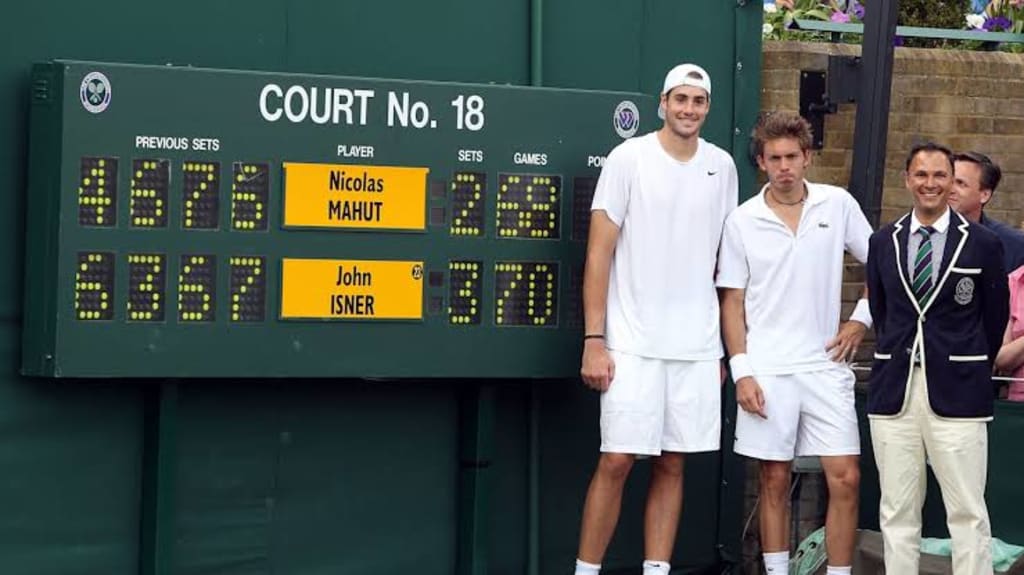
In the 2010 Wimbledon, Isner vs. Mahut. The scoreboard read 70-68. Over a hundred aces. The match lasted 11 hours. The final point came down to a single break.
The serve is the one shot in tennis you fully control. Toss, bend, turn, swing. The ball lands in. Point. The opponent stands still. The ball has already hit the backstop. So it is easy to think: if you are two meters tall, with a freakish wingspan, practicing serves every day, hitting 230 km/h, placing the ball within centimeters, can you ace your way through and never lose?
The idea is seductive. But it cannot escape three things: probability, rules, and the strategic contest.
1. The Math Is Right There
The first-serve ace rate of elite big servers is usually only 25-30%. This is only the ace rate after the first serve lands in. First-serve percentage? Around 60-70%. Multiply the two, and the probability of a direct ace on any given point is about 15-20%. That is already the human ceiling. Isner, Karlovic, Opelka, around 2.1 meters tall, with serves trained beyond ordinary imagination, have not pushed their ace rates much beyond that range.
Assume a 20% ace rate per point. A game is at least 4 points. The probability of four consecutive aces is 0.24=0.16%0.24=0.16%. The probability of hitting 100 straight aces over 100 service points in a match is essentially zero. Training cannot solve probability. The math is right there.
In basketball, people ask: if you could shoot 100% from three, would you be unbeatable? Curry turned the three into an all-time weapon, shooting over 40% on huge volume. Even he cannot shoot 100%. The same goes for the tennis serve. An ace is the cleanest way to win a point. It is not a guaranteed point.
2. The Second Serve Is a Lock Forged by the Rules
Tennis rules give you two serves. Sounds generous. Anyone who has actually played knows the second serve is a punishment.
On the first serve you can go all out. Hunt aces, hunt direct points, hunt return errors. The second serve does not allow that. It must slow down, add spin, and make sure it lands in. The second-serve ace rate is lower, and the double-fault risk is higher. The opponent knows you need to land it, so they move early and attack. Returners like Djokovic, Agassi, and Ferrer are best at turning an opponent's second serve into their own opportunity.
Serving is not only about aces. There is also the first shot after the serve. If the first serve misses and the second serve gets attacked, you have to face the opponent's aggressive return. If you cannot volley, cannot transition with your forehand, cannot defend after serving, then no matter how high your ace rate is, you will be dragged into rallies. Rallies are often not the strong suit of big servers.
3. Returners Are Not Wooden
When many people picture a big server, they imagine the opponent standing still, dazed. Professional returners are not wooden.
They study your toss, your stance, your placement patterns. If you serve well out wide, they stand out wide. If you serve well into the body, they shorten their swing. If you like to serve to the backhand on second serves, they move early. Data teams break your serving habits into spreadsheets: on big points he serves out wide 70% of the time; at 40-40 he is more likely to go into the body. The returner starts gambling, starts attacking, starts applying pressure with positioning.
Serving is a strategic contest. You train it to the limit; the opponent studies it to the limit. Over the same match, the same season, the same career, habits get figured out. One serving pattern cannot last a lifetime.
4. Height Is a Gift, and a Debt
Being two meters tall is a serving gift. The contact point is high, the angles are sharp, there is plenty of clearance over the net, and the ball speed is naturally faster. Height is also a debt.
A high center of gravity makes low balls hard. Direction changes are slow; movement is labored. Hips and knees take more load; injury risk is higher. Big servers often are weaker at returning and baseline play. Isner peaked at No. 8, won Miami, never won a major. Karlovic peaked at No. 14. Opelka peaked at No. 17. Their serves are already at the human limit, yet they cannot dominate with the serve alone.
In the 2010 Wimbledon match between Isner and Mahut, neither could break serve. They reached 70-68. Over a hundred aces. The match lasted 11 hours. It ended with a single break. Aces can keep you from losing your serve. They cannot directly win you the match. At some point you have to break, or win a tiebreak. In a tiebreak, returning, baseline play, and nerves are all required.
5. Holding Serve Alone Does Not Win Matches
Big servers can have very high hold rates. By some statistical measures, elite big servers win about 72% of service points and can hold serve up to 92% of the time. Sounds unbeatable. They still lose 8 out of every 100 service games. In a best-of-five major, a player may serve 20-30 times. Losing 2-3 of those games can be enough to lose the match.
Their return-game win rate is often very low, perhaps only 5-10%. The total points are actually close; matches turn on a few key points. You hold, I hold, the set goes to a tiebreak. One mini-break in a tiebreak can decide the set. A big server can win many points with the serve, but cannot guarantee an ace on every key point.
Majors are best-of-five. Long matches drain the body. Shoulder and elbow load, mental pressure, and fluctuations in form all slow the serve down. When first-serve percentage drops and second serves get attacked, the match becomes dangerous. Clay and slow hard courts further reduce the serve's advantage. Big servers are more likely to pull off upsets on fast courts at Wimbledon and the US Open, but long-term dominance is very difficult.
6. Diminishing Marginal Returns
Of course you have to practice the serve. Professionals practice it to death. Serve coaches, biomechanical analysis, placement data, shoulder and elbow care are all standard. The serve is the highest-value single skill in tennis.
From "very good" to "unanswerable," marginal returns fall off fast. An extra hour on serve might take you from 200 km/h to 205 km/h, from a 25% ace rate to 26%. That same hour spent on return, baseline, net play, or fitness might win you more points across a whole match. Overtraining the serve also risks shoulder and elbow injury. Opportunity cost is everywhere.
Players like Zverev and Medvedev are close to the minimalist school: serve plus grind from the baseline. Hold serve, wait for errors. The ceiling is high. But there is a gap to all-around players like Sinner and Alcaraz, and an even wider gap to the Big Three. The Big Three were not the hardest servers, but their serves were extremely strong on key points and part of a complete game. They made the serve serve the whole game, rather than betting the whole game on the serve.
7. Will a "Curry" of Tennis Ever Appear?
Maybe one day tennis will produce a Curry-like figure who changes the sport with the serve. He might be 2.1 meters tall but move like someone 1.8 meters. He might use data-driven training to place serves within centimeters. He might force returners to relearn their positioning and make the serve an even more efficient weapon.
He will not ace 100% of the time. Returning will evolve, rules will balance, opponents will study. Tennis is a strategic contest. A person changes a sport not because he found an invincible bug, but because he pushed a skill to a new height and forced everyone to rethink.
8. An Ace Is Only One Point
Next time you see an ace, don't just stare at the scoreboard.
Watch where the server stands for the next shot. Watch whether the returner moved early. Watch whether the server's toss gets shorter on the second serve. Watch whether the returner gambles on one side on a key point.
An ace is only one point. There is always the next point.
About the Creator
Jin
Writer of reamstories
https://reamstories.com/jin
Enjoyed the story? Support the Creator.
Subscribe for free to receive all their stories in your feed. You could also become a paid subscriber, letting them know you appreciate their work.
Comments
There are no comments for this story
Be the first to respond and start the conversation.