
The Asian Games Hands Out 41 Swimming Golds. Here’s Why That’s Not Cheating.
The pool isn’t rigged. It’s a copy of the Olympic programme, and a mirror of Asia’s uneven playing field.
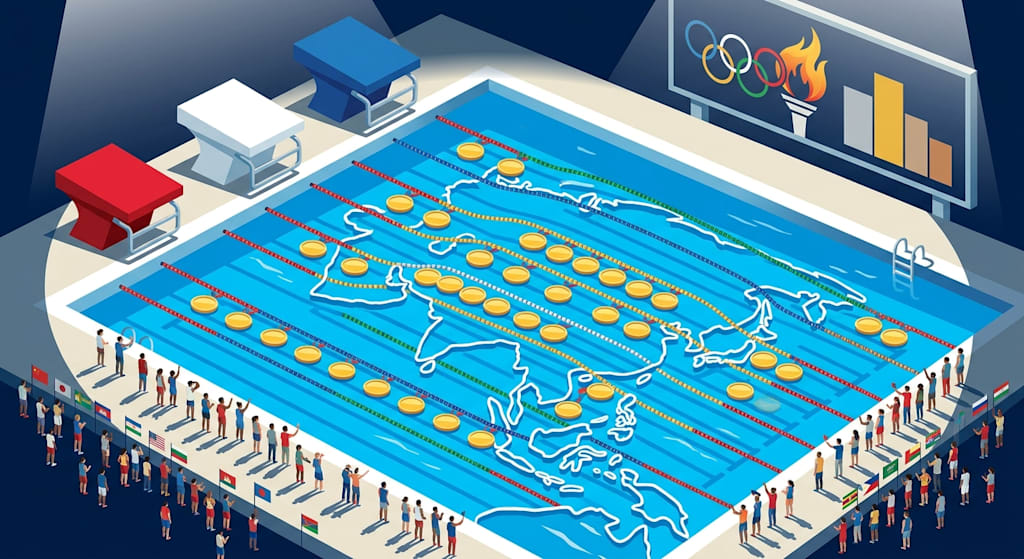
At the Nagoya Asian Games swimming venue, the scoreboard lists 41 gold medals. China takes 30. Japan takes 7. South Korea takes 1. Hong Kong, China and Chinese Taipei split the rest. Thirty-seven delegations enter 409 swimmers. Only China, Japan, and South Korea can fill all 41 events. One sport carries a quarter of the Games’ golds. The reason is not a secret.
The event list follows the Olympics
The Asian Games does not write its own event list. Olympic events mirror the next Olympics. If the Olympics has 41 swimming events, the Asian Games has 41. The rule is alignment with the Olympic programme.
History shows the pattern. The 1990 Beijing Asian Games had 31 swimming events. Hiroshima 1994 had 31. Bangkok 1998 had 32. Doha 2006 had 38. Incheon 2014 had 38. Hangzhou 2022 had 41. Each jump matches an Olympic expansion. The 2028 Los Angeles Olympics adds six 50m events: men’s and women’s backstroke, breaststroke, and butterfly. Swimming golds rise from 35 to 41. Nagoya follows early to prepare athletes for that programme.
Why swimming multiplies
Why swimming? Its event structure is a table. Strokes: freestyle, breaststroke, backstroke, butterfly. Distances: 50m, 100m, 200m, 400m, 800m, 1500m. Formats: individual, relay. Genders: men’s, women’s, mixed. Combine the columns and the rows multiply. Track and field works the same way, but swimming has more commercial pull, more viewers, and a powerful world federation. World Aquatics has long been led by Western countries. They protect their strong events and push new ones. Swimming golds grow. The Asian Games accepts the result.
Fair on paper, uneven in practice
On paper, the event list is fair. Olympic events are fully aligned. The host can add a few non-Olympic sports. Swimming has many events because the Olympic system gives it many events. The Asian Games also lets the host add wushu, sepak takraw, kabaddi, and other Asian sports. That is a balance.
In practice, the spread is uneven. Many swimming events reward countries with deep talent pools. Most Asian countries and regions have small populations and limited sports budgets. They cannot cover 41 events. They enter selectively. Golds then collect in China, Japan, and South Korea. At Hangzhou, China took most swimming golds. Japan and South Korea followed. Other countries and regions rarely finished first. More events widen that gap.
More gold does not mean lower value
More gold does not automatically mean lower value. Asian Games swimming results feed into World Championships qualification and Olympic points. Countries send their best. China’s lead comes from training systems, sports science, and talent depth. Event subdivision does make a single gold feel less rare. When one stroke splits into distance and format variants, viewers may feel fatigue at another swimming final. That is a viewing problem, not proof that the medals are fake.
Medal count should not be the only measure of a sports power. If you only read the medal table, many swimming events help big countries. If you watch athletes break personal bests, or see a smaller delegation qualify one swimmer, the value changes.
The larger Asian sports gap
The swimming debate sits inside a larger Asian sports problem. China, Japan, and South Korea have long taken about two-thirds of Asian Games golds. Swimming is one visible part of that. The gap comes from economic development, population, sports systems, and voice in international federations.
World Aquatics will not cut swimming events soon. It may add more. Small Asian countries can keep complaining, or they can build distinctive sports and use the host’s non-Olympic slots. The Olympic Council of Asia has to balance Olympic alignment with Asian variety.
What the pool shows
At the Nagoya pool, the lights go down. The 41 golds have owners. China, Japan, and South Korea stand on the podium. Other delegations linger at the poolside. The event list follows the Olympics. The medal spread follows Asia’s uneven sports map. Those are two different problems. Fixing the second one will take more than cutting a few swimming finals.
About the Creator
Jin
Writer of reamstories
https://reamstories.com/jin
Enjoyed the story? Support the Creator.
Subscribe for free to receive all their stories in your feed. You could also become a paid subscriber, letting them know you appreciate their work.
Comments
There are no comments for this story
Be the first to respond and start the conversation.