
The Applause That Arrived Seventeen Years Late
Zhang Xue sank a motorcycle in 2009. Last week, he set a Guinness World Record doing it.
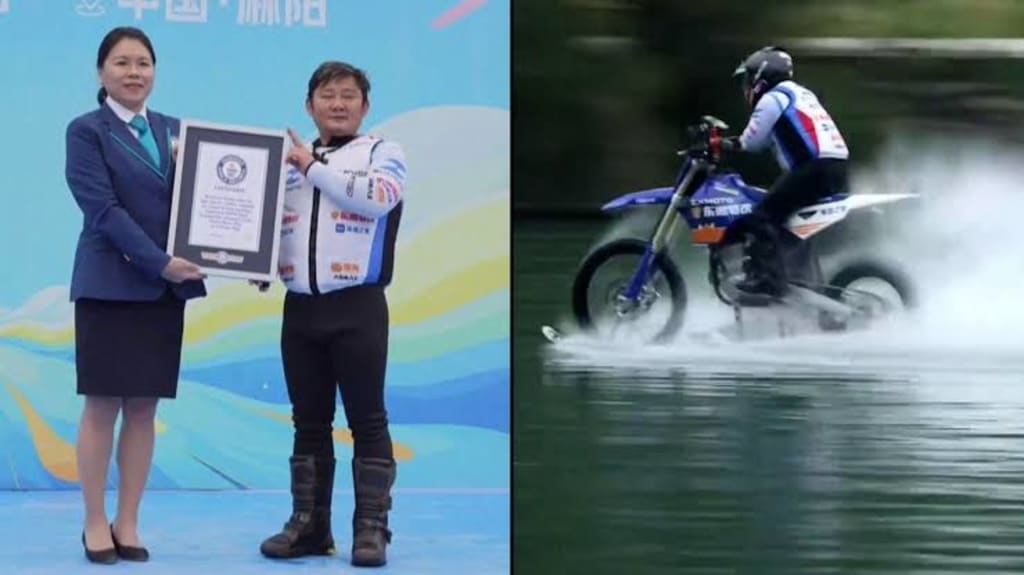
The moment the motorcycle cut across the Jinjiang River in Mayang, most people saw first how cool it looked. The bike skimmed the surface, waves peeling away on both sides as if making room. Coolness was only the outermost layer. What gave the footage its weight was the 20 meters that sank into the water seventeen years earlier, and a man who never put that failure down.
In 2009, Zhang Xue tried to make a motorcycle run on water. Not the later, systematically modified racing machine with angle-of-attack plates. Just an ordinary motorcycle. The first attempt sank. The second attempt sank too. In between he switched to a Yamaha, and it still sank. Someone asked him, "So you're going to keep trying, right?" He was squatting by the water, still twisting something in his hands, and barely looked up. "If you do something and you don't do it well, how do you feel? No, I have to get it right."
There was no rhetoric in that sentence. It ended up governing the next seventeen years.
For those seventeen years, he could have never mentioned those 20 meters again. He could have built motorcycles, sold motorcycles, and lived a steady life. He came back anyway. He tried again. He gave the younger version of himself, the one squatting by the water twisting a screw, an answer.
And so the Jinjiang River in Mayang caught the applause that arrived seventeen years late.
This time, the challenge was a Guinness World Record: the farthest distance traveled by a modified motorcycle on open water. It sounds like a dramatic headline. In practice, it is a hard engineering problem.
A high-speed motorcycle can skim water, but water offers no grip like a road. There is only the push of the water itself. Once the motorcycle loses enough speed, lift is insufficient and the body starts to drop. When speed decays past a certain point, the bike sinks. Long-distance water-skimming is not simply a matter of "daring to twist the throttle." It requires finding an extremely narrow balance between speed and the water's support. Zhang Xue's team added plates with an angle of attack to a lightweight motorcycle, so that water flowing at high speed could lift the bike. The plates were functional, not decorative. They generated lift.
Having the plates only got them past the first gate.
The engine had to maintain high rpm and stable output throughout. On water there are no tires pressing power into the ground; the bike can only be pushed forward by the water's reaction force. If the output falters even slightly, the speed curve can break. If speed drops, the bike sinks. After lightweight modification, the body also had to retain balance and stability, so the bike would not drift to either side while skimming. The rider had no margin either. Too fast, and the front wheel would lift. Too slow, and there would not be enough speed, so the bike would sink. Between a little faster and a little slower, what was being tested was the engine, the body, and that bit of judgment in the hands.
So this record was not just a daredevil show. It tested the engine's stable output under extreme conditions, the balance of a lightweight-modified body, the hydrodynamic design of the angle-of-attack plates, and the rider's control in a no-grip scenario. If any link failed, the waves would not catch the bike. How far Chinese manufacturing can go when there is no road and no precedent: this challenge was a public engineering stress test.
But the most moving part was not the technology itself.
It was that the 20 meters from seventeen years ago did not become a line you tell over drinks: "I tried that once, too." He kept it in his mind and turned it into an unfinished assignment. Seventeen years later, he came back with a modified bike, a team, and a more mature approach. He lifted that idea, the one that had sunk into the water, back onto the surface.
After the challenge succeeded, when he took off his helmet, his hands were sweaty. He glanced first at the timer, said, "Not bad," then squatted down to check the plates under the bike. The water of the Jinjiang River in Mayang was still flowing, just as it had seventeen years earlier.
The applause arrived seventeen years late. It still came.
About the Creator
Jin
Writer of reamstories
https://reamstories.com/jin
Enjoyed the story? Support the Creator.
Subscribe for free to receive all their stories in your feed. You could also become a paid subscriber, letting them know you appreciate their work.
Comments
There are no comments for this story
Be the first to respond and start the conversation.