
Thank You, Willie O'Ree
A story honoring the very man who made history in the world's greatest sport, and made waves for hockey players (and fans) of color


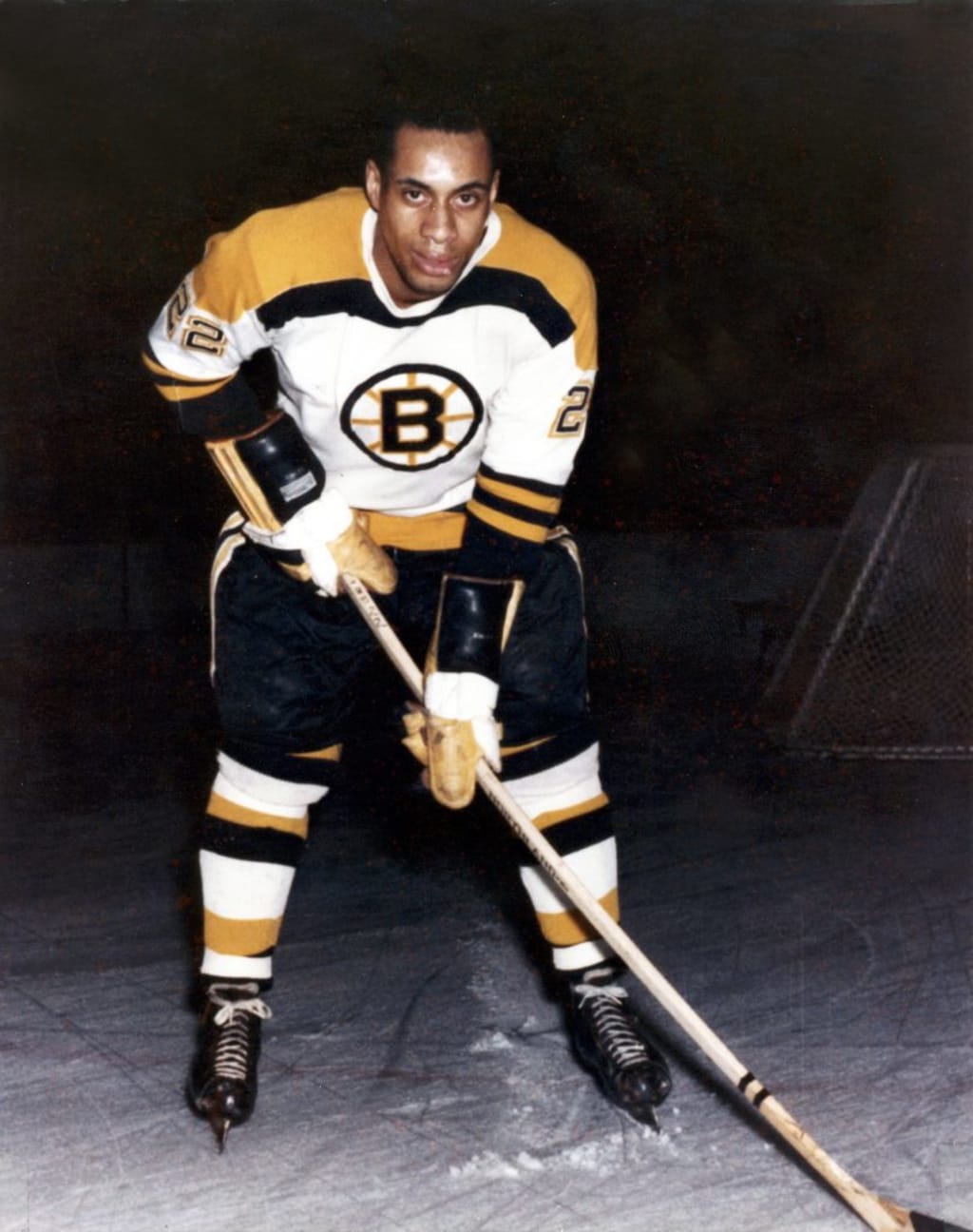
Funny story; a fear I had when watching hockey as a kid was that I wouldn't be able to find the puck, hence why I was grateful to the NHL on FOX for giving us the glow puck. I never thought I'd be into hockey as much as I am now. And no, it wasn't because I'm Black. Mainly, it was because I didn't have cable as a kid. Basketball, baseball, and football were available daily without cable, but hockey really wasn't. I followed everything via the sports section and only watched the All-Star Game because it was on a non-cable channel. When I got cable in 1997, I watched more hockey...way more.
Even before I started watching hockey religiously, I knew that there were very few players who looked like me. I never gave it a thought; I just enjoyed watching the sport. I forget the exact moment when I watched an Oilers game and saw three Black players on the team: Mike Grier, Anson Carter, and Georges Laraque. I remember the feeling I had when I saw those three, and more players over the years such as Peter Worrell, Kevin Weekes, Wayne Simmonds, P.K. Subban, and the legendary Jarome Iginla. However, as I continued to learn more and more about hockey and its history, I would learn that all of this started with one man: Willie O'Ree.
Born on October 15, 1935 in Fredericton, New Brunswick, Willie Eldon O'Ree's hockey career actually began at the age of 15 with his hometown Fredericton Capitals in the minor league. He played in his birth place for four seasons and played an addition three for the Quebec Frontenacs, the Kitchener Canucks, and the Quebec Aces. It was in the middle of his stint with the Aces that O'Ree got the call to join the NHL's Boston Bruins.
Two years prior, O'Ree was blinded when an errant puck struck his right eye, and if the Bruins had known about it, he would have never been called up. He was able to keep it a secret, and on January 18, 1958--nearly 11 years after Jackie Robinson broke baseball's color barrier on April 15, 1947, O'Ree did the same for hockey. O'Ree's NHL career was very short; he only played two games for the Bruins during that 1957-58 season, and wouldn't be back in the NHL until the 1960-61 season, playing 43 games for the Bruins and racking up 14 points (4 G/10 A).
Unsurprisingly, as Jackie did a decade prior, O'Ree dealt with mass racism during his career. He was traded to the Montréal Canadiens after his run with the Bruins ended, but the team was full of bigots who refused to invite him to try out with the team, resulting in O'Ree being sent down to the AHL's Hull-Ottawa Canadiens. In addition, O'Ree faced several racial taunts from fans, who would tell him to "Go back to the South," and ask him why he wasn't "picking cotton." That's still a problem even now. Players like Donald Brashear and Wayne Simmonds received racist taunts throughout their careers (a racist fan once threw a banana at Simmonds), and we all know about how Blues fans treated Nazem Kadri (a Canadian-born player of Middle Eastern descent) during last year's playoffs.
O'Ree played the remainder of his career in the minors, mainly in the Western Hockey League, where he won a pair of scoring titles with the Los Angeles Blades and the San Diego Gulls. O'Ree retired from hockey in 1979, with the Gulls retiring his number #22 afterwards.
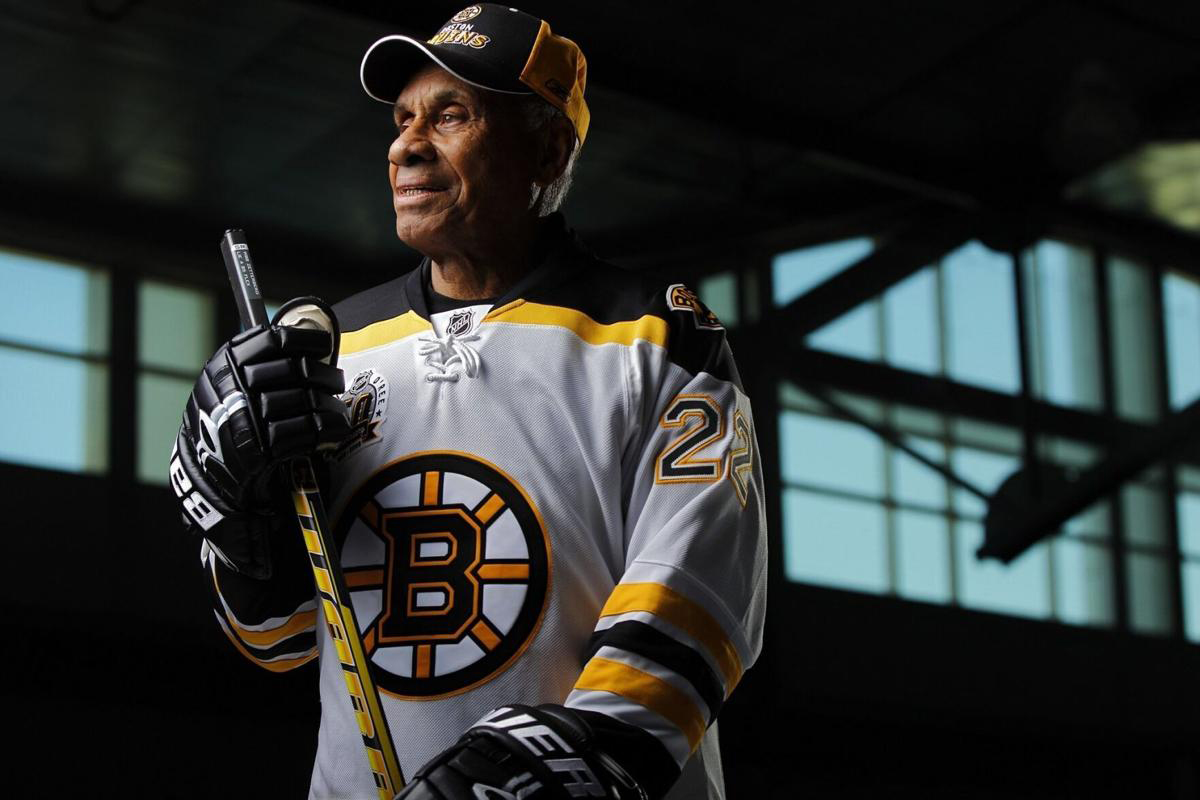
It would be 13 years until another Black player would enter the NHL, with Mike Marson doing so as the Washington Capitals' first-ever draft pick in 1974. O'Ree was inducted in to the Hockey Hall of Fame in 2018, and in 2022, he received the Congressional Gold Medal as part of the signing of the Willie O'Ree Congressional Gold Medal act by President Joe Biden. O'Ree received all sorts of honors for his contributions, but with it comes to me, all I could give is two simple words: thank you.
My thanks comes from years of being a diehard hockey fan who just happens to be of color, and also being proud to see players who look like me on the ice. O'Ree contributed immensely when it came to diversity in the NHL; it's not just Black players, we are seeing a lot of players from different racial backgrounds--players such as Matt Dumba, the aforementioned Nazem Kadri, Alec Martinez, Evan Rodrigues, and brothers Nicholas and Jason Robertson. I mentioned Mike Grier earlier; he is the current GM of the San Jose Sharks, the first Black GM in NHL history (his brother, Chris Grier, is the GM of the NFL's Miami Dolphins). I mentioned Anson Carter; he's currently an in-studio analyst for TNT. Kevin Weekes is also doing the same for the NHL Network, and has also been an in-game analyst, while P.K. Subban currently works as a studio analyst for ESPN.
Even now, however, it has been tough for not only players of color, but hockey fans of color as well. I myself have never faced any racism for being a Black person who is into hockey, but I know others have. Despite this, we are still seeing so much when it comes to diversity. K'Andre Miller is currently tearing it up as a member of the New York Rangers. Quinton Byfield became the highest-drafted Black player in NHL history when he was taken second-overall by the Los Angeles Kings in 2020 (behind Byfield's Rangers teammate, Alexis Lafreniere). Sarah Nurse is also making waves; winning the silver in the 2018 Winter Olympics, winning gold in 2022, and gained buzz during All-Star Weekend in 2023, when she scored on reigning Vezina winner Igor Shesterkin in a skills challenge. So many big and notable moments including players of color in hockey, and we all owe that to Willie O'Ree. Once again, thank you.
About the Creator
Clyde E. Dawkins
I'm a big sports fan, especially hockey, and I've been a fan of villainesses since I was eight! My favorite shows are The Simpsons and Family Guy, etc.
Enjoyed the story? Support the Creator.
Subscribe for free to receive all their stories in your feed. You could also become a paid subscriber, letting them know you appreciate their work.
Comments
There are no comments for this story
Be the first to respond and start the conversation.