
Sydney Greenstreet and Peter Lorre:
A Masterclass in Menace

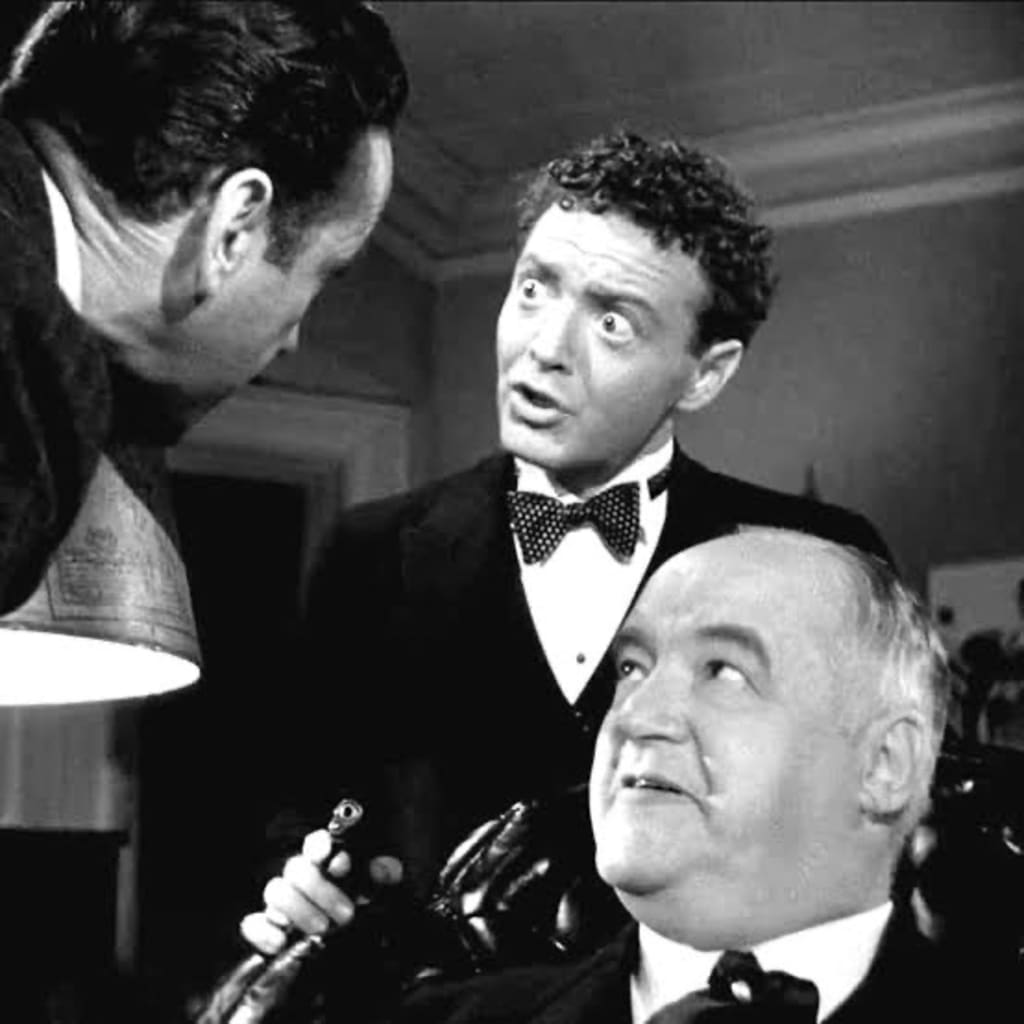
Humphrey Bogart may be the star of The Maltese Falcon, but two of the film's most fascinating characters belong to actors who approach villainy from opposite directions.
Sydney Greenstreet plays Kasper Gutman, the imposing criminal mastermind known as the Fat Man. Peter Lorre plays Joel Cairo, a perfumed, impeccably dressed schemer whose nervous manner conceals a dangerous streak. Together, they create a pair of antagonists who are as entertaining as they are unsettling.
What's remarkable is how just how differently they command a room.
Greenstreet's Gutman possesses the confidence and gives the impression of a man accustomed to getting what he wants. He doesn't need to shout, threaten everyone in sight, or constantly remind people of his authority. He can sit comfortably in a chair, speak in a measured voice, and discuss criminal enterprises with the enthusiasm of a collector explaining a prized possession.
His greatest weapon is the impression that he has all the time in the world.
Gutman has pursued the Maltese Falcon for years. He has devoted enormous resources to finding it, and he discusses its history with an almost scholarly fascination. He isn't merely interested in acquiring an expensive object. He has convinced himself that the pursuit is worth the sacrifices it demands.
Greenstreet is able to make this obsession strangely charming.
There is also humor in Gutman's elaborate politeness and his willingness to engage in lengthy explanations, even when the circumstances suggest that a more direct approach might be preferable. He can be accommodating one moment and threatening the next, and the transition is all the more effective because he never entirely abandons his manners.
His civility is not evidence of goodness. It is simply the preferred style of a man who believes himself superior to the people around him.
Then, there is Peter Lorre's Joel Cairo.
Where Gutman is expansive, Cairo is tightly wound. Where Gutman seems comfortable in his own skin, Cairo appears perpetually irritated that the world refuses to behave according to his expectations. He carries himself with an almost fussy precision, and his polished appearance makes his flashes of anger all the more revealing.
Lorre gives Cairo a nervous energy that keeps every encounter unpredictable. His character can be petulant, calculating, and genuinely dangerous, sometimes within the same conversation.
He is also funny, although his humor often comes from the gap between the elegant image he presents and the rather ugly business in which he is engaged.
Cairo wants to be taken seriously. He expects others to recognize his intelligence and sophistication. Yet, his composure repeatedly cracks when someone challenges him or refuses to cooperate.
Lorre understands that a man doesn't have to dominate a room to be dangerous. Sometimes, the person who appears most easily offended can be the one most likely to make a situation worse.
The contrast between these two characters is one of the film's great pleasures. Gutman represents patience, appetite, and the confidence that comes from years of manipulating others. Cairo represents nervous ambition, wounded pride, and the frustration of a man who knows what he wants but cannot reliably control the circumstances around him.
Both want the Falcon. Neither can be trusted. And neither is as powerful as he would like Sam Spade to believe.
The Beginning of a Remarkable Partnership
There is another reason these performances deserve attention: The Maltese Falcon amazingly marked Greenstreet's film debut at the age of 61.
Before arriving in Hollywood, Greenstreet spent decades working on the stage. John Huston recognized his potential after seeing him perform in a Los Angeles theatrical production. His casting as Gutman introduced movie audiences to an actor who possessed extraordinary screen presence without relying on the conventions of the traditional leading man.
Greenstreet's size, voice, and carefully controlled movements made him an unforgettable presence. Rather than trying to appear physically threatening at every opportunity, he used his composure to suggest that violence was merely one of several options available to him.
The result was an absolute remarkable debut. Deservingly, Greenstreet received an Academy Award nomination for Best Supporting Actor for his performance.
Lorre, meanwhile, had already established himself as an internationally recognized actor. His performance as the murderer in Fritz Lang's M (1931) had demonstrated his ability to make a character simultaneously disturbing and fascinating. In Hollywood, he brought that distinctive screen presence to roles that frequently blended intelligence, eccentricity, and menace.
In The Maltese Falcon, those qualities found an ideal vehicle.
The film also began a celebrated on-screen partnership between Lorre and Greenstreet. They would appear together in several subsequent films, including Casablanca (1942), Passage to Marseille (1944), and The Mask of Dimitrios (1944).
Their pairing worked because they complemented rather than duplicated each other. Greenstreet could make villainy seem comfortable and civilized; Lorre could make it seem nervous and unpredictable. Each brought out something distinctive in the other.
Together, they helped establish a particular kind of Hollywood antagonist: intelligent, articulate, and perfectly capable of discussing business over a drink while contemplating someone else's destruction.
Two Men, One Obsession
The brilliance of Greenstreet and Lorre's performances lies in their shared conviction that the Maltese Falcon is worth almost anything.
Neither character questions the value of the pursuit itself. Their disagreements concern strategy, ownership, and the conduct of the people involved. The possibility that their obsession might be misguided barely enters the conversation.
That is what makes them such effective foils for Bogart's Sam Spade.
Spade is certainly interested in the Falcon, but he approaches the situation as a detective trying to understand a complicated criminal enterprise. Gutman and Cairo approach it as men whose lives have become organized around obtaining a prize.
They are not simply chasing a bird. They are chasing the promise of everything they believe the bird represents.
Greenstreet gives that promise the reassuring voice of a man who has already rationalized every sacrifice. Lorre gives it the agitated insistence of a man who fears that someone else might reach the prize first.
Neither performance needs to explain the danger of obsession. We see it in the way these men behave.
That, is the secret of great supporting performances: they do more than help the protagonist tell his story. They create an entire world around him, populated by characters whose desires and contradictions make that world feel real.
Without Greenstreet, the film would lose much of its commanding menace. Without Lorre, it would lose much of its nervous unpredictability.
With both of them, the search for the Maltese Falcon becomes something richer than a detective's puzzle. It becomes a darkly comic study of greed, vanity, and the extraordinary lengths people will go to obtain something they have convinced themselves they cannot live without.
The bird may be the prize, but Greenstreet and Lorre make the pursuit unforgettable.
About the Creator
ambiguous karma
I'm a historian and religious studies scholar with 2 B.A.'s in History and Religious Studies (Salem College) I write with grit, insight, and satire: exploring power, belief, and resistance across time. Scholar by training, rebel by nature.
Enjoyed the story? Support the Creator.
Subscribe for free to receive all their stories in your feed. You could also become a paid subscriber, letting them know you appreciate their work.
Comments
There are no comments for this story
Be the first to respond and start the conversation.