
South Korea’s Gold Medal Loophole Is Collapsing. The Athletes Lit the Match.
For 53 years, winning gold bought a pass from military service. Three post-match interviews may have ended it.
1
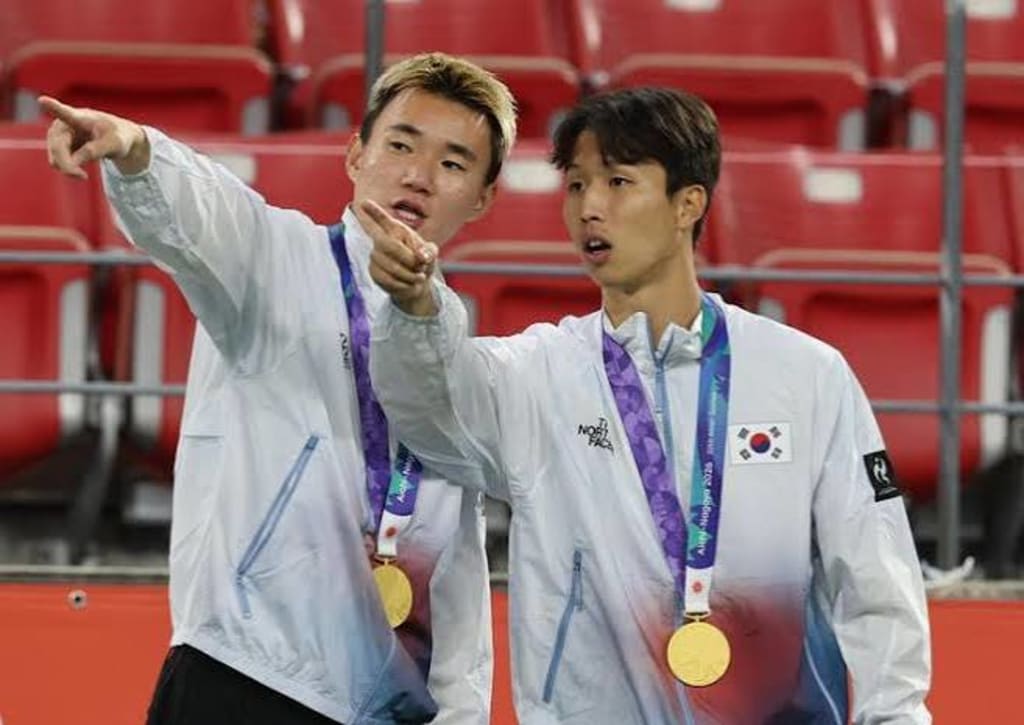
On October 3, 2026, South Korea beat Japan 1-0 in the men’s football final at the Aichi-Nagoya Asian Games.
In the mixed zone afterward, forward Yang Min-hyeok said: “The medal and the trophy don’t matter. Our only gain is exemption from military service.” Captain Lee Ki-hyuk, due to enlist in a few days, waved his gold medal and said: “Now I don’t have to go to the army.” Park Seung-soo, a 19-year-old forward, posted a photo that night wearing a discharge commemorative cap.
Three sentences. Three images. One public-opinion storm.
Assembly member Ahn Cheol-soo asked on social media: “Is the military such a terrible place?” On October 6, Ministry of National Defense spokesperson Jeong Bin-na said she was “deeply regretful over the remarks by some in the sports world.” The next day, Defense Minister Kang Shin-chul told the National Assembly: “The Ministry of National Defense’s goal is to gradually reduce the special military service exemption system and ultimately abolish it.”
A system that had run for 53 years was now at risk of ending because of three post-match interviews.
2
In 1973, Park Chung-hee introduced the exemption. Athletes and artists who won international honor for the country could skip active-duty service.
The framework stayed mostly unchanged for more than fifty years. Under the current Enforcement Decree of the Military Service Act, top-three Olympic finishers and Asian Games champions are assigned to supplemental service. They need three weeks of basic military training, then 544 hours of public-interest service over 34 months.
South Korean media noted: “Among countries that still have or once had conscription, it is hard to find an example like South Korea that retains so many alternative-service and military-service-exemption arrangements.” Israel faces a severe security situation and has no comparable arrangement.
The exemption is not a common practice among conscription countries. It is a specific policy choice. When the social environment changes, its legitimacy comes under strain.
3
On the surface, the debate is about whether athletes deserve exemption. Beneath it, two ideas of fairness collide.
One idea: military service is a constitutional duty. Professional achievement should not change that. This view has particular force among young South Korean men. Social media comments were blunt: “The soldiers in the military who serve diligently will surely feel angry.”
A more charged comparison came from BTS. A petition said: “If the standard is enhancing South Korea’s national standing, who can deny that young people like BTS deserve exemption from military service more than those Asian Games champions?”
That sentence cannot be refuted. BTS members enlisted even though they knew they might be eligible for exemption. Yang Min-hyeok said the medal and trophy did not matter. Park Seung-soo posted a photo of a discharge cap. The public did not need a narrator to explain the attitude problem.
Another idea: the exemption is a rational way to maximize national interest. Top athletes create far more economic value than ordinary people. Take the World Cup. Even if the team fails to advance from the group stage, South Korea’s 26 national-team players can generate more than $10 million in prize money. After Son Heung-min obtained exemption eligibility at the 2018 Asian Games, his transfer valuation reached €102.3 million.
This argument has a fatal weakness: it is hard to say in public. When players put the tacit exchange on the table and claim that “the medal doesn’t matter, exemption does,” they tear up the social understanding. The public could accept trading gold medals for exemption. It could not accept athletes treating military service as a burden to be escaped.
When exemption works as a reward, it quietly confirms that service is a punishment.
4
The exemption also faces doubts about fairness in practice.
Of the 80 sports personnel who received exemptions in the past five years, 65 qualified through Asian Games gold medals. Of the 57 athletes who obtained exemption eligibility at this Asian Games, football and baseball players made up the vast majority. One lawmaker said during a parliamentary audit that 36 baseball players alone received exemptions. Many athletes in less popular sports, even with the same effort, found it hard to get the same opportunity because of the Asian Games’ event lineup.
The free-rider problem in team sports is just as clear. At this Asian Games, forward Park Seung-soo played only 16 minutes in the entire tournament but still obtained exemption eligibility.
Enforcement has loopholes. Nearly half of the athletes receiving exemption treatment were found to have violated service rules. After being assigned to supplemental service, they must complete 544 hours of public-interest service. Most were also playing in professional leagues. Enforcement often became a formality.
5
The controversy may push institutional change because it lands at a moment when South Korea’s conscription system faces structural pressure.
South Korea’s total fertility rate fell to 0.72 in 2023. More than a decade ago, the Ministry of National Defense said a shortage of conscripts would emerge starting in the 2020s and that exemptions should be reduced in stages until abolished. Abolishing the exemption is not a whim of the current government. Demographic trends forced the choice.
Public opinion has shifted. South Korean media analysis noted that “men in their 20s and 30s are extremely sensitive to military service and fairness issues.” BTS members enlisted despite knowing they might be eligible for exemption. That fact has been repeated as the fairness benchmark: “Even BTS went to the military.”
A rare cross-party consensus has formed. People Power Party lawmaker Park Sung-hoon said, “Whether the current arts and sports personnel system fits the times and public common sense should be re-examined without taboos.” Democratic Party lawmaker Ahn Gyu-back said, “Troop numbers have reached the edge of a cliff; it is time to abolish the military service exemption system in the arts and sports fields.”
6
“Abolition” is now the policy direction. How to do it remains disputed.
A points system is widely discussed. Eligibility would no longer depend on one competition result. It would be based on an athlete’s cumulative performance across multiple international competitions. The South Korean sports world had discussed this plan several times. It was shelved because sports associations could not agree on implementation details.
A delayed enlistment plan would postpone athletes’ enlistment age to their 30s. It does not resolve the core contradiction. Military service obligation is not replaced. It is postponed.
The Sangmu unit is another option. After abolition, more players might fulfill service by joining the Armed Forces Sports Unit while continuing to train and compete. Sangmu’s capacity is limited. Players in overseas leagues would find it hard to balance both.
Minister of Culture, Sports and Tourism Choi Hwi-young said during the parliamentary audit: “Reduction is the inevitable direction, but while reducing, how to supplement the positive side needs consideration.” The ministry may want to design alternative mechanisms to protect athletes’ careers while shrinking the system.
7
Supporters of the system say every goal Son Heung-min scores in the Premier League promotes South Korea. Its value, they argue, exceeds two years of service by an ordinary soldier. Opponents ask: if winning glory for the country can exempt someone from service, what about entrepreneurs who pay taxes? Doctors who save lives? Teachers who educate?
Whether the final choice is to keep, shrink, or abolish the exemption, the system’s legitimacy must rest on open discussion, not a silent social understanding.
The players’ remarks may have done one useful thing. They broke that silence. They forced South Korean society to confront a question it avoided for more than fifty years: what price is it willing to pay for fairness and competitiveness?
A South Korean sports commentator put it pointedly: “If you are dissatisfied with the system, the question is not the athletes who won medals, but the society that set the standards.”
The rules are now up for revision. The hard part is writing a replacement that satisfies both fairness and competitiveness. That work has not started yet.
About the Creator
Jin
Writer of reamstories
https://reamstories.com/jin
Enjoyed the story? Support the Creator.
Subscribe for free to receive all their stories in your feed. You could also become a paid subscriber, letting them know you appreciate their work.
Comments
There are no comments for this story
Be the first to respond and start the conversation.