
Nagoya 2026 Cut Go, Chess, and Bridge From the Asian Games. Here’s Why That Happened.
The host didn’t push for them. The Olympic Council is shrinking the program. And Go has a hard time fitting the Olympic mold.
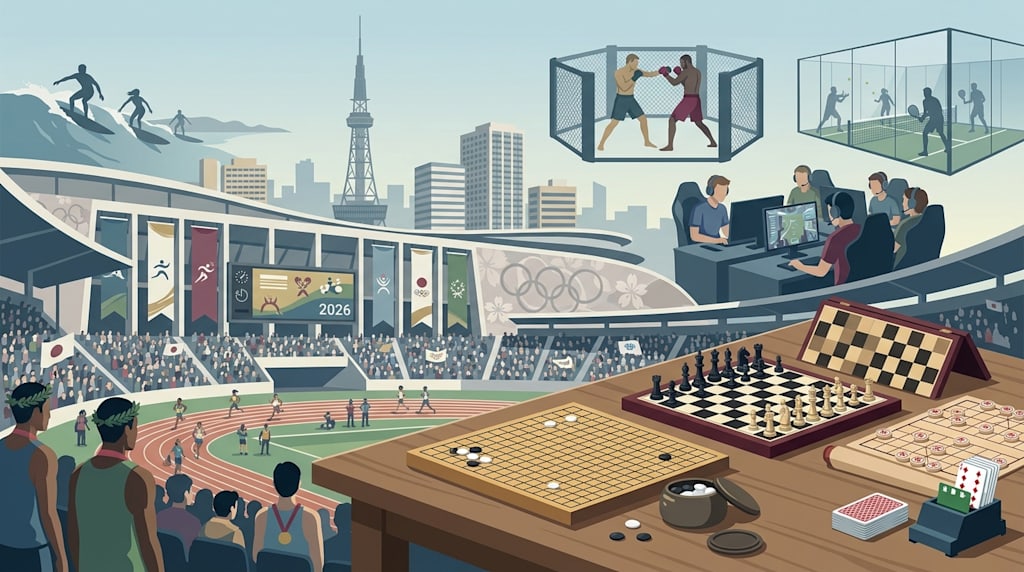
In September 2026, the Aichi-Nagoya Asian Games begin. The program has more than 40 sports and 469 medal events. It is bigger than Hangzhou’s. Go, chess, xiangqi, and bridge are gone. So are dragon boat racing and open water swimming. New events include mixed martial arts, surfing, padel, virtual taekwondo, and teqball.
This was not a random swap. Three things pushed the board games out: the host’s priorities, the Olympic Council of Asia’s reforms, and the structure of the sports themselves.
Why Japan did not fight for Go
Go’s place at the Asian Games has always depended on the host. China pushed for it in 2010 in Guangzhou. China pushed again for Hangzhou in 2023. Without a host willing to spend political capital, Go does not stay.
Japan is a Go power. Nagoya is a Go city. But Japan did not push. Japanese Go has struggled against China and South Korea for two decades. World titles go to Chinese and Korean players. Japanese players rarely contend. At Hangzhou, Go had three events: men’s individual, men’s team, and women’s team. China won women’s team gold. South Korea won the men’s individual and team golds. Japan won nothing.
Japan brought 932 athletes to Nagoya, its largest team ever. It wants a record gold haul. Its medal hopes are in cycling, wrestling, judo, table tennis, gymnastics, and athletics. Go is not a Japanese gold mine. It might even help China or South Korea. In a medal race, leaving it off the program is a rational choice.
The Olympic Council is shrinking the Games
Host preference is only part of the story. The Olympic Council of Asia has been cutting the Asian Games for years. In 2010, it adopted a “28+X” formula: 28 Olympic sports plus a few non-Olympic ones, capped at 35 sports. The reform started at Incheon in 2014. Go, xiangqi, chess, and other mind sports were removed then.
The goal is to align with the Olympics. IOC President Kirsty Coventry has said the OCA wants the Asian Games held one year before the Summer Olympics, making it an Olympic qualifier. At Nagoya, archery, hockey, sailing, squash, surfing, tennis, and triathlon already provide quotas for Los Angeles 2028.
Non-Olympic sports lose space under that logic. Go, chess, and bridge are not Olympic events. They do not qualify athletes for the Olympics. They score poorly against the OCA’s “Olympic-style” criteria. The slow pace, the high viewing barrier, and the lack of a unified professional system all count against them. Nagoya did not single out Go. It removed every mind sport from Hangzhou.
Go’s own problems
Even without a reluctant host and a shrinking program, Go has a fragile place at the Asian Games. It entered in 2010, missed 2014 and 2018, returned in 2023, and is out again in 2026. That pattern says more than any single decision.
The first problem is watching. A professional Go game can last hours. The decisive moves often depend on sequences that casual viewers cannot follow. Television cannot easily show the tension. Short-video audiences rarely watch a silent board. Mixed martial arts, surfing, and esports offer more immediate spectacle.
The second problem is entry. A sport needs at least six member countries to propose it for the Asian Games. China, Japan, and South Korea could push Go. But the three do not always cooperate. Other Asian countries are not competitive in Go, so they have little reason to campaign for it.
The third problem is structure. Go has no global professional system. China, Japan, and South Korea run separate tours. International events have different rules and organizers. Go players do not have a clear “athlete” identity in the Asian Games system. When the OCA and the host judge whether a sport is a sport, these details matter.
Why esports stayed
Esports grew while board games disappeared. At Nagoya, esports has 11 medal events, up from seven at Hangzhou. It covers fighting games, MOBAs, battle royales, and racing games. China has won gold in Naraka: Bladepoint and other titles. Esports is now a fixture.
Esports and Go are both intellectual contests. Their event logic is different. Esports has a young audience, a mature business network, and standardized rules. It has faced the “is it a sport?” question. But it brings ratings, sponsors, and young viewers. That is what large multi-sport events need when they compete with the Olympics and the World Cup.
Go cannot offer the same return. Its audience is older. Its commercial value sits in a few top events. Its broadcast format does not fit modern sports media. In a limited program, keeping esports and cutting Go is an easy call.
Where does Go go from here?
Go’s absence does not mean it has no value. At Nagoya, it still appears in cultural events. Japan, a Go power, respects the game in its own way. Wang Lei, coach of China’s women’s Go team, said after Hangzhou that “the hope will not die out.” That line captures Go’s real position. Its place at the Asian Games is not guaranteed. It has to be won.
Go can return if a host is willing to push for it. It also needs a role under the OCA’s Olympic reforms. The OCA has discussed a separate event system for esports and mind sports. That could be a path. Until then, Go’s Asian Games future depends on the next host willing to spend for it.
Rules are made by people, not by the board. A Go game is often decided by the whole board, not one move. The Asian Games is shifting toward Olympic alignment and younger audiences. For Go to land a stone there, it needs more than a good move. It needs a new strategy.
About the Creator
Jin
Writer of reamstories
https://reamstories.com/jin
Enjoyed the story? Support the Creator.
Subscribe for free to receive all their stories in your feed. You could also become a paid subscriber, letting them know you appreciate their work.
Comments
There are no comments for this story
Be the first to respond and start the conversation.