
# Mexico's Hidden Sports: 7 Disciplines That Deserve Your Attention
## Beyond soccer and boxing, millions of Mexicans practice sports that produce world champions in complete anonymity

## Introduction: A Country That Only Looks One Way
Every Sunday, millions of Mexicans sit in front of their televisions to watch soccer matches. Office conversations revolve around Liga MX results. Sports newscasts dedicate 80% of their airtime to what happens on grass fields. Meanwhile, in quiet gyms, empty tracks, and courts without audiences, Mexican athletes conquer world medals that nobody celebrates.
Mexico has a complicated relationship with sports. We deeply love certain disciplines and systematically ignore others, even when the latter bring us more international glory than the former. This phenomenon is no coincidence: it responds to decades of media policies, commercial interests, and a sports culture that feeds itself.
But there is a sporting Mexico that deserves to be discovered. A country where ancestral disciplines with centuries of history are practiced, where talented young people dominate sports that create millionaires in other nations, and where passion far exceeds the lack of resources and attention.
## Purépecha Ball: The Pre-Hispanic Sport That Survives
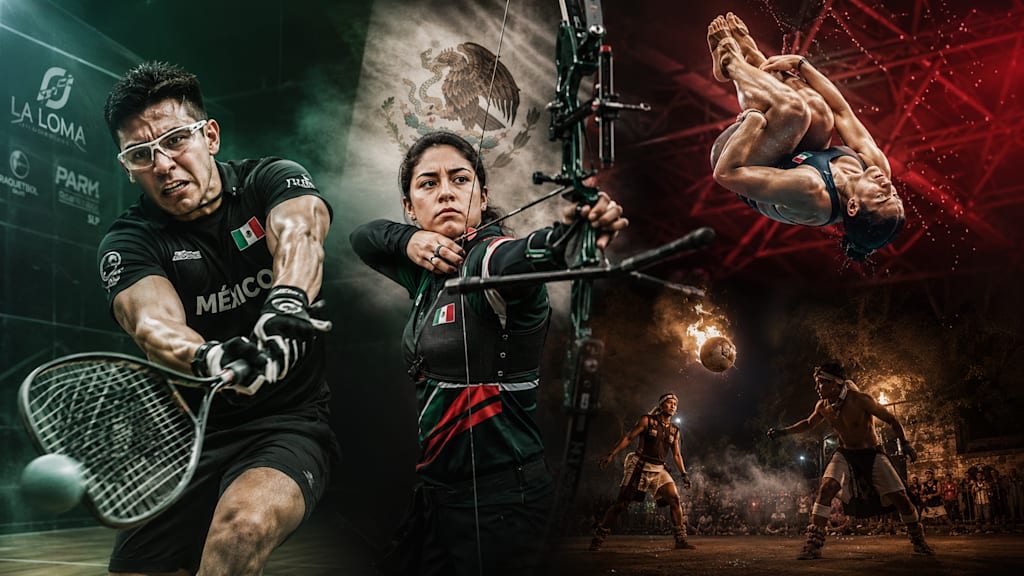
In the communities of Michoacán, every night of celebration brings a spectacle that few Mexicans have witnessed: pelota purépecha, also known as uarhukua. This ancestral sport, practiced by the Purépecha people since before the Spanish arrival, combines elements of field hockey with rituals that connect players to their ancestors.
The game is played with a rag ball wrapped in leather that is set on fire. Players, armed with wooden sticks, hit this burning sphere across fields that can extend for kilometers. The nighttime matches, with the fire ball crossing through darkness, create images that seem drawn from ancient legends.
What is remarkable is that this sport does not merely survive as a tourist attraction. There are organized leagues, regional tournaments, and a federation fighting for official recognition. Thousands of young Purépecha people practice it regularly, keeping alive a tradition that has more than 3,500 years of history.
## Racquetball: Mexican Dominance That Nobody Knows
If there were a ranking of sports where Mexico dominates at the world level, racquetball would occupy the top positions. Paola Longoria, considered the best player in history, has accumulated more than 100 professional titles. Her dominance is so absolute that she has gone years without losing a single match in official competitions.
But Longoria is not alone. Mexican racquetball constantly produces world champions in all categories. Rodrigo Montoya, Álvaro Beltrán, and a generation of young talents keep Mexico as the undisputed powerhouse of this sport.
The contrast is painful. In the United States, professional racquetball players can live comfortably from their sport. In Mexico, even world champions must seek alternative jobs or depend on government scholarships that arrive late and poorly. Paola Longoria, with all her historic achievements, has had to publicly fight for support that should be automatic for someone at her level.
## Diving: The Silent Factory of Medalists
Mexico has a tradition spanning more than 50 years of producing elite world-class divers. From Joaquín Capilla, who won Olympic medals in the 1950s, to current representatives, the country has maintained a constant presence on international podiums.
What is interesting is how this tradition has been built. The Mexican Swimming Federation has developed a talent detection system that identifies children with potential from very early ages. Training centers in states like Jalisco, Nuevo León, and Mexico City shape these young people with methodologies that combine international techniques with local adaptations.
However, outside of the Olympic Games, Mexican divers work in anonymity. Their competitions are not broadcast on open television. Their names appear in newspapers only when there are medals, and disappear the next day. It is a sport that delivers glory but does not generate fans.
## Archery: World-Class Mexican Precision
Mexican archery is experiencing a golden moment that goes completely unnoticed. In recent years, the women's team has achieved historic results in world championships and world cups, competing head-to-head with traditional powerhouses like South Korea.
Alejandra Valencia, originally from Sonora, has become one of the best archers on the planet. Her story is that of many Mexican athletes: extraordinary talent, enormous sacrifice, and minimal recognition. Between international competitions, Valencia has had to organize raffles and seek sponsors on her own.
Archery requires considerable investment in equipment. A professional bow with all its accessories can cost more than 5,000 dollars. Arrows wear out and must be constantly replaced. For athletes without solid institutional support, staying competitive at the world level becomes a financial feat in addition to an athletic one.
## Frontón and Basque Pelota: Spanish Heritage, Mexican Dominance
Basque pelota arrived in Mexico with Spanish immigrants and found fertile ground in this country. Today, Mexico has more frontón courts than Spain and produces players who compete at the highest international level.
Mexican frontón has its own characteristics. It is played on courts that can be found in public parks in any city in the country. It is a democratic sport: it does not require expensive memberships or sophisticated equipment. A ball, a paddle, and a wall are enough to practice it.
This accessibility has created an enormous player base. In states like Jalisco, State of Mexico, and Mexico City, there are amateur leagues with thousands of participants. From this pool emerge the athletes who represent Mexico in world championships, where they regularly obtain medals.
## Olympic Wrestling: A Tradition of Modern Warriors
Mexican Olympic wrestling has a history spanning more than a century. Since the first Olympic Games in which Mexico participated, wrestlers have been part of national delegations. However, this sport lives in the shadow of its more famous cousin: professional wrestling.
While AAA and CMLL wrestlers fill arenas and appear on television, Olympic wrestlers train in modest gyms with limited resources. The irony is that many professional wrestlers began their careers in Olympic wrestling before migrating to entertainment, where salaries and fame are incomparably greater.
Despite everything, Mexico continues to produce competitive wrestlers at the international level. Wrestling schools in northern states keep alive a tradition that has produced Pan American medalists and Olympic competitors.
## Track Cycling: Speed Without Spotlights
The Aguascalientes velodrome is one of the most modern track cycling facilities in Latin America. Built for the 2011 Pan American Games, it has hosted world championships and produced continental records. However, most Mexicans are unaware of its existence.
Mexican track cycling has experienced notable growth in the last decade. Young cyclists have won medals in international competitions and have set marks that place Mexico among the emerging countries in this sport.
The problem, as in other cases, is visibility. Road cycling receives some attention during competitions like the Vuelta a México, but track cycling remains invisible to the general public. Competitions take place before empty stands, and athletes' achievements barely merit mentions in sports sections.
## Why This Matters: Beyond the Medals
The invisibility of these sports has consequences that go beyond the lack of recognition for athletes. When a discipline has no visibility, it does not attract sponsors. Without sponsors, federations depend exclusively on government funds that are insufficient and inconsistent. Without resources, development programs weaken. Without solid programs, talent is lost or migrates to other countries.
It is a vicious cycle that can only be broken with media attention. And this is where we all come in. As sports fans, we have the power to decide what we consume. Every click on a racquetball story, every search about pelota purépecha, every conversation about diving contributes to changing the equation.
Mexico is a much more diverse and successful sporting country than its newscasts suggest. Discovering these hidden sports is not only an act of justice toward the athletes who practice them, but also an opportunity to enrich our own experience as fans. There is a world of competition, drama, and excellence waiting to be discovered, right here, in our own country.
The next time you look for something sports-related to watch, consider looking toward those corners that nobody turns to see. You might find Mexico's true champions.
About the Creator
ELIAS PULIDO
Storyteller by necessity. The best stories don't live in headlines — they live in the details nobody notices. I write about people, ideas, and the moments when the world shifts direction. Sometimes without anyone realizing it.
Enjoyed the story? Support the Creator.
Subscribe for free to receive all their stories in your feed.
Comments
There are no comments for this story
Be the first to respond and start the conversation.