
Kevin Durant Is Still a Great Scorer. That Was Never the Whole Job.
Since leaving Golden State, he has changed teams, cities, and co-stars. The ending keeps repeating.
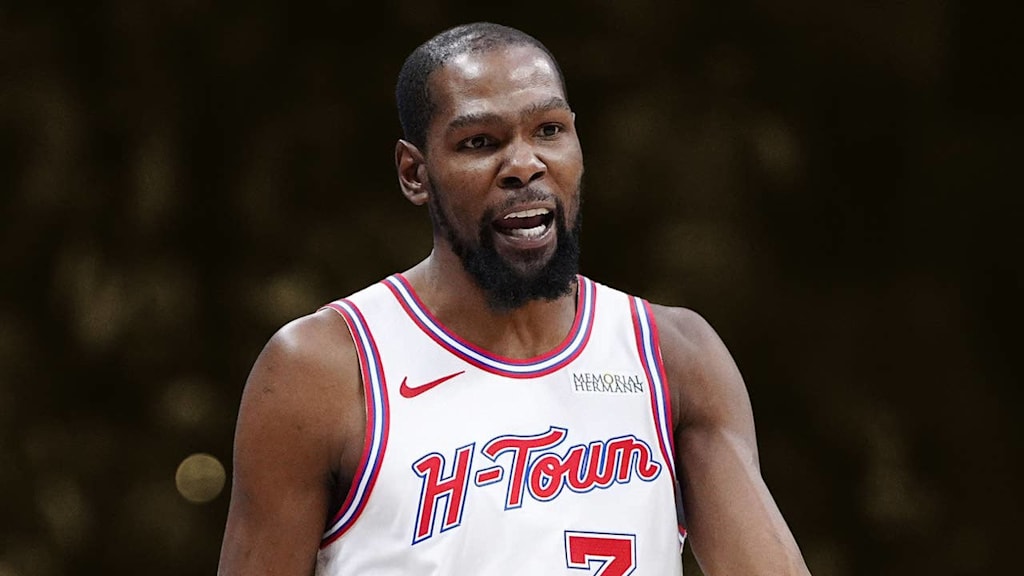
This season, the Rockets put Durant back into a familiar script.
He played almost every regular-season game. At thirty-six, with a ruptured Achilles and years of knee and ankle injuries behind him, he played eighty-one games and averaged thirty-seven minutes. Udoka could not rest him. Houston’s offense stalled without him. Şengün needed Durant’s gravity on the weak side. Green needed Durant’s spacing at the top. VanVleet needed Durant as the last option in the pick-and-roll. Durant started on time, scored, got back on defense, and posted up again.
Then the playoffs began. He missed two games.
The Lakers took a 3-0 lead. After Game 3, Durant sat on the sideline in street clothes, a walking boot on his foot. The camera passed his face. He showed nothing. He would probably play in Game 4, take a shot, take painkillers, the way he did in Brooklyn and Phoenix. The series was already over. Even a fifty-point game would not bring Houston back.
Another wasted year.
Since leaving the Warriors, Durant’s playoff record is 13-18. He has won two series. Brooklyn, Phoenix, and Houston all sent him home in the first round. With Golden State, almost every playoff series he played was a rout.
Bad luck is not the explanation.
Durant’s problems were never in the highlight reel.
What the Highlights Show
His strengths are easy to see. Even someone who started watching basketball three months ago can spot them.
Height. Wingspan. Standing reach. A mismatch machine. The pull-up jumper, released so high it is almost impossible to contest. The isolation dribble, the stop, the rise. Cut two minutes of his highlights, add dramatic music, and anyone will reach the same conclusion. This guy is incredible.
That is why Durant remains “Death” in the public imagination. On any given night, he can kill a team with isolation scoring. His scoring ability is historically great.
His weaknesses are harder to see. They do not show up in highlights. They do not show up in the obvious columns of a box score. They do not even show up in an ordinary regular-season game. They surface in the playoffs, on a team that needs him to be the leader, in an environment without Curry, without Green, without Thompson.
Stamina
When Durant was in Oklahoma City, fans aimed their anger at Westbrook. Westbrook produced absurd plays. The zombie jumper clanked off the rim. The reckless drive turned into a turnover. He lost his head in crunch time. But over a larger sample, Durant’s playoff efficiency and volume were not much better than Westbrook’s.
The problem was not skill. It was conditioning.
Durant’s height, wingspan, and style cost him more energy per shot than an ordinary scorer spends. His pull-up is beautiful. That beauty is built on leg and core strength. By the playoffs, by the fourth quarter, by overtime, his shot arc flattens. His legs stop driving through the ball. His percentage drops.
In the 2016 playoffs, Durant averaged 28.4 points, 7.1 rebounds, and 3.3 assists. He shot 43% from the field, 28% from three, and 89% from the line. Westbrook averaged 26 points, 6.9 rebounds, and 11 assists. He shot 41% from the field, 32% from three, and 83% from the line. The older brother could not laugh at the younger brother.
In the Western Conference Finals against the Warriors, Durant averaged 30 points, 8 rebounds, and 2.9 assists. He shot 42% from the field, 29% from three, and 92% from the line. Westbrook averaged 26.7 points, 7 rebounds, and 11.3 assists. He shot 40% from the field, 32% from three, and 82% from the line. Durant scored more. His efficiency was not overwhelmingly better. When the game reached its most critical stage, Durant’s legs usually told him first. You do not have the strength anymore.
That is why Durant could be so efficient with the Warriors. In Golden State, he did not have to carry the team every possession. Curry was there. Green was there. Thompson was there. Durant could save his best energy for the most lethal moment.
After he left, he had to carry the volume, draw the defense, and solve the fourth quarter. The scythe was still there. The man swinging it no longer had enough strength.
Volume
Durant has never proved he can carry a team’s offensive volume. Volume, not efficiency.
With the Warriors, he did not have to. Curry’s gravity pulled the defense away. Durant faced one-on-one coverage, sometimes open shots. He produced the most efficient stretch of his career. That efficiency had a precondition. The precondition was Curry.
Durant’s catch-and-shoot share with the Warriors was 47%. With Brooklyn and Phoenix, it dropped to 28%. In Golden State, half of his offense came off catch-and-shoot chances created by the system. In Brooklyn and Phoenix, he had to create off the dribble, face double teams, and generate his own shot.
Isolation is his strength. Isolation and carrying volume are different jobs.
Isolation is a one-off. It is the hard solve when the play breaks down. Carrying volume is sustained. It means eighty-two regular-season games and twenty playoff games, facing the opponent’s highest defensive intensity every night, while maintaining efficiency and output. Durant can kill you in one game with an unstoppable pull-up. He cannot carry a championship team that way for a season.
After he left Golden State, he also lost his defensive protection. With the Warriors, Green handled the help defense and Thompson handled the perimeter. Durant did his job. In Brooklyn, Phoenix, and Houston, he was often switched onto the perimeter and forced to face smaller guards. His energy expenditure rose. His offensive efficiency suffered.
Both ends were overdrawn.
The System
The later Warriors years exposed the next problem.
From 2017 to 2019, Golden State’s playoff path grew harder each year. There were many reasons. One fact is hard to avoid. In the first year, Durant still ran the offense. In the next two years, he began to freelance. The frequency of isolation possessions rose.
When the ball reached him, the offense stopped.
Many people remember those Houston teams as powerful. After Durant went down in 2019, the Warriors cut through the field and reached the Finals. The contrast is cruel. It is also the truth. Golden State’s motion offense, without Durant, found its flow again.
Durant later admitted that he questioned Kerr’s offense as too complicated. He thought all the running, screening, and passing before giving him the ball was unnecessary. He wanted Kerr to simplify. Give him the ball. Let him work.
Durant needs a system. He does not want to be constrained by one. He wants the ball, freedom, and the chance to solve problems in crunch time. He forgets that the Warriors’ system made him efficient because it solved problems before he went into isolation.
After he left, he went to Brooklyn, Phoenix, and Houston. Every team tried to build a system around him. Every team learned that when Durant is on the floor, the system becomes “give the ball to Durant.” That was not what he wanted. It was what he caused.
The Locker Room
After he left the Warriors, Durant’s twisted side came out.
In Brooklyn, the Big Three fell apart. Injuries were part of it. So was personality. After Irving became “Professor Kyrie,” Durant joined him in criticizing Harden, who was still playing hard. Harden was handling playmaking and scoring. Two players who were not on the floor sniped at him. Later, in Phoenix, when the team struggled, Durant mostly spoke off the court.
After the Draymond Green formula closed its loop, Durant argued with fans online. He used burner accounts to like posts criticizing Curry. He took shots at former teammates. That kind of behavior does not help a locker room.
A team leader who is not in the gym leading extra workouts, but on Twitter arguing with fans, tells you something.
Barkley said it: “Durant is still one of the best players on the floor, but his teams have always lacked leadership. Golden State was the only one that escaped that, because when he joined, that team was already a championship team.”
Leadership is invisible. In the playoffs, when a team is in trouble, it matters more than any pull-up jumper. Durant can score. He cannot make his teammates better, keep a locker room stable, or bind everyone into one rope during adversity.
He can be Death. He cannot be a leader.
The Roster
After he left the Warriors, every team dismantled its roster to get him.
Brooklyn gave up a haul. Phoenix paid five first-round picks, five pick swaps, Bridges, Johnson, and Paul. After he arrived, the team’s depth and role players were often hollowed out.
Durant needs a system. He needs someone to organize, defend, space the floor, and share ball-handling pressure. Every time, the team traded away those system parts to get him.
What remained was often a group of teammates who needed him to carry them. He is not that kind of player.
The loop is simple. He needs a system. The team dismantles the system to get him. He wants a championship. The team mortgages the future to get him.
What Golden State Hid
The Warriors’ system was the only system on earth that could hide all his weaknesses.
Curry drew double teams. Green organized the defense. Thompson spaced the floor. The bench filled the rotation minutes. Durant only had to do what he does best. Catch. Isolate. Put the ball in the basket.
After he left, he had to carry volume, organize offense, lead the locker room, and steady the team in crunch time. He either cannot do those things or will not do them.
He is a historically great scorer. A historically great scorer is not the same as a historically great leader. He can kill you in one game with an unstoppable pull-up. He cannot use leadership to carry a championship team for a season.
That difference does not show up in highlights. It does not show up in the box score. Put him in an environment without Curry. Let him lead a team for a few seasons. The answer surfaces on its own.
The Pattern
Durant is one of the most expensive puzzle pieces in basketball history.
He was never the one who drew the puzzle.
In Golden State, someone drew it for him. He fit in. He became Death. After he left, he changed teams and tried to draw it himself. He produced three pictures. Each one was more abstract than the last.
He is not lazy. He is not weak. He confused scoring ability with winning ability. A championship requires more than putting the ball in the basket. It requires maintaining a system over eighty-two games, adjusting matchups in the playoffs, bringing a locker room together, and making sacrifices in adversity.
Durant either will not do those things or cannot do them.
His failure after leaving the Warriors is not bad luck. His problems were always there. The Warriors’ system hid them for three years.
After he left, the weaknesses surfaced on their own.
About the Creator
Jin
Writer of reamstories
https://reamstories.com/jin
Enjoyed the story? Support the Creator.
Subscribe for free to receive all their stories in your feed. You could also become a paid subscriber, letting them know you appreciate their work.
Comments
There are no comments for this story
Be the first to respond and start the conversation.